Alternative Approaches to Diverse College Student Development Theory Redaktion: Bonner Ii, Fred A.; Marbley, Aretha F.; Smith, Stella L.; Banda, Rosa M.
Alternative Approaches to Diverse College Student Development Theory Redaktion: Bonner Ii, Fred A.; Marbley, Aretha F.; Smith, Stella L.; Banda, Rosa M.
Sie sind bereits eingeloggt. Klicken Sie auf 2. tolino select Abo, um fortzufahren.
Bitte loggen Sie sich zunächst in Ihr Kundenkonto ein oder registrieren Sie sich bei bücher.de, um das eBook-Abo tolino select nutzen zu können.
Developing alternative student development frameworks and models, this groundbreaking book provides student affairs practitioners, as well as faculty, with illuminating perspectives and viable approaches for understanding the development of today's diverse student populations, and for building the foundation for their academic success and self-authorship. With the increasing number of adult working students, minoritized, multiracial, LGTBQ, and first-generation students, this book offers readers vital insights into -and ways to interrogate- existing practice, and develop relevant responses to…mehr
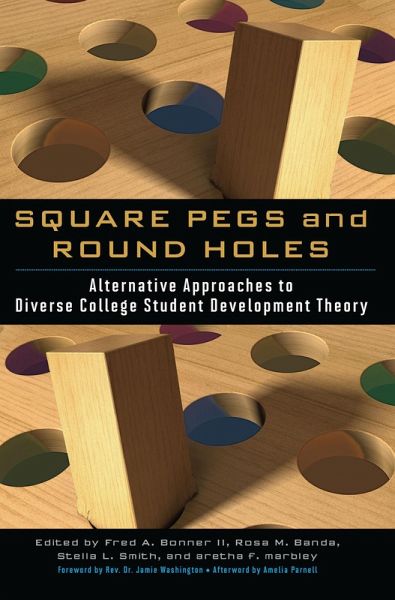
Developing alternative student development frameworks and models, this groundbreaking book provides student affairs practitioners, as well as faculty, with illuminating perspectives and viable approaches for understanding the development of today's diverse student populations, and for building the foundation for their academic success and self-authorship. With the increasing number of adult working students, minoritized, multiracial, LGTBQ, and first-generation students, this book offers readers vital insights into -and ways to interrogate- existing practice, and develop relevant responses to the needs of these populations.Building on and critiquing the past frameworks, and integrating the insights of contemporary scholarship on student development, the contributors collectively put forward a robust theoretical and methodological foundation for this work, using Critical Race Theory as their central frame. CRT allows chapter authors to situate race related encounters at the center of their proposed alternative framework or model, and deconstruct and challenge commonly held assumptions about diverse college student development. In the tradition of CRT, each author offers an alternative model or framework that can be applied to the diverse population upon which the chapter is framed, prompting readers to address such questions as:. Who are our college students?. What set of experiences do our students bring to the higher education context? . What role have their environments/contexts (i.e. home, p-12, community, family, peer groups, mentors) played in our student's lives? . What impact have intervening variables (i.e. race, oppression, power) hadon their experiences?. What strategies do they use to overcome developmental obstacles?. How do they define success, and how they know they have achieved it ?By laying bare the experiences of these diverse college students that inform this volume's "alternative" frameworks this book contests that notion that they constitute square pegs that must fit into the round holes of traditional frameworks.
Dieser Download kann aus rechtlichen Gründen nur mit Rechnungsadresse in A, B, BG, CY, CZ, D, DK, EW, E, FIN, F, GR, HR, H, IRL, I, LT, L, LR, M, NL, PL, P, R, S, SLO, SK ausgeliefert werden.
Die Herstellerinformationen sind derzeit nicht verfügbar.
Autorenporträt
Fred A. Bonner II is professor and endowed chair of educational leadership and counseling in the Whitlowe R. Green College of Education at Prairie View A&M University. He also serves as the founding executive director and chief scientist of the Minority Achievement Creativity and High Ability (MACH-III) Center. His research foci illuminate the experiences of academically gifted African American males across the P-20 pipeline, diverse faculty in academe, and diverse populations in science, technology, engineering, and math (STEM). He is coeditor of two books with Stylus Publishing, Building on Resilience: Models and Frameworks of Black Male Success Across the P-20 Pipeline (2014) and Diverse Millennials Students in College: Implications for Faculty and Student Affairs (2011). Bonner is currently developing a theoretical framework, mascusectionality, that will explore the engagements of Black men. Rosa M. Banda, PhD, is assistant professor of educational leadership at Texas A&M University-Corpus Christi. Formerly, Banda was a research associate to the Samuel DeWitt Proctor Chair in Education in the Graduate School of Education at Rutgers University. Banda earned her PhD in higher education administration and human resource development from Texas A&M University-College Station. A critical social justice advocate, Banda's primary research interests include high achieving Latinas in engineering, gifted poor students of color, faculty diversity, and qualitative research. Stella L. Smith, PhD, is the associate director for the Minority Achievement, Creativity and High-Ability (MACH-III) Center and an adjunct instructor in the Department of Educational Leadership and Counseling at Prairie View A&M University. A qualitative researcher, her scholarly interests focus on the experiences of faculty and administrators of color in higher education; African American females in leadership in higher education; access and inclusion of underserved populations in higher
Inhaltsangabe
Foreword-Rev. Dr. Jamie Washington Intoduction-Fred A. Bonner II, Rosa M. Banda, Stella L. Smith, and aretha f. marbley Part One. The Need for Alternatives In College Student Development Theory 1. Alternative College Student Development Frameworks. An Exploration Across Race, Gender, and Sexuality-Fred A. Bonner II, Rosa M. Banda, Stella L. Smith, and aretha f. marbley 2. Modeling Alternative College Student Development Frameworks. Increasing Access and Inspiring College Success-Saundra M. Tomlinson-Clarke, Petra A. Robinson, and Sattik Deb Part Two. Alternative Frameworks and Models for African American College Student Populations 3. Finding My Way "Black". Resilience Building Afrocentric Identity Theories-Chavez Phelps and Mary F. Howard-Hamilton 4. Finding Our Way "Black" to Student Development Theory-Richard J. Reddick, Mariama N. Nagbe, Saralyn M. McKinnon-Crowley, G. Christopher Cutkelvin, and Howard A. Thrasher Part Three. Alternative Frameworks and Models for Asian American College Student Populations 5. A Critical Perspective of Asian American Identity-Samuel D. Museus, Hannah Hyun White, and Vanessa S. Na 6. Unboxing Asian/American Transracial Adoptee Collegian Identities-Nicholas D. Hartlep and Daniel K. Suda 7. Forced Migration and Forged Memories. Acts of Remembrance and Identity Development Among Southeast Asian American College Students-Jason Chan, Mike Hoa Nguyen, Latana Jennifer Thaviseth, and Mitchell J. Chang Part Four. Alternative Frameworks and Models for Latinx College Student Populations 8. Finding Meaning in the Models and Frameworks for Latinx College Students. At the Intersection of Student Agency and Context-Zarrina Talan Azizova and Jesse P. Mendez 9. Latinx Student Development Through Familismo and Conocimiento-Karina Chantal Canaba 10. ¿Quién Eres?. Identity Development of Latinx Student-Athletes-Nikola Grafnetterova and Rosa M. Banda Part Five. Alternative Frameworks and Models for LGBTQIA College Student Populations 11. Framing and Reframing the LGBTQ College Student Development Experience-Kristen A. Renn 12. Racing the Rainbow. Applying Critical Race Theory to LGB(TQ2. Ethnic Minority College Students' Development-Terrell L. Strayhorn 13. Breaking Through Barriers. Examining the Stresses that Impact Transgender Students' Collegiate Transitions-Christy Heaton and Alonzo M. Flowers III Part Six. Alternative Frameworks and Models for Bi- and Multiracial and Native American College Student Populations 14. Turning Points. Imagining and Designing Place and Belonging for Native Students-Amanda R. Tachine, Taylor Notah, Brian Skeet, Sequoia Lynn Dance, and Bryan McKinley Jones Brayboy 15. Reflecting on Multiracial College Student Identity Theories to Advance Future Higher Education Practice and Research-Victoria K. Malaney Brown 16. The Multidimensionality of Multiracial Identity in the Post-Civil Rights Era-Patricia E. Literte Part Seven. Alternative Frameworks and Models for Nontraditional College Student Populations 17. Dual Anchoring. Advancing a Framework for Nontraditional Doctoral Degree Student Success-Derrick Robinson 18. The Paradox of Community Colleges. Latino Men and the Educational Industrial Complex-Pavitee Peumsang, Jorge M. Burmicky, Victor B. Sáenz, and Emmet E. Campos Conclusion. Future Directions and Concluding Thoughts-Fred A. Bonner II, Rosa M. Banda, Stella L. Smith, and aretha f. marbley Afterword Amelia Parnell Contributors Index
Foreword-Rev. Dr. Jamie Washington Intoduction-Fred A. Bonner II, Rosa M. Banda, Stella L. Smith, and aretha f. marbley Part One. The Need for Alternatives In College Student Development Theory 1. Alternative College Student Development Frameworks. An Exploration Across Race, Gender, and Sexuality-Fred A. Bonner II, Rosa M. Banda, Stella L. Smith, and aretha f. marbley 2. Modeling Alternative College Student Development Frameworks. Increasing Access and Inspiring College Success-Saundra M. Tomlinson-Clarke, Petra A. Robinson, and Sattik Deb Part Two. Alternative Frameworks and Models for African American College Student Populations 3. Finding My Way "Black". Resilience Building Afrocentric Identity Theories-Chavez Phelps and Mary F. Howard-Hamilton 4. Finding Our Way "Black" to Student Development Theory-Richard J. Reddick, Mariama N. Nagbe, Saralyn M. McKinnon-Crowley, G. Christopher Cutkelvin, and Howard A. Thrasher Part Three. Alternative Frameworks and Models for Asian American College Student Populations 5. A Critical Perspective of Asian American Identity-Samuel D. Museus, Hannah Hyun White, and Vanessa S. Na 6. Unboxing Asian/American Transracial Adoptee Collegian Identities-Nicholas D. Hartlep and Daniel K. Suda 7. Forced Migration and Forged Memories. Acts of Remembrance and Identity Development Among Southeast Asian American College Students-Jason Chan, Mike Hoa Nguyen, Latana Jennifer Thaviseth, and Mitchell J. Chang Part Four. Alternative Frameworks and Models for Latinx College Student Populations 8. Finding Meaning in the Models and Frameworks for Latinx College Students. At the Intersection of Student Agency and Context-Zarrina Talan Azizova and Jesse P. Mendez 9. Latinx Student Development Through Familismo and Conocimiento-Karina Chantal Canaba 10. ¿Quién Eres?. Identity Development of Latinx Student-Athletes-Nikola Grafnetterova and Rosa M. Banda Part Five. Alternative Frameworks and Models for LGBTQIA College Student Populations 11. Framing and Reframing the LGBTQ College Student Development Experience-Kristen A. Renn 12. Racing the Rainbow. Applying Critical Race Theory to LGB(TQ2. Ethnic Minority College Students' Development-Terrell L. Strayhorn 13. Breaking Through Barriers. Examining the Stresses that Impact Transgender Students' Collegiate Transitions-Christy Heaton and Alonzo M. Flowers III Part Six. Alternative Frameworks and Models for Bi- and Multiracial and Native American College Student Populations 14. Turning Points. Imagining and Designing Place and Belonging for Native Students-Amanda R. Tachine, Taylor Notah, Brian Skeet, Sequoia Lynn Dance, and Bryan McKinley Jones Brayboy 15. Reflecting on Multiracial College Student Identity Theories to Advance Future Higher Education Practice and Research-Victoria K. Malaney Brown 16. The Multidimensionality of Multiracial Identity in the Post-Civil Rights Era-Patricia E. Literte Part Seven. Alternative Frameworks and Models for Nontraditional College Student Populations 17. Dual Anchoring. Advancing a Framework for Nontraditional Doctoral Degree Student Success-Derrick Robinson 18. The Paradox of Community Colleges. Latino Men and the Educational Industrial Complex-Pavitee Peumsang, Jorge M. Burmicky, Victor B. Sáenz, and Emmet E. Campos Conclusion. Future Directions and Concluding Thoughts-Fred A. Bonner II, Rosa M. Banda, Stella L. Smith, and aretha f. marbley Afterword Amelia Parnell Contributors Index
Es gelten unsere Allgemeinen Geschäftsbedingungen: www.buecher.de/agb
Impressum
www.buecher.de ist ein Internetauftritt der buecher.de internetstores GmbH
Geschäftsführung: Monica Sawhney | Roland Kölbl | Günter Hilger
Sitz der Gesellschaft: Batheyer Straße 115 - 117, 58099 Hagen
Postanschrift: Bürgermeister-Wegele-Str. 12, 86167 Augsburg
Amtsgericht Hagen HRB 13257
Steuernummer: 321/5800/1497
USt-IdNr: DE450055826