
51,95 €
inkl. MwSt.
Sofort per Download lieferbar
26 °P sammeln

Andere Kunden interessierten sich auch für
") E.E. Slutsky as Economist and Mathematician (eBook, ePUB)51,95 €
E.E. Slutsky as Economist and Mathematician (eBook, ePUB)51,95 € (eBook, ePUB)") Bolshevism at a Deadlock (Routledge Revivals) (eBook, ePUB)49,95 €
Bolshevism at a Deadlock (Routledge Revivals) (eBook, ePUB)49,95 € (eBook, ePUB)") The Crisis of Keynesian Economics (Routledge Revivals) (eBook, ePUB)45,95 €
The Crisis of Keynesian Economics (Routledge Revivals) (eBook, ePUB)45,95 €") Stalin's Economist (eBook, PDF)51,95 €
Stalin's Economist (eBook, PDF)51,95 €") Management in Transitional Economies (eBook, ePUB)51,95 €
Management in Transitional Economies (eBook, ePUB)51,95 €") Marx and Le Capital (eBook, ePUB)41,95 €
Marx and Le Capital (eBook, ePUB)41,95 €") A History of Utilitarian Ethics (eBook, ePUB)46,95 €
A History of Utilitarian Ethics (eBook, ePUB)46,95 €
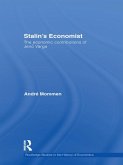

This book analyses the contribution of Eugen (Jeno) Varga (1879-1964) on Marxist-Leninist economic theory as well as the influence he exercised on Stalin's foreign policy and through the Comintern on the international communist movement. During the Hungarian Councils' Republic of 1919 Varga was one of those chiefly responsible for transforming the economy into one big industrial and agrarian firm under state authority. After the fall of the revolutionary regime that year, Varga joined the Hungarian Communist Party, soon after which, he would become one of the Comintern's leading economists, predicting the inevitable crisis of the capitalist system.
Varga became the Soviet Union's official propagandist. As an economic specialist he would advise the Soviet government on German reparation payments and, unlike Stalin, believed that the capitalist state would be able to plan post-war economic recovery, which contradicted Stalin's foreign policy strategy and led to his disgrace. Thus by the beginning of the Cold War in 1947, Varga was discredited, but allowed to keep a minor academic position. After Stalin's death in 1953 he reappeared as a well-respected economist whose political influence had nonetheless waned.
In this study Mommen reveals how Stalin's view on international capitalism and inter-imperialist rivalries was profoundly influenced by debates in the Comintern and by Varga's concept of the general crisis of capitalism. Though Stalin appreciated Varga's cleverness, he never trusted him when making his strategic foreign policy decisions. This was clearly demonstrated in August 1939 with Stalin's pact with Hitler, and in 1947, with his refusal to participate in Marshall's European Recovery Plan.
This book should be of interest to a wide variety of students and researchers, including those concentrating on the history of economic thought, Soviet studies, international relations, and European and Cold War history.
Varga became the Soviet Union's official propagandist. As an economic specialist he would advise the Soviet government on German reparation payments and, unlike Stalin, believed that the capitalist state would be able to plan post-war economic recovery, which contradicted Stalin's foreign policy strategy and led to his disgrace. Thus by the beginning of the Cold War in 1947, Varga was discredited, but allowed to keep a minor academic position. After Stalin's death in 1953 he reappeared as a well-respected economist whose political influence had nonetheless waned.
In this study Mommen reveals how Stalin's view on international capitalism and inter-imperialist rivalries was profoundly influenced by debates in the Comintern and by Varga's concept of the general crisis of capitalism. Though Stalin appreciated Varga's cleverness, he never trusted him when making his strategic foreign policy decisions. This was clearly demonstrated in August 1939 with Stalin's pact with Hitler, and in 1947, with his refusal to participate in Marshall's European Recovery Plan.
This book should be of interest to a wide variety of students and researchers, including those concentrating on the history of economic thought, Soviet studies, international relations, and European and Cold War history.
Dieser Download kann aus rechtlichen Gründen nur mit Rechnungsadresse in A, B, BG, CY, CZ, D, DK, EW, E, FIN, F, GR, HR, H, IRL, I, LT, L, LR, M, NL, PL, P, R, S, SLO, SK ausgeliefert werden.