45,95 €
45,95 €
inkl. MwSt.
Sofort per Download lieferbar

23 °P sammeln
45,95 €
Als Download kaufen
45,95 €
inkl. MwSt.
Sofort per Download lieferbar
23 °P sammeln
Jetzt verschenken
Alle Infos zum eBook verschenken
45,95 €
inkl. MwSt.
Sofort per Download lieferbar
Alle Infos zum eBook verschenken
23 °P sammeln

Andere Kunden interessierten sich auch für
") International Organizations and the Idea of Autonomy (eBook, PDF)55,95 €
International Organizations and the Idea of Autonomy (eBook, PDF)55,95 €") The Right to Self-determination Under International Law (eBook, PDF)45,95 €
The Right to Self-determination Under International Law (eBook, PDF)45,95 €") Uncertainty in International Law (eBook, PDF)43,95 €
Uncertainty in International Law (eBook, PDF)43,95 €") Participants in the International Legal System (eBook, PDF)70,95 €
Participants in the International Legal System (eBook, PDF)70,95 €") The Kurdish Conflict (eBook, PDF)56,95 €
The Kurdish Conflict (eBook, PDF)56,95 €") Islamic Law and the Law of Armed Conflict (eBook, PDF)55,95 €
Islamic Law and the Law of Armed Conflict (eBook, PDF)55,95 €") Self-Determination in the Post-9/11 Era (eBook, PDF)29,95 €
Self-Determination in the Post-9/11 Era (eBook, PDF)29,95 €







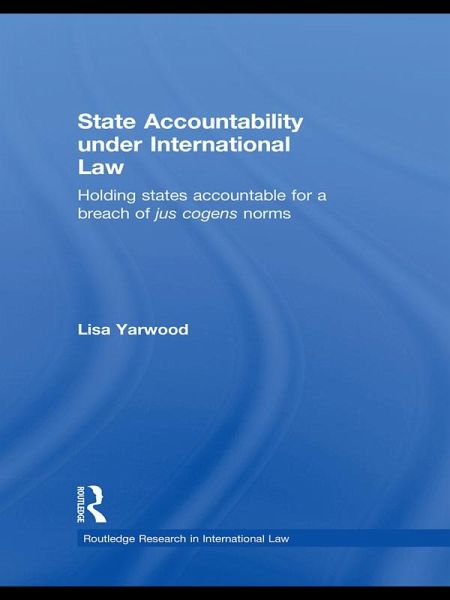
This book considers the extent to which States are held accountable for breaches of jus cogens norms under international law. The concept of State accountability is distinguished from the doctrine of State responsibility and refers to an ad hoc practice in international relations that seeks to ensure States do not escape with impunity when they violate norms that are considered fundamental to the interests of the international community as a whole.
State Accountability under International Law sets forth a definition of State accountability and establishes a threshold against which the existence, or not, of State accountability can be determined. Using a Foucauldian influenced interpretive methodology, this book adopts a novel construction of State accountability as having legal, political and even moral characteristics. It argues that the international community seeks to hold States accountable utilising a variety of traditional and non-traditional responses that cumulatively recognise that the institutions that comprise and legitimise the State were instrumental in the particular breach. Using case studies taken from State practice from throughout the twentieth century and covering a range of geographic contexts, the conclusion is that there is evidence that State accountability, as it is conceptualised here, is evolving into a legal principle.
The book draws together the many academic theories relating to accountability that have arisen in various areas of international law including environmental law, human rights and trade law before going on to examine an emerging practice of State accountability. A variety of ad hoc attempts and informal mechanisms are assessed against the threshold of State accountability established, with emphasis being given to practical examples ranging from the accountability of Germany and Japan after World War Two to the current attempts to seek accountability from Russia for former crimes of the USSR.
State Accountability under International Law sets forth a definition of State accountability and establishes a threshold against which the existence, or not, of State accountability can be determined. Using a Foucauldian influenced interpretive methodology, this book adopts a novel construction of State accountability as having legal, political and even moral characteristics. It argues that the international community seeks to hold States accountable utilising a variety of traditional and non-traditional responses that cumulatively recognise that the institutions that comprise and legitimise the State were instrumental in the particular breach. Using case studies taken from State practice from throughout the twentieth century and covering a range of geographic contexts, the conclusion is that there is evidence that State accountability, as it is conceptualised here, is evolving into a legal principle.
The book draws together the many academic theories relating to accountability that have arisen in various areas of international law including environmental law, human rights and trade law before going on to examine an emerging practice of State accountability. A variety of ad hoc attempts and informal mechanisms are assessed against the threshold of State accountability established, with emphasis being given to practical examples ranging from the accountability of Germany and Japan after World War Two to the current attempts to seek accountability from Russia for former crimes of the USSR.
Dieser Download kann aus rechtlichen Gründen nur mit Rechnungsadresse in A, B, BG, CY, CZ, D, DK, EW, E, FIN, F, GR, HR, H, IRL, I, LT, L, LR, M, NL, PL, P, R, S, SLO, SK ausgeliefert werden.