49,95 €
49,95 €
inkl. MwSt.
Sofort per Download lieferbar

25 °P sammeln
49,95 €
Als Download kaufen
49,95 €
inkl. MwSt.
Sofort per Download lieferbar
25 °P sammeln
Jetzt verschenken
Alle Infos zum eBook verschenken
49,95 €
inkl. MwSt.
Sofort per Download lieferbar
Alle Infos zum eBook verschenken
25 °P sammeln

Andere Kunden interessierten sich auch für
") China's Political Economy in Modern Times (eBook, PDF)45,95 €
China's Political Economy in Modern Times (eBook, PDF)45,95 €") China's Emergent Political Economy (eBook, PDF)45,95 €
China's Emergent Political Economy (eBook, PDF)45,95 €") The Development of Capitalism in Russia (eBook, PDF)45,95 €
The Development of Capitalism in Russia (eBook, PDF)45,95 €") China's Role in Global Economic Recovery (eBook, PDF)55,95 €
China's Role in Global Economic Recovery (eBook, PDF)55,95 €") Governments and Markets in East Asia (eBook, PDF)18,95 €
Governments and Markets in East Asia (eBook, PDF)18,95 €") Chinese Economic Diplomacy (eBook, PDF)49,95 €
Chinese Economic Diplomacy (eBook, PDF)49,95 €") China and East Asian Regionalism (eBook, PDF)55,95 €
China and East Asian Regionalism (eBook, PDF)55,95 €

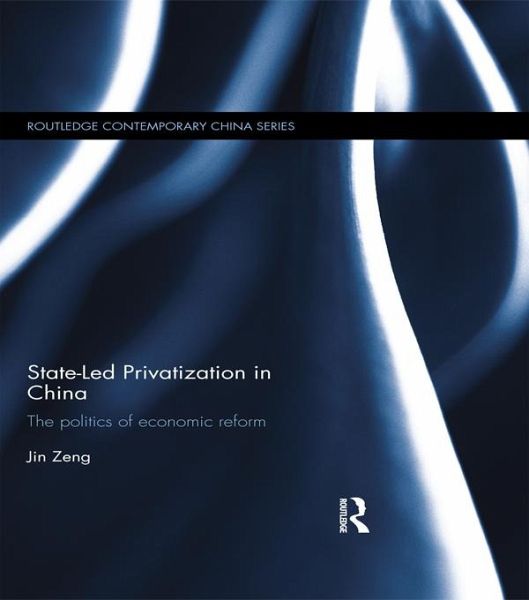
Large-scale privatization did not emerge spontaneously in China in the late 1990s. Rather, the Chinese state led and carefully "planned" ownership transformation with timetables and measurable privatization quotas, not for the purpose of extracting the state from the economy, but in order to strengthen the rule of the Party. While it is widely believed that authoritarian regimes are better suited than democracies to carry out economic reform, this book provides a more nuanced understanding of reform in China, demonstrating that the Chinese state's capacity to impose unpopular reform is contingent on its control over local state agents and its adaptability to societal demands.
Building on rich fieldwork data gathered in three Chinese cities (Shenyang, Shanghai, and Xiamen), this book offers the first comparative study of China's privatization processes at the local level. Instead of focusing solely on political elites, Jin Zeng adopts a multi-level interaction approach to examine how the complex interplay of the central leadership, grassroots officials, and state-owned enterprise managers and workers shaped the contour of privatization in China.The book advances three central arguments. First, local economic structure and cadre evaluation system mediated local officials' incentives to initiate privatization. Second, local officials relied on mobilization campaigns and various appeasement measures to implement privatization. Finally, the dynamics of privatization were fundamentally driven by the central government's reactions to social opposition and by the subsequent responses of local officials to the changed political-regulatory environment.
As a detailed analysis of the dual transformation of the property regime and state-society relations in China, this book will be invaluable to students and scholars of Chinese politics, economic reform, as well as those interested in comparative political economy and economic development more broadly.
Building on rich fieldwork data gathered in three Chinese cities (Shenyang, Shanghai, and Xiamen), this book offers the first comparative study of China's privatization processes at the local level. Instead of focusing solely on political elites, Jin Zeng adopts a multi-level interaction approach to examine how the complex interplay of the central leadership, grassroots officials, and state-owned enterprise managers and workers shaped the contour of privatization in China.The book advances three central arguments. First, local economic structure and cadre evaluation system mediated local officials' incentives to initiate privatization. Second, local officials relied on mobilization campaigns and various appeasement measures to implement privatization. Finally, the dynamics of privatization were fundamentally driven by the central government's reactions to social opposition and by the subsequent responses of local officials to the changed political-regulatory environment.
As a detailed analysis of the dual transformation of the property regime and state-society relations in China, this book will be invaluable to students and scholars of Chinese politics, economic reform, as well as those interested in comparative political economy and economic development more broadly.
Dieser Download kann aus rechtlichen Gründen nur mit Rechnungsadresse in A, B, BG, CY, CZ, D, DK, EW, E, FIN, F, GR, HR, H, IRL, I, LT, L, LR, M, NL, PL, P, R, S, SLO, SK ausgeliefert werden.