80,95 €
80,95 €
inkl. MwSt.
Sofort per Download lieferbar

40 °P sammeln
80,95 €
Als Download kaufen
80,95 €
inkl. MwSt.
Sofort per Download lieferbar
40 °P sammeln
Jetzt verschenken
Alle Infos zum eBook verschenken
80,95 €
inkl. MwSt.
Sofort per Download lieferbar
Alle Infos zum eBook verschenken
40 °P sammeln

Andere Kunden interessierten sich auch für
") Algorithmic Learning in a Random World (eBook, PDF)128,95 €
Algorithmic Learning in a Random World (eBook, PDF)128,95 €") Information and Complexity in Statistical Modeling (eBook, PDF)40,95 €
Information and Complexity in Statistical Modeling (eBook, PDF)40,95 €") An Introduction to Statistical Learning (eBook, PDF)48,95 €
An Introduction to Statistical Learning (eBook, PDF)48,95 €") An Introduction to Statistical Learning (eBook, PDF)52,95 €
An Introduction to Statistical Learning (eBook, PDF)52,95 €") Developing Statistical Software in Fortran 95 (eBook, PDF)72,95 €
Developing Statistical Software in Fortran 95 (eBook, PDF)72,95 €") Computational Statistics (eBook, PDF)72,95 €
Computational Statistics (eBook, PDF)72,95 €") The Nature of Statistical Learning Theory (eBook, PDF)175,95 €
The Nature of Statistical Learning Theory (eBook, PDF)175,95 €
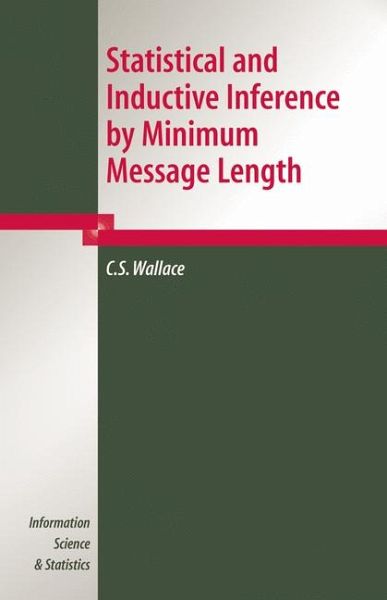
Since 1965, Prof. Wallace and others have been developing an approach tostatistical estimation, hypothesis testing, model selection and their applications in the Artificial Intelligence field of Machine Learning. The approach is based on Information Theory, using concepts from classical Shannon theory and more recent work on Algorithmic Complexity. The new approach has come to be called the Minimum Message Length principle, since it is based on the idea of constructing a message which concisely encodes the available data. Although a range of journal and conference papers has been published on the principle and its application, and several computer programs applying it have been shown to perform well and have been fairly widely used, there is no text providing a thorough treatment of the principle or giving general guidance for its application.
Dieser Download kann aus rechtlichen Gründen nur mit Rechnungsadresse in A, B, BG, CY, CZ, D, DK, EW, E, FIN, F, GR, HR, H, IRL, I, LT, L, LR, M, NL, PL, P, R, S, SLO, SK ausgeliefert werden.
From the reviews: "The subject matter is highly technical, and the book is correspondingly detailed. The book is intended for graduate-level courses, and should be effective in that role if the instructor is sufficiently expert in the area. For researchers at the postdoctoral level, the book will provide a wealth of information about the field.... [T]he book is likely to remain the primary reference in the field for many years to come." (Donald RICHARDS, JASA, June 2009, Vol. 104, No. 486) "Any statistician interested in the foundations of the discipline, or the deeper philosophical issues of inference, will find this volume a rewarding read." (International Statistical Institute, December 2005) "This very significant monograph covers the topic of the Minimum Message Length (MML) principle, a new approach to induction, hypothesis testing, model selection, and statistical inference. ... This valuable book covers the topics at a level suitable for professionals and graduate students in Statistics, Computer Science, Data Mining, Machine Learning, Estimation and Model-selection, Econometrics etc." (Jerzy Martyna, Zentralblatt MATH, Vol. 1085, 2006) "This book is around a simple idea: 'The best explanation of the facts is the shortest'. ... The book applies the above idea to statistical estimation in a Bayesian context. ... I think it will be valuable for readers who have at the same time strong interest in Bayesian decision theory and in Shannon information theory." (Michael Kohler, Metrika, Vol. 64, 2006)