133,95 €
inkl. MwSt.
Erscheint vor. 22.01.26
67 °P sammeln

Andere Kunden interessierten sich auch für
") Statistics in Environmental Monitoring and Assessment (eBook, ePUB)133,95 €
Statistics in Environmental Monitoring and Assessment (eBook, ePUB)133,95 €") Statistics in Natural Resources (eBook, PDF)45,95 €
Statistics in Natural Resources (eBook, PDF)45,95 €") Spatial Statistics for Data Science (eBook, PDF)52,95 €
Spatial Statistics for Data Science (eBook, PDF)52,95 €") Parameter Redundancy and Identifiability (eBook, PDF)51,95 €
Parameter Redundancy and Identifiability (eBook, PDF)51,95 €") Statistical Methods for Spatial Data Analysis (eBook, PDF)46,95 €
Statistical Methods for Spatial Data Analysis (eBook, PDF)46,95 €") Spatial Linear Models for Environmental Data (eBook, PDF)81,95 €
Spatial Linear Models for Environmental Data (eBook, PDF)81,95 €") Personality Traits and Drug Consumption (eBook, PDF)40,95 €
Personality Traits and Drug Consumption (eBook, PDF)40,95 €
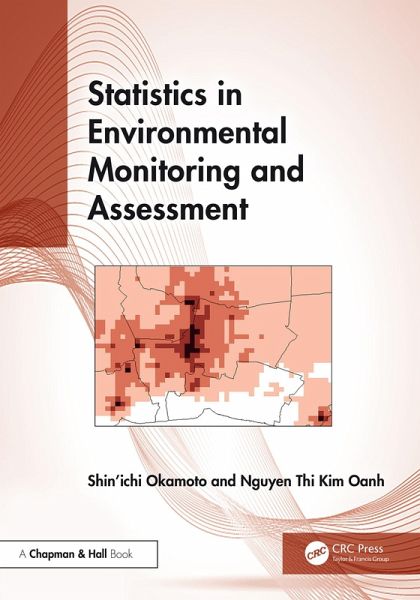
Statistics in Environmental Monitoring and Assessment details how statistics plays an essential role in every step of an environmental monitoring and assessment program, from the sampling design to the data management and data analysis methods that are used to extract meaningful information for environmental quality management.
Large temporal and spatial variations of the environmental variables present a great challenge for producing a representative characterisation of the status of any given environmental media, water, air, biota, or solid. This book explains these issues in an easy-to-understand manner and illustrates using actual applications in real-life case studies. Each case study comes with a clear explanation for every related fundamental concept and methodology that details the statistical methods used in the analysis and considerations taken when using a particular method.
Primarily intended for graduate students in environmental sciences who wish to use statistics as a research tool, it will also benefit researchers who are interested in applications of statistical methods for designing environmental monitoring programs and analysis of environmental data to assess the status of various environmental matrices. This book is organised in three parts with Part I providing a review of the basics of statistics, Part II focusing on sampling designs, and Part III focusing on applications of statistical methods for data analysis.
Key Features:
Large temporal and spatial variations of the environmental variables present a great challenge for producing a representative characterisation of the status of any given environmental media, water, air, biota, or solid. This book explains these issues in an easy-to-understand manner and illustrates using actual applications in real-life case studies. Each case study comes with a clear explanation for every related fundamental concept and methodology that details the statistical methods used in the analysis and considerations taken when using a particular method.
Primarily intended for graduate students in environmental sciences who wish to use statistics as a research tool, it will also benefit researchers who are interested in applications of statistical methods for designing environmental monitoring programs and analysis of environmental data to assess the status of various environmental matrices. This book is organised in three parts with Part I providing a review of the basics of statistics, Part II focusing on sampling designs, and Part III focusing on applications of statistical methods for data analysis.
Key Features:
- Contains real-life case studies
- Includes practical statistical designs for environmental sampling
- Analyses monitoring data for environmental assessment
- Comprehensively explains theoretical parts related to the statistical analysis methods
Dieser Download kann aus rechtlichen Gründen nur mit Rechnungsadresse in A, B, BG, CY, CZ, D, DK, EW, E, FIN, F, GR, HR, H, IRL, I, LT, L, LR, M, NL, PL, P, R, S, SLO, SK ausgeliefert werden.