16,95 €
inkl. MwSt.
Sofort per Download lieferbar
8 °P sammeln

Andere Kunden interessierten sich auch für
") The Contemporary Archaeology of Emotions: Re-Framing the Past and Present (eBook, PDF)36,95 €
The Contemporary Archaeology of Emotions: Re-Framing the Past and Present (eBook, PDF)36,95 €") Being Scioto Hopewell: Ritual Drama and Personhood in Cross-Cultural Perspective (eBook, PDF)175,95 €
Being Scioto Hopewell: Ritual Drama and Personhood in Cross-Cultural Perspective (eBook, PDF)175,95 €") Three Prehistoric Inventions That Shaped Us (eBook, PDF)65,95 €
Three Prehistoric Inventions That Shaped Us (eBook, PDF)65,95 €") The Domestication of Humans (eBook, PDF)41,95 €
The Domestication of Humans (eBook, PDF)41,95 €") Tracking the Neolithic House in Europe (eBook, PDF)40,95 €
Tracking the Neolithic House in Europe (eBook, PDF)40,95 €") The Poznan School of Archaeology (eBook, PDF)120,95 €
The Poznan School of Archaeology (eBook, PDF)120,95 €") Applied Bioarchaeology (eBook, PDF)112,95 €
Applied Bioarchaeology (eBook, PDF)112,95 €







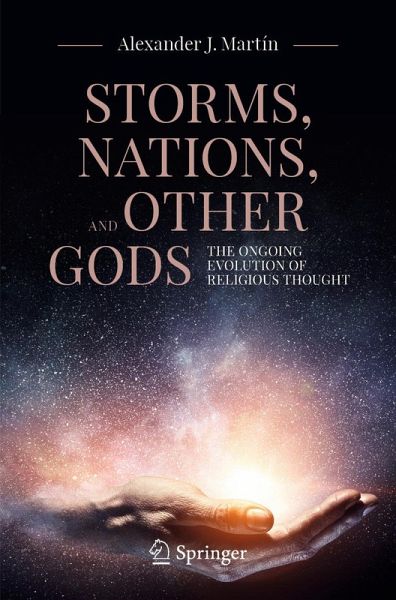
This book explores how two million years of natural selection left us with a strong tendency to bestow purposeful intention to the natural world-forming a robust cognitive basis for religious belief across human cultures. This cognitive legacy forms the foundation of much of how we interpret the world around us today, and understanding the reasons why and how it evolved can shed light on the peculiar relationships we sometimes form with the many complex social institutions of our time, including one of the most dominant and ubiquitous ones, the nation-state.
To explore how our tendencies for religious belief interact with the complex social institutions we currently live under, we go on a journey from the start of the Pleistocene era to domestication, from ancient states to colonialism, and from the industrial revolution to the birth of modern nations, all while tracking the various biological, cognitive, and social elements that explain why today we interpret the nation-state (and other modern social institutions) in very similar ways to how we understood deities of the ancient past. Understanding why and how this happens requires reconstructing how evolution shaped our cognition, how complex social organizations arose after domestication, how they act as external forces to ourselves, and how they grew into distinct and cohesive social entities that our cognition interprets as purposeful players with agency and intent.
This book continues the long-held tradition in the social sciences of making this type of interdisciplinary synthesis accessible to the general public, and for that reason, it minimizes discipline-specific jargon and describes experiments and results rather than relying on cited works.
To explore how our tendencies for religious belief interact with the complex social institutions we currently live under, we go on a journey from the start of the Pleistocene era to domestication, from ancient states to colonialism, and from the industrial revolution to the birth of modern nations, all while tracking the various biological, cognitive, and social elements that explain why today we interpret the nation-state (and other modern social institutions) in very similar ways to how we understood deities of the ancient past. Understanding why and how this happens requires reconstructing how evolution shaped our cognition, how complex social organizations arose after domestication, how they act as external forces to ourselves, and how they grew into distinct and cohesive social entities that our cognition interprets as purposeful players with agency and intent.
This book continues the long-held tradition in the social sciences of making this type of interdisciplinary synthesis accessible to the general public, and for that reason, it minimizes discipline-specific jargon and describes experiments and results rather than relying on cited works.
Dieser Download kann aus rechtlichen Gründen nur mit Rechnungsadresse in A, B, BG, CY, CZ, D, DK, EW, E, FIN, F, GR, HR, H, IRL, I, LT, L, LR, M, NL, PL, P, R, S, SLO, SK ausgeliefert werden.