0,49 €
inkl. MwSt.
Sofort per Download lieferbar
0 °P sammeln

Andere Kunden interessierten sich auch für
") Strength and How to Obtain It (eBook, ePUB)1,99 €
Strength and How to Obtain It (eBook, ePUB)1,99 €") Strength and How to Obtain It (eBook, ePUB)1,99 €
Strength and How to Obtain It (eBook, ePUB)1,99 €") The Runner's Expert Guide to Stretching (eBook, ePUB)12,95 €
The Runner's Expert Guide to Stretching (eBook, ePUB)12,95 €") Joe Friel's High-Performance Cyclist (eBook, ePUB)14,95 €
Joe Friel's High-Performance Cyclist (eBook, ePUB)14,95 €") Rebound (eBook, ePUB)9,95 €
Rebound (eBook, ePUB)9,95 €") The Sports Rehabilitation Therapists' Guidebook (eBook, ePUB)38,95 €
The Sports Rehabilitation Therapists' Guidebook (eBook, ePUB)38,95 €") Running Free of Injuries (eBook, ePUB)13,95 €
Running Free of Injuries (eBook, ePUB)13,95 €

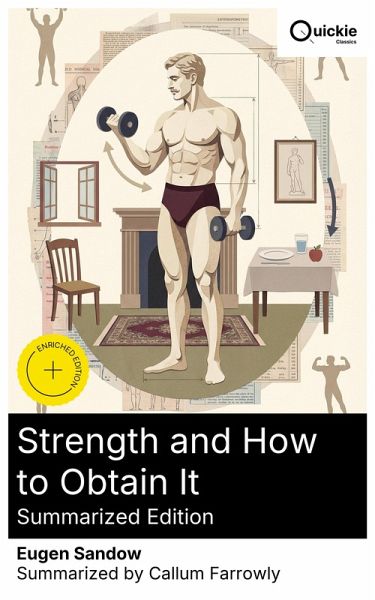
Strength and How to Obtain It is a late-Victorian manual that systematizes physical culture into a progressive regimen of light-dumbbell work, muscle control, calisthenics, and hygienic rules. Sandow couples prescriptive charts, measurements, and illustrative plates with a briskly didactic, quasi-scientific tone, invoking classical proportion as the benchmark. He details diet, breathing, bathing, rest, and the spacing of effort, guiding readers through graded drills suited to the home as well as the gymnasium. Eugen Sandow (born Friedrich Wilhelm Müller, 1867-1925) was the most famous strongman of his generation, a touring showman who turned feats of power into a pedagogy. Schooled by continental athletics and endorsed by medical men and anthropometrists, he pursued the "ideal" proportions of classical statuary, then marketed devices and courses to make them attainable. The book distills that experience into method: entrepreneurial savvy wedded to disciplined routine, aimed at reclaiming robust health for urban, sedentary readers. Students of strength training, sport history, and body culture will find this volume indispensable. Read it as both a practical primer-many drills still serve-and a revealing artifact. For coaches, historians, and self-improvers, Sandow offers a clear blueprint that instructs and illuminates. Quickie Classics summarizes timeless works with precision, preserving the author's voice and keeping the prose clear, fast, and readable-distilled, never diluted. Enriched Edition extras: Introduction · Synopsis · Historical Context · Brief Analysis · 4 Reflection Q&As · Editorial Footnotes.
Dieser Download kann aus rechtlichen Gründen nur mit Rechnungsadresse in A, B, BG, CY, CZ, D, DK, EW, E, FIN, F, GR, H, IRL, I, LT, L, LR, M, NL, PL, P, R, S, SLO, SK ausgeliefert werden.