27,95 €
inkl. MwSt.
Sofort per Download lieferbar
14 °P sammeln

Andere Kunden interessierten sich auch für
") Studying Lacan's Seminar VI (eBook, ePUB)27,95 €
Studying Lacan's Seminar VI (eBook, ePUB)27,95 €") Studying Lacan's Seminar VII (eBook, PDF)35,95 €
Studying Lacan's Seminar VII (eBook, PDF)35,95 €") Reading Lacan's Écrits: From 'Signification of the Phallus' to 'Metaphor of the Subject' (eBook, PDF)44,95 €
Reading Lacan's Écrits: From 'Signification of the Phallus' to 'Metaphor of the Subject' (eBook, PDF)44,95 €") Studying Lacan's Seminars IV and V (eBook, PDF)39,95 €
Studying Lacan's Seminars IV and V (eBook, PDF)39,95 €") Reading Lacan's Écrits (eBook, PDF)34,95 €
Reading Lacan's Écrits (eBook, PDF)34,95 €") Psychoanalysis and Literary Theory (eBook, PDF)36,95 €
Psychoanalysis and Literary Theory (eBook, PDF)36,95 €") Reading Lacan's Écrits (eBook, PDF)33,95 €
Reading Lacan's Écrits (eBook, PDF)33,95 €

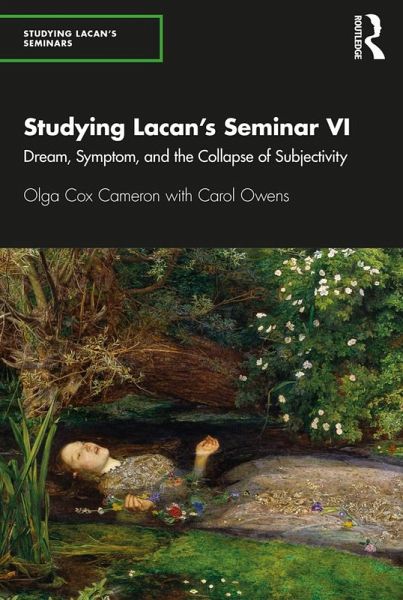
The second volume in the Studying Lacan's Seminars series, this book is the first comprehensive study of Lacan's Seminar VI: Desire and its Interpretation. A natural companion to Bruce Fink's recent translation of the seminar into English (2019), this book offers a genuine opportunity to delve deeply into the seminar, and a hospitable introduction to Lacan's teachings of the 1950s.
This important book brings together various aspects of Cox Cameron's teachings and systematic, careful, and critical readings of Seminar VI. Lacan's theorizing and conceptualizing of the object a, the fundamental fantasy, and aphanisis, as well as the ambiguous treatment of the phallus in his work at the time, are all introduced, contextualized, and explored in detail. The trajectories of his thinking are traced in terms of future developments and elaborations in the seminars that follow closely on the heels of Seminar VI - Seminars VII (Ethics of Psychoanalysis), VIII (Transference), IX (Identification), and X (Anxiety). Consideration is also given to how certain themes and motifs are recapitulated or reworked in his later teachings such as in Seminars XX (Encore), and XXIII (The Sinthome). Also included in this volume are two further essays by Cox Cameron, a most valuable critique of the concept of the phallus in Lacan's theories of the 1950s, and an overview of Seminar VI originally presented as a keynote address to the APW congress in Toronto 2014.
The book is of great interest to Lacanian scholars and students, as well as psychoanalytic therapists and analysts interested in Lacan's teachings of the 1950s and in how important concepts developed during this period are treated in his later work.
This important book brings together various aspects of Cox Cameron's teachings and systematic, careful, and critical readings of Seminar VI. Lacan's theorizing and conceptualizing of the object a, the fundamental fantasy, and aphanisis, as well as the ambiguous treatment of the phallus in his work at the time, are all introduced, contextualized, and explored in detail. The trajectories of his thinking are traced in terms of future developments and elaborations in the seminars that follow closely on the heels of Seminar VI - Seminars VII (Ethics of Psychoanalysis), VIII (Transference), IX (Identification), and X (Anxiety). Consideration is also given to how certain themes and motifs are recapitulated or reworked in his later teachings such as in Seminars XX (Encore), and XXIII (The Sinthome). Also included in this volume are two further essays by Cox Cameron, a most valuable critique of the concept of the phallus in Lacan's theories of the 1950s, and an overview of Seminar VI originally presented as a keynote address to the APW congress in Toronto 2014.
The book is of great interest to Lacanian scholars and students, as well as psychoanalytic therapists and analysts interested in Lacan's teachings of the 1950s and in how important concepts developed during this period are treated in his later work.
Dieser Download kann aus rechtlichen Gründen nur mit Rechnungsadresse in A, B, BG, CY, CZ, D, DK, EW, E, FIN, F, GR, HR, H, IRL, I, LT, L, LR, M, NL, PL, P, R, S, SLO, SK ausgeliefert werden.
"What a fantastic guide this book is, I was wishing Olga Cox Cameron could lead me through all of Lacan's seminars. This is a beautifully clear and funny and insightful reading of Seminar VI, showing us that there is no one Lacan, but many, and that self-critical attention to what is of dubious value in his work is the only way to discover what is so amazingly useful. At the same time the book is conceptually dense and enjoyable. I laughed out loud at points, especially the "Here is the News" example, and there is so much in here that I learnt and thought about." - Ian Parker, Fellow of the British Psychological Society, Emeritus Professor of Management at the University of Leicester, Co-Director of the Discourse Unit, and Managing Editor of Annual Review of Critical Psychology
"Cox Cameron has written an elegant and clear study of Lacan's rich and complex Seminar VI. She skilfully walks the reader through the key tenets of one of Lacan's most important seminars and at the same time locates his teaching in the movement of his thought. A reflective and informed study that pairs beautifully with the original text." - Russell Grigg
"In this book on Lacan's Seminar VI, Desire and Its Interpretation, Olga Cox Cameron provides extensive, lucid, and inspired commentary on some of Lacan's densest formulations, deftly elucidating such complex notions as being, the phallus, fantasy, and the object. As she contextualizes the work Lacan does here with respect to the Seminars that preceded it and the Seminars that followed it, she nicely outlines where Lacan remains Freudian and where he parts company with Freud-as regards dream interpretation and the interpretation of works of art, for example. The material is brought alive with references to mother-child experiences and myriad literary texts. The reader will thank her for providing us with such an eye-opening guide to a sometimes murky Seminar!" - Bruce Fink, Lacanian psychoanalyst, analytic supervisor, and Professor of Psychology at Duquesne University, Pittsburgh, Pennsylvania
"Cox Cameron has written an elegant and clear study of Lacan's rich and complex Seminar VI. She skilfully walks the reader through the key tenets of one of Lacan's most important seminars and at the same time locates his teaching in the movement of his thought. A reflective and informed study that pairs beautifully with the original text." - Russell Grigg
"In this book on Lacan's Seminar VI, Desire and Its Interpretation, Olga Cox Cameron provides extensive, lucid, and inspired commentary on some of Lacan's densest formulations, deftly elucidating such complex notions as being, the phallus, fantasy, and the object. As she contextualizes the work Lacan does here with respect to the Seminars that preceded it and the Seminars that followed it, she nicely outlines where Lacan remains Freudian and where he parts company with Freud-as regards dream interpretation and the interpretation of works of art, for example. The material is brought alive with references to mother-child experiences and myriad literary texts. The reader will thank her for providing us with such an eye-opening guide to a sometimes murky Seminar!" - Bruce Fink, Lacanian psychoanalyst, analytic supervisor, and Professor of Psychology at Duquesne University, Pittsburgh, Pennsylvania