33,95 €
inkl. MwSt.
Sofort per Download lieferbar
17 °P sammeln

Andere Kunden interessierten sich auch für
") Studying Lacan's Seminar VII (eBook, PDF)33,95 €
Studying Lacan's Seminar VII (eBook, PDF)33,95 €") Shandean Psychoanalysis (eBook, ePUB)31,95 €
Shandean Psychoanalysis (eBook, ePUB)31,95 €") Studying Lacan's Seminar VI (eBook, ePUB)32,95 €
Studying Lacan's Seminar VI (eBook, ePUB)32,95 €") Philosophy After Lacan (eBook, ePUB)31,95 €
Philosophy After Lacan (eBook, ePUB)31,95 €") Fanon, Phenomenology, and Psychology (eBook, ePUB)36,95 €
Fanon, Phenomenology, and Psychology (eBook, ePUB)36,95 €") Introducing the Clinical Work of Wilfred Bion (eBook, ePUB)31,95 €
Introducing the Clinical Work of Wilfred Bion (eBook, ePUB)31,95 €") Reading Lacan's Écrits: From 'Signification of the Phallus' to 'Metaphor of the Subject' (eBook, ePUB)41,95 €
Reading Lacan's Écrits: From 'Signification of the Phallus' to 'Metaphor of the Subject' (eBook, ePUB)41,95 €



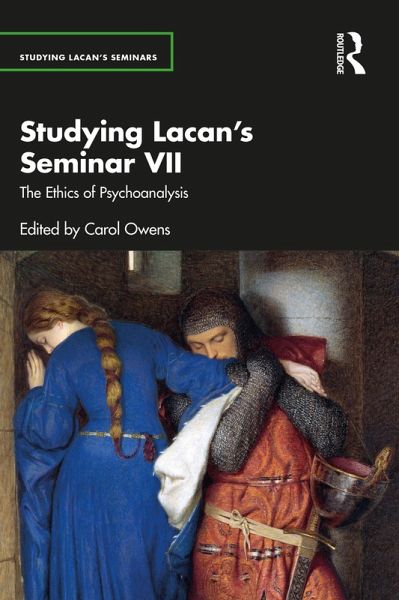
Studying Lacan's Seminar VII offers a contemporary, critically informed set of analyses of Lacan's ethics seminar and astute reflections about what Lacan's ethics offer to the field of psychoanalytic thought today.
The volume interrogates the seminar with fresh voices and situated curiosities and perspectives, making for a compellingly exciting range of explorations of the crucial matters related to an ethics of psychoanalysis. The chapters question and tease out the paradoxes Lacan draws attention to in his seminar of 1959-1960, and in addition, they offer radical engagements with the seminar in light of theories of racism, inequality, capitalism, education, and subjectivity. The key elements in Lacan's seminar are explained, debated, and reconsidered with Antigone, das Ding, and the inevitable "ne céder pas sur son désir " duly unpacked, examined, and ruminated upon.
Studying Lacan's Seminar VII will be of interest to psychoanalytic scholars and students of Lacanian psychoanalysis, as well as psychoanalytic therapists and analysts. It will also be of interest to scholars and students of politics, philosophy, and studies at the intersections of racism, film, feminism, sociology, gender, and queer theory.
The volume interrogates the seminar with fresh voices and situated curiosities and perspectives, making for a compellingly exciting range of explorations of the crucial matters related to an ethics of psychoanalysis. The chapters question and tease out the paradoxes Lacan draws attention to in his seminar of 1959-1960, and in addition, they offer radical engagements with the seminar in light of theories of racism, inequality, capitalism, education, and subjectivity. The key elements in Lacan's seminar are explained, debated, and reconsidered with Antigone, das Ding, and the inevitable "ne céder pas sur son désir " duly unpacked, examined, and ruminated upon.
Studying Lacan's Seminar VII will be of interest to psychoanalytic scholars and students of Lacanian psychoanalysis, as well as psychoanalytic therapists and analysts. It will also be of interest to scholars and students of politics, philosophy, and studies at the intersections of racism, film, feminism, sociology, gender, and queer theory.
Dieser Download kann aus rechtlichen Gründen nur mit Rechnungsadresse in A, B, BG, CY, CZ, D, DK, EW, E, FIN, F, GR, HR, H, IRL, I, LT, L, LR, M, NL, PL, P, R, S, SLO, SK ausgeliefert werden.
Lacan's promotion of desire as the crucial concept of an ethics for psychoanalysis, has transformed scholarly inquiry on ethics tout court. This exciting and indispensable volume brings together contributions by major theorists to offer a wealth of original approaches to the most challenging questions raised by Lacan's seventh seminar. Far from a compilation of received wisdom on Lacan, this volume approaches the seminar with fresh perspectives and invigorating explorations of crucial matters for an ethics of psychoanalysis. Can there be an ethics without positing a sovereign good or a categorical imperative? Can an ethics of desire be anything other than hedonism? How does a theory of jouissance elucidate the relationship between good and evil? What can Lacan's ideas on courtly love teach us about racism or the concept of das Ding help us understand about our investment in commodity fetishism? Is Antigone's fidelity to her desire an example of a psychoanalytic ethics or a cautionary tale about the death drive? In astute and rigorously argued discussion, these essays offer both superb guidance to the seminar's arguments and a rich demonstration of the value of psychoanalysis for contemporary thinking on ethics. - Molly Anne Rothenberg, Professor Emeritus of English, Tulane University
What are the ethics of psychoanalysis, and what is its relation to the desire to do good? This impressive and illuminating collection of essays provides not only careful readings of Lacan's challenging seminar but also brilliant interpretations of how concepts as enigmatic and provocative as das Ding and 'not giving ground relative to desire' can be applied to the practice of psychoanalysis and to political problems. The authors in this book do not stop at pointing out key ways in which the desire to do good actually enacts harm, but shed fresh new light on ways 'The Ethics of Psychoanalysis' can illuminate radical ethical stances within psychoanalytic praxis and with respect to racism, social inequalities, and capitalist relations of production. The price to pay for following your desire to read this book is well worth it! - Stephanie Swales, Psychoanalyst, and Associate Professor University of Dallas
Lacan's Seminar VII is without any doubt one of his richest and most intriguing seminars. From the commentaries on Heidegger, das Ding, de Sade, Kant, courtly love, to the extensive commentary on Antigone, the seminar virtually bristles with unexpected, audacious and groundbreaking ideas that have irrevocably changed the way we look at these authors and notions. This volume not only lives up to the challenge of commenting on such a work, but also retains its exciting appeal and conceptual boldness. It is not merely an academic discussion of Lacan's ideas and concepts, but effectively brings these ideas to life in our contemporary context. What is a "Supreme-Being-in-Evil"? Why is ethics different from morality? Could courtly love be related to hysteria? Could it be related to racism and "the sublimation of race"? How does das Ding relate to the origin of value? What are the persistent paradoxes of desire? And what about the price of freedom? This panoramic overview of the contributions cannot do them justice, of course, but it can certainly alert us to the fact that something truly significant and thought-provoking is happening here. - Alenka Zupancic, Professor of philosophy and psychoanalysis at the Institute for Philosophy in Ljubljana and the European Graduate School, Switzerland
Is it even possible to imagine a better team of commentators to tackle Lacan's Seminar VII afresh? Studying Lacan's Seminar VII comprises the top echelon of Lacan scholars, offering not only definitive but also highly original perspectives on those topics - evil, morality, courtly love, tragedy, sublimation, freedom, desire - that makes The Ethics of Psychoanalysis amongst the most impactful of all Lacan's seminars. The retroactive influence of these essays - which traverse the domains of philosophy, culture, politics and the clinic - is such that the seminar is made newly vital, newly essential to any questioning of the ethical in the 21st century. - Derek Hook, Clinical Supervisor and Professor, Duquesne University
What are the ethics of psychoanalysis, and what is its relation to the desire to do good? This impressive and illuminating collection of essays provides not only careful readings of Lacan's challenging seminar but also brilliant interpretations of how concepts as enigmatic and provocative as das Ding and 'not giving ground relative to desire' can be applied to the practice of psychoanalysis and to political problems. The authors in this book do not stop at pointing out key ways in which the desire to do good actually enacts harm, but shed fresh new light on ways 'The Ethics of Psychoanalysis' can illuminate radical ethical stances within psychoanalytic praxis and with respect to racism, social inequalities, and capitalist relations of production. The price to pay for following your desire to read this book is well worth it! - Stephanie Swales, Psychoanalyst, and Associate Professor University of Dallas
Lacan's Seminar VII is without any doubt one of his richest and most intriguing seminars. From the commentaries on Heidegger, das Ding, de Sade, Kant, courtly love, to the extensive commentary on Antigone, the seminar virtually bristles with unexpected, audacious and groundbreaking ideas that have irrevocably changed the way we look at these authors and notions. This volume not only lives up to the challenge of commenting on such a work, but also retains its exciting appeal and conceptual boldness. It is not merely an academic discussion of Lacan's ideas and concepts, but effectively brings these ideas to life in our contemporary context. What is a "Supreme-Being-in-Evil"? Why is ethics different from morality? Could courtly love be related to hysteria? Could it be related to racism and "the sublimation of race"? How does das Ding relate to the origin of value? What are the persistent paradoxes of desire? And what about the price of freedom? This panoramic overview of the contributions cannot do them justice, of course, but it can certainly alert us to the fact that something truly significant and thought-provoking is happening here. - Alenka Zupancic, Professor of philosophy and psychoanalysis at the Institute for Philosophy in Ljubljana and the European Graduate School, Switzerland
Is it even possible to imagine a better team of commentators to tackle Lacan's Seminar VII afresh? Studying Lacan's Seminar VII comprises the top echelon of Lacan scholars, offering not only definitive but also highly original perspectives on those topics - evil, morality, courtly love, tragedy, sublimation, freedom, desire - that makes The Ethics of Psychoanalysis amongst the most impactful of all Lacan's seminars. The retroactive influence of these essays - which traverse the domains of philosophy, culture, politics and the clinic - is such that the seminar is made newly vital, newly essential to any questioning of the ethical in the 21st century. - Derek Hook, Clinical Supervisor and Professor, Duquesne University