49,95 €
inkl. MwSt.
Sofort per Download lieferbar
25 °P sammeln

Andere Kunden interessierten sich auch für
") Transport Justice (eBook, ePUB)51,95 €
Transport Justice (eBook, ePUB)51,95 €") Rural Accessibility in European Regions (eBook, ePUB)37,95 €
Rural Accessibility in European Regions (eBook, ePUB)37,95 €") Connecting Places, Connecting People (eBook, ePUB)55,95 €
Connecting Places, Connecting People (eBook, ePUB)55,95 €") The Shoup Doctrine (eBook, ePUB)30,95 €
The Shoup Doctrine (eBook, ePUB)30,95 €") Driverless Urban Futures (eBook, ePUB)51,95 €
Driverless Urban Futures (eBook, ePUB)51,95 €") Rethinking Parking (eBook, ePUB)36,95 €
Rethinking Parking (eBook, ePUB)36,95 €") Infrastructural Optimism (eBook, ePUB)36,95 €
Infrastructural Optimism (eBook, ePUB)36,95 €

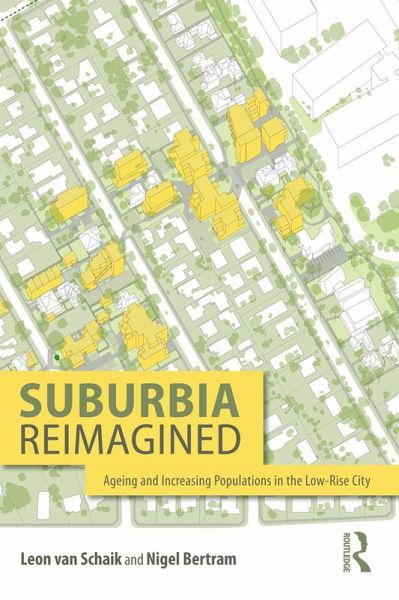
Worldwide, more and more people are living in cities, with suburbs conceived as appendages to the city, rather than being part of the city system, which is densely populated and offers a full range of services. But suburbs are not the city spread too thin, and in fact hold potential for a lived complexity as satisfying as that assumed to be available in inner cities. Just as the ecological function of wetlands was ignored by modernist planning, and swamps once-drained are now recognised as vital to water cycles, suburbs are increasingly recognised as part of a city's wellbeing with their own alternative ideology and opportunities for urbanity and ecological sustainability. Suburbia Reimagined shows how such subdivision structures can offer new possibilities for sustainably integrating living between generations and between established and arriving migrant communities.
The authors worked locally and internationally with university campuses, shopping centres, hospitals, airports, and other large entities spread through suburbia, to identify a broad range of suburban situations that have been modified to ensure that residents have a full access to amenities and services. The book addresses the history and design of suburbia, from the post-war soldier settlements of the 40s and 50s to the university hinterlands of Silicon Valley in order to reappraise the locked potential within such subdivision patterns. The authors propose a new model forward, examining case studies ranging from repurposed malls and railways for ecological sustainability to cul-de-sacs as social units and post-industrial factory conversions, ultimately showing the nascent patterns in suburbia that have the potential to support a rich life for all age groups.
The authors worked locally and internationally with university campuses, shopping centres, hospitals, airports, and other large entities spread through suburbia, to identify a broad range of suburban situations that have been modified to ensure that residents have a full access to amenities and services. The book addresses the history and design of suburbia, from the post-war soldier settlements of the 40s and 50s to the university hinterlands of Silicon Valley in order to reappraise the locked potential within such subdivision patterns. The authors propose a new model forward, examining case studies ranging from repurposed malls and railways for ecological sustainability to cul-de-sacs as social units and post-industrial factory conversions, ultimately showing the nascent patterns in suburbia that have the potential to support a rich life for all age groups.
Dieser Download kann aus rechtlichen Gründen nur mit Rechnungsadresse in A, B, BG, CY, CZ, D, DK, EW, E, FIN, F, GR, HR, H, IRL, I, LT, L, LR, M, NL, PL, P, R, S, SLO, SK ausgeliefert werden.