79,95 €
79,95 €
inkl. MwSt.
Sofort per Download lieferbar

40 °P sammeln
79,95 €
Als Download kaufen
79,95 €
inkl. MwSt.
Sofort per Download lieferbar
40 °P sammeln
Jetzt verschenken
Alle Infos zum eBook verschenken
79,95 €
inkl. MwSt.
Sofort per Download lieferbar
Alle Infos zum eBook verschenken
40 °P sammeln

Andere Kunden interessierten sich auch für
") High Pressure Surface Science and Engineering (eBook, ePUB)275,95 €
High Pressure Surface Science and Engineering (eBook, ePUB)275,95 €") Synchrotron Radiation (eBook, ePUB)55,95 €
Synchrotron Radiation (eBook, ePUB)55,95 €") Rare-earth-free Ferrimagnetic Mn4N Spintronics (eBook, ePUB)79,95 €
Rare-earth-free Ferrimagnetic Mn4N Spintronics (eBook, ePUB)79,95 € (eBook, ePUB)") Transport in Semiconductor Mesoscopic Devices (Second Edition) (eBook, ePUB)47,95 €
Transport in Semiconductor Mesoscopic Devices (Second Edition) (eBook, ePUB)47,95 €") Understanding Surface and Thin Film Science (eBook, ePUB)94,95 €
Understanding Surface and Thin Film Science (eBook, ePUB)94,95 €") Introduction to Surface and Superlattice Excitations (eBook, ePUB)64,95 €
Introduction to Surface and Superlattice Excitations (eBook, ePUB)64,95 €") Statistical Physics of Condensed Matter Systems (eBook, ePUB)47,95 €
Statistical Physics of Condensed Matter Systems (eBook, ePUB)47,95 €




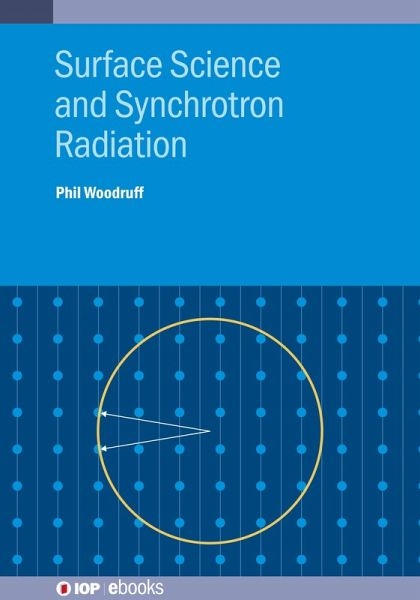
Experimental techniques to understand the physics and chemistry of solid surfaces blossomed following the introduction of all-metal demountable stainless steel ultrahigh vacuum methods in the late 1960s, leading to the development of many new techniques in the following years. These techniques exploit instrumentation that can be installed in university and company laboratories and are now widely used. A slightly later development, namely the availability of facilities to deliver synchrotron radiation (SR), particularly since the 1980s, has impacted on a wide range of disciplines in physics, chemistry, materials science and the life sciences. In particular, SR has allowed important enhancements in the capability of existing surface science techniques based on X-rays and vacuum ultra-violet radiation through improved spectral brilliance, and spectral and spatial resolution. Even more significantly, SR, with its wide range energy tunability in this spectral range has opened up entirely new surface methods with no equivalents in home laboratories. These enhanced and new capabilities are the particular focus of this book.
Key Features:
Key Features:
- Explains why synchrotron radiation is relevant for studies of surfaces
- Describes the unique properties of synchrotron radiation that provide information on surfaces not accessible without it
- Illustrates how synchrotron radiation can aid understanding of the electronic properties of surfaces
- Illustrates how synchrotron radiation can aid understanding of the structure of surfaces
Dieser Download kann aus rechtlichen Gründen nur mit Rechnungsadresse in A, D ausgeliefert werden.