72,95 €
72,95 €
inkl. MwSt.
Sofort per Download lieferbar

36 °P sammeln
72,95 €
Als Download kaufen
72,95 €
inkl. MwSt.
Sofort per Download lieferbar
36 °P sammeln
Jetzt verschenken
Alle Infos zum eBook verschenken
72,95 €
inkl. MwSt.
Sofort per Download lieferbar
Alle Infos zum eBook verschenken
36 °P sammeln

Andere Kunden interessierten sich auch für
") Advancing Surgical Education (eBook, PDF)136,95 €
Advancing Surgical Education (eBook, PDF)136,95 €") Embracing Indigenous Knowledge in Science and Medical Teaching (eBook, PDF)40,95 €
Embracing Indigenous Knowledge in Science and Medical Teaching (eBook, PDF)40,95 €") Medical Education for the Future (eBook, PDF)175,95 €
Medical Education for the Future (eBook, PDF)175,95 €") Faculty Development in the Health Professions (eBook, PDF)152,95 €
Faculty Development in the Health Professions (eBook, PDF)152,95 €") Accessibility, Inclusivity and Diversity in Education and Beyond (eBook, PDF)128,95 €
Accessibility, Inclusivity and Diversity in Education and Beyond (eBook, PDF)128,95 €") How-to Guide for Team-Based Learning (eBook, PDF)52,95 €
How-to Guide for Team-Based Learning (eBook, PDF)52,95 €") Quality Assurance in Medical Education (eBook, PDF)44,95 €
Quality Assurance in Medical Education (eBook, PDF)44,95 €
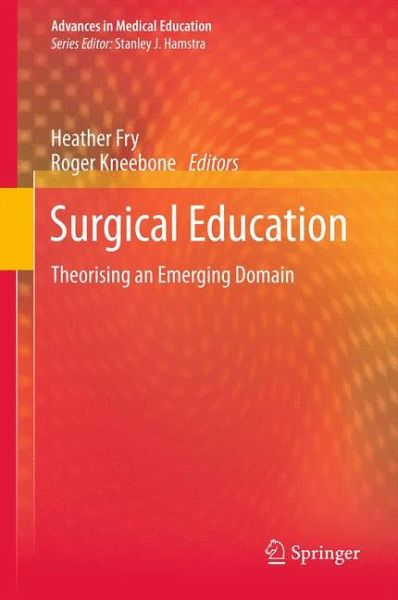
Surgical Education: Theorising an Emerging Domain delineates surgical (as opposed to medical) education as a new and emerging field of academic enquiry. This reflects profound changes in healthcare training and practice on an international basis. As such, this book introduces, examines and explores the contribution of selected concepts and theories to surgical learning and practice. The first four chapters consider core facets of surgical education, such as simulation, while subsequent chapters take a key idea, often well known in another field, and examine its relevance to surgical education.
Of course, performing invasive procedures is no longer the exclusive preserve of 'traditional' surgeons. Boundaries between surgery and the interventional specialties (radiology, cardiology, intensive care) are becoming increasingly blurred, especially as technology continues to expand. Changing work patterns and explosive technological development mark this out as a major growth area. New educational approaches (e.g. the use of simulation) are emerging. And all clinical practice is a team activity, where clinicians from many specialties (medicine, nursing, allied professions) come together with shared goals. For all the above groups, and their patients, education (teaching, training, learning and assessment) is of crucial importance.
Yet the unique characteristics of surgical education have not previously been addressed from an educational perspective, nor have its possibilities as a new research domain been mapped. The domain needs to be theorised and its epistemological foundations established. There is thus both a need and a market for a definitive work in this area, aimed at surgeons, other clinicians, non-clinicians, educators, and others interested in this new domain.
Of course, performing invasive procedures is no longer the exclusive preserve of 'traditional' surgeons. Boundaries between surgery and the interventional specialties (radiology, cardiology, intensive care) are becoming increasingly blurred, especially as technology continues to expand. Changing work patterns and explosive technological development mark this out as a major growth area. New educational approaches (e.g. the use of simulation) are emerging. And all clinical practice is a team activity, where clinicians from many specialties (medicine, nursing, allied professions) come together with shared goals. For all the above groups, and their patients, education (teaching, training, learning and assessment) is of crucial importance.
Yet the unique characteristics of surgical education have not previously been addressed from an educational perspective, nor have its possibilities as a new research domain been mapped. The domain needs to be theorised and its epistemological foundations established. There is thus both a need and a market for a definitive work in this area, aimed at surgeons, other clinicians, non-clinicians, educators, and others interested in this new domain.
Dieser Download kann aus rechtlichen Gründen nur mit Rechnungsadresse in A, B, BG, CY, CZ, D, DK, EW, E, FIN, F, GR, HR, H, IRL, I, LT, L, LR, M, NL, PL, P, R, S, SLO, SK ausgeliefert werden.
From the reviews:
"This volume in the Advances in Medical Education series is dedicated to surgical education. ... It is aimed at surgeons, other clinicians, nonclinicians, educators, and others interested in this new domain. ... Since the book focuses on surgical education and tries to elaborate different aspects and approaches to this wide and complex field, it is unique. ... it is useful resource for surgeons and educators (surgical or nonsurgical) who have an interest in educational research and administration." (Hisakazu Hoshi, Doody's Review Service, April, 2012)
"This volume in the Advances in Medical Education series is dedicated to surgical education. ... It is aimed at surgeons, other clinicians, nonclinicians, educators, and others interested in this new domain. ... Since the book focuses on surgical education and tries to elaborate different aspects and approaches to this wide and complex field, it is unique. ... it is useful resource for surgeons and educators (surgical or nonsurgical) who have an interest in educational research and administration." (Hisakazu Hoshi, Doody's Review Service, April, 2012)