72,95 €
72,95 €
inkl. MwSt.
Sofort per Download lieferbar

36 °P sammeln
72,95 €
Als Download kaufen
72,95 €
inkl. MwSt.
Sofort per Download lieferbar
36 °P sammeln
Jetzt verschenken
Alle Infos zum eBook verschenken
72,95 €
inkl. MwSt.
Sofort per Download lieferbar
Alle Infos zum eBook verschenken
36 °P sammeln

- Format: PDF
- Merkliste
- Auf die Merkliste
- Bewerten Bewerten
- Teilen
- Produkt teilen
- Produkterinnerung
- Produkterinnerung

Bitte loggen Sie sich zunächst in Ihr Kundenkonto ein oder registrieren Sie sich bei
bücher.de, um das eBook-Abo tolino select nutzen zu können.
Hier können Sie sich einloggen
Sie sind bereits eingeloggt. Klicken Sie auf 2. tolino select Abo, um fortzufahren.

Bitte loggen Sie sich zunächst in Ihr Kundenkonto ein oder registrieren Sie sich bei bücher.de, um das eBook-Abo tolino select nutzen zu können.
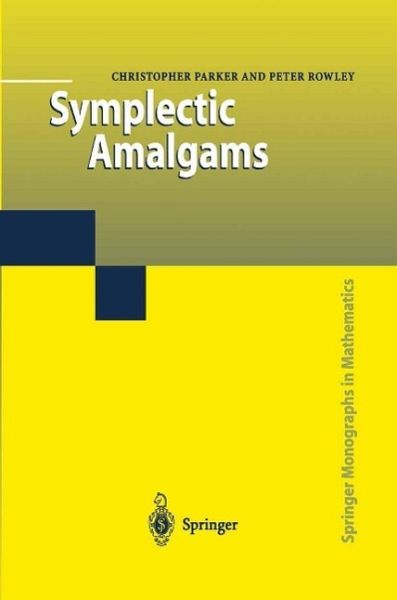
Interest in this field is widening and so the proof has to be readable by more than just specialists in amalgams. This book provides a complete overview of research in the field that is accessible to both specialists and non-specialists alike and is written by two of the world's most notable specialists in group amalgams.
- Geräte: PC
- ohne Kopierschutz
- eBook Hilfe
- Größe: 31.04MB
Andere Kunden interessierten sich auch für
James HirschfeldGeneral Galois Geometries (eBook, PDF)68,95 €
Hendrik Van MaldeghemGeneralized Polygons (eBook, PDF)72,95 €
Peter DembowskiFinite Geometries (eBook, PDF)44,95 €
Emilio BujalanceAutomorphism Groups of Compact Bordered Klein Surfaces (eBook, PDF)40,95 €
Research Directions in Symplectic and Contact Geometry and Topology (eBook, PDF)88,95 €
Arseniy SheydvasserLinear Fractional Transformations (eBook, PDF)40,95 €
Denis AurouxSymplectic 4-Manifolds and Algebraic Surfaces (eBook, PDF)40,95 €-
-
-
Interest in this field is widening and so the proof has to be readable by more than just specialists in amalgams. This book provides a complete overview of research in the field that is accessible to both specialists and non-specialists alike and is written by two of the world's most notable specialists in group amalgams.
Dieser Download kann aus rechtlichen Gründen nur mit Rechnungsadresse in A, B, BG, CY, CZ, D, DK, EW, E, FIN, F, GR, HR, H, IRL, I, LT, L, LR, M, NL, PL, P, R, S, SLO, SK ausgeliefert werden.
Produktdetails
- Produktdetails
- Verlag: Springer London
- Seitenzahl: 361
- Erscheinungstermin: 6. Dezember 2012
- Englisch
- ISBN-13: 9781447101659
- Artikelnr.: 44000769
- Verlag: Springer London
- Seitenzahl: 361
- Erscheinungstermin: 6. Dezember 2012
- Englisch
- ISBN-13: 9781447101659
- Artikelnr.: 44000769
- Herstellerkennzeichnung Die Herstellerinformationen sind derzeit nicht verfügbar.
Christopher Parker, University of Birmingham, UK / Peter Rowley, University of Manchester, UK
1 Introduction.- 1.1 Symplectic Amalgams.- 1.2 Goldchmidt G4-Amalgam Again.- 2 Preliminaries.- 2.1 Some Group Theory Results.- 2.2 Some Representation Theory Results.- 2.3 Sesquilinear Forms.- 2.4 Two Theorems of McLaughlin.- 2.5 Ultraspecial and Extraspecial Groups.- 2.6 Tensor Products and Group Actions on p-Groups.- 2.7 The Goldschmidt Amalgams.- 3 The Structure of SL2(q) and its Modules.- 3.1 Group Theoretic Properties of SL2(q).- 3.2 Modules for SL2(q).- 4 Elementary Properties of Symplectic Amalgams.- 4.1 The Coset Graph.- 4.2 Proof of Theorem 1.6.- 5 The Structure of Q?.- 6 The L?-Chief Factors in V?.- 7 Reduced Symplectic Amalgams.- 7.1 A Reduced Symplectic Subamalgam.- 7.2 Reduced Amalgams and Consequences of Theorem 6.1.- 8 The Largest Normal p?-Subgroup of L?/Q?.- 9 The Components of L?/Q?.- 9.1 The Action of L? on Compp(L?).- 9.2 Two or more Normal Components in L?/Q?.- 10 The Reduction to Quasisimple when $$C_{U_alpha } (U_alpha /Z_alpha ) nleqslant Q_beta$$.- 11 A First Look at the Amalgams with V?/Z(V?) = q4.- 11.1 A Characteristic 3 Amalgam.- 11.2 The Proof of Theorem 11.1.- 12 The Story so Far.- 13 Groups of Lie Type.- 13.1 Weyl Groups and Parabolic Subgroups.- 13.2 Sylow p-subgroups of Lie Type Groups.- 13.3 Automorphisms and Centres.- 13.4 The Order of Abelian p-subgroups.- 13.5 Extremal Subgroups.- 14 Modules for Groups of Lie Type.- 14.1 Modules in Characteristic p.- 14.2 Module Results for Low Rank Groups of Lie Type.- 14.3 Modules for Lie Type Groups and (2, q)-Transvections.- 14.4 Natural Modules for Orthogonal Groups.- 14.5 Natural Modules for the Symplectic Groups.- 14.6 Natural Modules for G2(q).- 14.7 Some Spin Modules.- 14.8 Modules for Lie Type Groups in Non-defining Characteristic.- 14.9 Some Non-containments.-15 Sporadic Simple Groups and Their Modules.- 16 Alternating Groups and Their Modules.- 17 Rank One Groups.- 18 Lie Type Groups in Characteristic p and Rank ?.- 18.1 A Subamalgam of A.- 18.2 The Examples.- 18.3 L?/Q? a Symplectic Group and V?/Z(V?) a Spin Module.- 19 Lie Type Groups and Natural Modules.- 19.1 The Symplectic and Orthogonal Groups.- 19.2 Sp4(2) - A Special Case.- 19.3 Groups of Type G2(q).- 20 Lie Type Groups in Characteristic not p.- 21 Alternating Groups.- 21.1 Large Alternating Groups.- 21.2 Small Alternating Groups.- 22 Sporadic Simple Groups.- 23 The Proof of the Main Theorems.- 24 A Brief Survey of Amalgam Results.- 24.1 Amalgam Results.- 24.2 Pushing-up.- References.- Indexs.