29,95 €
29,95 €
inkl. MwSt.
Sofort per Download lieferbar

15 °P sammeln
29,95 €
Als Download kaufen
29,95 €
inkl. MwSt.
Sofort per Download lieferbar
15 °P sammeln
Jetzt verschenken
Alle Infos zum eBook verschenken
29,95 €
inkl. MwSt.
Sofort per Download lieferbar
Alle Infos zum eBook verschenken
15 °P sammeln

Andere Kunden interessierten sich auch für
") Teaching Later British Literature (eBook, ePUB)29,95 €
Teaching Later British Literature (eBook, ePUB)29,95 €") Bees in Early Modern Transatlantic Literature (eBook, PDF)39,95 €
Bees in Early Modern Transatlantic Literature (eBook, PDF)39,95 €") Science Fiction: Its Criticism and Teaching (eBook, PDF)29,95 €
Science Fiction: Its Criticism and Teaching (eBook, PDF)29,95 €") The Selected Writings of William Hazlitt Vol 4 (eBook, PDF)52,95 €
The Selected Writings of William Hazlitt Vol 4 (eBook, PDF)52,95 €") Teaching Victorian Literature in the Twenty-First Century (eBook, PDF)112,95 €
Teaching Victorian Literature in the Twenty-First Century (eBook, PDF)112,95 €") The Journals of Thomas Babington Macaulay Vol 3 (eBook, PDF)177,95 €
The Journals of Thomas Babington Macaulay Vol 3 (eBook, PDF)177,95 €") The Nineteenth Century Periodical Press and the Development of Detective Fiction (eBook, PDF)39,95 €
The Nineteenth Century Periodical Press and the Development of Detective Fiction (eBook, PDF)39,95 €
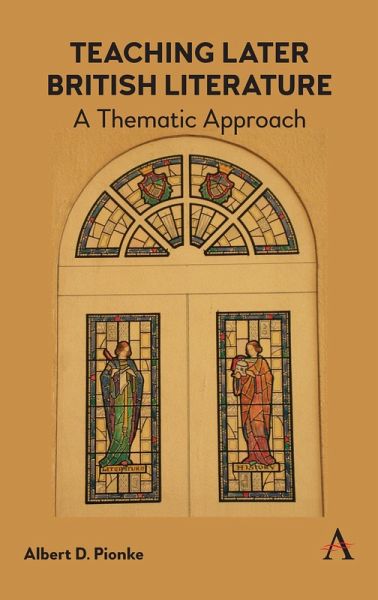
There are few more intimidating moments in an English teacher's career than those in which they learn that they have been assigned 'the survey' for the first time. Distilling scores of years of literary history and thousands of pages of literary texts into a coherent semester can seem impossible at first. Add to this the fact that few teachers at the high school level receive in-depth instruction in literary history, whereas their counterparts at the college and university levels receive little preparation in syllabus construction, and the overdetermining force of available textbooks and antecedent examples tends to assert itself.
All anthologies worth their salt provide expansive biographical headnotes for individual authors and group all of the works written by those authors under their respective headnotes. Authors are typically arranged in chronological order by date of birth and their works usually appear in the order of composition and first publication. Most survey courses then faithfully reproduce this format by leading students through a series of classes, each devoted to the works of a single author. This approach has many advantages, not least that of ensuring that courses enjoy a degree of uniformity that allows for the transfer of credits between institutions. One conspicuous disadvantage of proceeding in this fashion, however, is that the intellectual distinctiveness of the period can be lost in the details of particular writers, who tend to seem rather disconnected from one another and from the historical moment of which they are a part. Put another way, and allowing for the dynamism of individual instructors and the devotion of individual readers, the knowledge gained is often enumerative rather than synthetic.
Written in response to this state of affairs, 'A Handbook to Teaching Later British Literature' ultimately advances a number of proximate, intermediate and more distant goals. Most immediately, it seeks to make individual texts of later British literature easier to understand by placing them in conversation and in context. In so doing, the book models repeatedly for new and experienced teachers the process of constructing a comparative, topic-based argument about multiple texts, something that many of them will then require their students to demonstrate in their formal papers for such courses. Through its use of culturally resonant themes grounded in specific historical events and intellectual trends, the book also seeks to make the literary periods of British Romanticism, Victorianism and Modernism more recognizable and distinct from one another, certainly, but also from other periods of Anglo-American literature. At the same time, by revealing how the themes of one period grow out of the themes of earlier periods, the book offers a synthetic reading of later British literature as a continuously developing whole. Finally, this book is intended to help instructors at the advanced high school and college levels of literature teaching to guide students into becoming critical readers for the rest of their lives, by providing a framework of topics and ideas that can be used to understand literary works as yet unread, perhaps even those as yet unwritten.
All anthologies worth their salt provide expansive biographical headnotes for individual authors and group all of the works written by those authors under their respective headnotes. Authors are typically arranged in chronological order by date of birth and their works usually appear in the order of composition and first publication. Most survey courses then faithfully reproduce this format by leading students through a series of classes, each devoted to the works of a single author. This approach has many advantages, not least that of ensuring that courses enjoy a degree of uniformity that allows for the transfer of credits between institutions. One conspicuous disadvantage of proceeding in this fashion, however, is that the intellectual distinctiveness of the period can be lost in the details of particular writers, who tend to seem rather disconnected from one another and from the historical moment of which they are a part. Put another way, and allowing for the dynamism of individual instructors and the devotion of individual readers, the knowledge gained is often enumerative rather than synthetic.
Written in response to this state of affairs, 'A Handbook to Teaching Later British Literature' ultimately advances a number of proximate, intermediate and more distant goals. Most immediately, it seeks to make individual texts of later British literature easier to understand by placing them in conversation and in context. In so doing, the book models repeatedly for new and experienced teachers the process of constructing a comparative, topic-based argument about multiple texts, something that many of them will then require their students to demonstrate in their formal papers for such courses. Through its use of culturally resonant themes grounded in specific historical events and intellectual trends, the book also seeks to make the literary periods of British Romanticism, Victorianism and Modernism more recognizable and distinct from one another, certainly, but also from other periods of Anglo-American literature. At the same time, by revealing how the themes of one period grow out of the themes of earlier periods, the book offers a synthetic reading of later British literature as a continuously developing whole. Finally, this book is intended to help instructors at the advanced high school and college levels of literature teaching to guide students into becoming critical readers for the rest of their lives, by providing a framework of topics and ideas that can be used to understand literary works as yet unread, perhaps even those as yet unwritten.
Dieser Download kann aus rechtlichen Gründen nur mit Rechnungsadresse in A, D ausgeliefert werden.