16,95 €
16,95 €
inkl. MwSt.
Sofort per Download lieferbar

8 °P sammeln
16,95 €
Als Download kaufen
16,95 €
inkl. MwSt.
Sofort per Download lieferbar
8 °P sammeln
Jetzt verschenken
Alle Infos zum eBook verschenken
16,95 €
inkl. MwSt.
Sofort per Download lieferbar
Alle Infos zum eBook verschenken
8 °P sammeln

Andere Kunden interessierten sich auch für
") Techlash (eBook, PDF)16,95 €
Techlash (eBook, PDF)16,95 €") Read Write Own (eBook, ePUB)10,99 €
Read Write Own (eBook, ePUB)10,99 €") What Went Wrong with Capitalism (eBook, ePUB)14,83 €
What Went Wrong with Capitalism (eBook, ePUB)14,83 €") Subprime Attention Crisis (eBook, ePUB)6,99 €
Subprime Attention Crisis (eBook, ePUB)6,99 €") Silicon Values (eBook, ePUB)11,95 €
Silicon Values (eBook, ePUB)11,95 €") Life After Google (eBook, ePUB)9,88 €
Life After Google (eBook, ePUB)9,88 €") The Price is Wrong (eBook, ePUB)14,95 €
The Price is Wrong (eBook, ePUB)14,95 €




Hailed by Publishers Weekly as "a potent primer on the need to rein in big tech" and Kirkus Reviews as "a rock-solid plan for controlling the tech giants," readers will be energized by Tom Wheeler's vision of digital governance."
Featured on Barack Obama's 11/3/23 list of "What I'm Reading on the Rise of Artificial Intelligence"
An accessible and visionary book that connects the experiences of the late 19th century's industrial Gilded Age with its echoes in the 21st century digital Gilded Age...
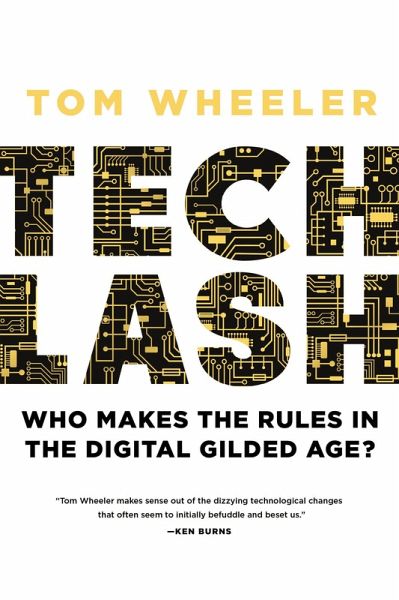
Hailed by Ken Burns as one of the foremost "explainers" of technology and its effect throughout history, Tom Wheeler now turns his gaze to the public impact of entrepreneurial innovation. In Techlash, he connects the experiences of the late 19th century's industrial Gilded Age with its echoes in the 21st-century digital Gilded Age. In both cases, technological innovation and the great wealth that it created ran up against the public interest and the rights of others. As with the Industrial Revolution and the Gilded Age that it created, new digital technology has changed commerce and culture, creating great wealth in the process, all while being essentially unsupervised.
Warning that today is not the "Fourth Industrial Revolution" some envision, Wheeler calls for a new era of public interest oversight that leaves behind industrial-era regulatory ideas to embrace a new process of agile, supervised, and enforced code setting that protects consumers and competition while encouraging continued innovation. Wheeler combines insights from his experience at the highest echelons of business and government to create a compelling portrait of the need to balance entrepreneurial innovation with the public good.
"Once again, Tom Wheeler makes sense out of the dizzying technological changes that often seem to initially befuddle and beset us before they come into sharper focus, a focus he brings to each page and each new idea. . . it sometimes takes an original thinker to make clearer the "mess" in front of us. Bravo!" - Ken Burns
Featured on Barack Obama's 11/3/23 list of "What I'm Reading on the Rise of Artificial Intelligence"
An accessible and visionary book that connects the experiences of the late 19th century's industrial Gilded Age with its echoes in the 21st century digital Gilded Age...
Hailed by Ken Burns as one of the foremost "explainers" of technology and its effect throughout history, Tom Wheeler now turns his gaze to the public impact of entrepreneurial innovation. In Techlash, he connects the experiences of the late 19th century's industrial Gilded Age with its echoes in the 21st-century digital Gilded Age. In both cases, technological innovation and the great wealth that it created ran up against the public interest and the rights of others. As with the Industrial Revolution and the Gilded Age that it created, new digital technology has changed commerce and culture, creating great wealth in the process, all while being essentially unsupervised.
Warning that today is not the "Fourth Industrial Revolution" some envision, Wheeler calls for a new era of public interest oversight that leaves behind industrial-era regulatory ideas to embrace a new process of agile, supervised, and enforced code setting that protects consumers and competition while encouraging continued innovation. Wheeler combines insights from his experience at the highest echelons of business and government to create a compelling portrait of the need to balance entrepreneurial innovation with the public good.
"Once again, Tom Wheeler makes sense out of the dizzying technological changes that often seem to initially befuddle and beset us before they come into sharper focus, a focus he brings to each page and each new idea. . . it sometimes takes an original thinker to make clearer the "mess" in front of us. Bravo!" - Ken Burns
Lax regulation has allowed the most powerful tech companies to become 'pseudo-governments' imposing their will on the public, according to this impassioned broadside. Wheeler, former chairman of the Federal Communications Commission during the Obama administration, draws parallels between the Gilded Age and the present, noting that the income inequality and market concentration that characterize both eras were ameliorated in the 19th century by 'antitrust law and regulatory oversight.' Advocating for the use of similar tools to curtail the power of Alphabet (Google), Amazon, Apple, Meta (Facebook), and Microsoft, Wheeler warns that these companies have been implementing invasive data collecting and other problematic practices with few means for users to push back. Wheeler persuasively makes the case that tech CEOs can't be trusted to regulate themselves.... It's a potent primer on the need to rein in big tech.