15,95 €
15,95 €
inkl. MwSt.
Sofort per Download lieferbar

8 °P sammeln
15,95 €
Als Download kaufen
15,95 €
inkl. MwSt.
Sofort per Download lieferbar
8 °P sammeln
Jetzt verschenken
Alle Infos zum eBook verschenken
15,95 €
inkl. MwSt.
Sofort per Download lieferbar
Alle Infos zum eBook verschenken
8 °P sammeln

Andere Kunden interessierten sich auch für
") What Media Classes Really Want to Discuss (eBook, ePUB)38,95 €
What Media Classes Really Want to Discuss (eBook, ePUB)38,95 €") Politics and the Mass Media in Britain (eBook, ePUB)38,95 €
Politics and the Mass Media in Britain (eBook, ePUB)38,95 €") Horror Films (eBook, ePUB)39,95 €
Horror Films (eBook, ePUB)39,95 €") East European Cinemas (eBook, ePUB)37,95 €
East European Cinemas (eBook, ePUB)37,95 €") A Cognitive Psychology of Mass Communication (eBook, ePUB)81,95 €
A Cognitive Psychology of Mass Communication (eBook, ePUB)81,95 €") Journalism, Technology and Cultural Practice (eBook, ePUB)33,95 €
Journalism, Technology and Cultural Practice (eBook, ePUB)33,95 €") Digital-Age Resistance (eBook, ePUB)37,95 €
Digital-Age Resistance (eBook, ePUB)37,95 €





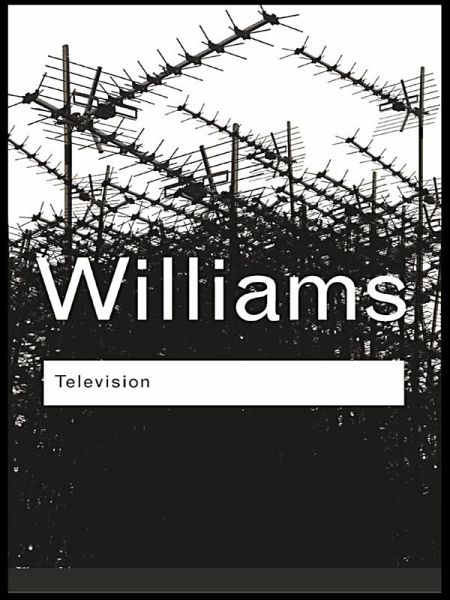
Television: Technology and Cultural Form was first published in 1974, long before the dawn of multi-channel TV, or the reality and celebrity shows that now pack the schedules. Yet Williams' analysis of television's history, its institutions, programmes and practices, and its future prospects, remains remarkably prescient.
Williams stresses the importance of technology in shaping the cultural form of television, while always resisting the determinism of McLuhan's dictum that 'the medium is the message'. If the medium really is the message, Williams asks, what is left for us to do or say? Williams argues that, on the contrary, we as viewers have the power to disturb, disrupt and to distract the otherwise cold logic of history and technology - not just because television is part of the fabric of our daily lives, but because new technologies continue to offer opportunities, momentarily outside the sway of transnational corporations or the grasp of media moguls, for new forms of self and political expression.
Williams stresses the importance of technology in shaping the cultural form of television, while always resisting the determinism of McLuhan's dictum that 'the medium is the message'. If the medium really is the message, Williams asks, what is left for us to do or say? Williams argues that, on the contrary, we as viewers have the power to disturb, disrupt and to distract the otherwise cold logic of history and technology - not just because television is part of the fabric of our daily lives, but because new technologies continue to offer opportunities, momentarily outside the sway of transnational corporations or the grasp of media moguls, for new forms of self and political expression.
Dieser Download kann aus rechtlichen Gründen nur mit Rechnungsadresse in A, B, BG, CY, CZ, D, DK, EW, E, FIN, F, GR, HR, H, IRL, I, LT, L, LR, M, NL, PL, P, R, S, SLO, SK ausgeliefert werden.
'Television: Technology and Cultural Form is a powerful and original book which marked the beginning of a new breed of British accounts of television. Instead of focusing solely on the content of television programs, it examined the shaping effect of television's technological structures upon its characteristic forms.' - Graeme Turner, Centre for Critical and Cultural Studies, University of Queensland, Australia
'Television: Technology and Cultural Form changed the way people understand TV. For the first time, a sophisticated critic and historian looked at the all medium's aspects--as a domestic technology, an object of public policy, a fetish of capital, a series of texts, and a creator of audiences... It was the first classic of TV studies.' - Toby Miller, New York University
'This book is a classic because it inaugurated ways of thinking about a new technology - television - as part of everyday material culture which are even more pertinent to us now as we enter the digital age.' - Charlotte Brunsdon, University of Warwick, UK
'A critical, insightful, iconoclastic and humane reading of television's first half century.' - Roger Silverstone, London School of Economics
'Television: Technology and Cultural Form changed the way people understand TV. For the first time, a sophisticated critic and historian looked at the all medium's aspects--as a domestic technology, an object of public policy, a fetish of capital, a series of texts, and a creator of audiences... It was the first classic of TV studies.' - Toby Miller, New York University
'This book is a classic because it inaugurated ways of thinking about a new technology - television - as part of everyday material culture which are even more pertinent to us now as we enter the digital age.' - Charlotte Brunsdon, University of Warwick, UK
'A critical, insightful, iconoclastic and humane reading of television's first half century.' - Roger Silverstone, London School of Economics