Sie sind bereits eingeloggt. Klicken Sie auf 2. tolino select Abo, um fortzufahren.
Bitte loggen Sie sich zunächst in Ihr Kundenkonto ein oder registrieren Sie sich bei bücher.de, um das eBook-Abo tolino select nutzen zu können.
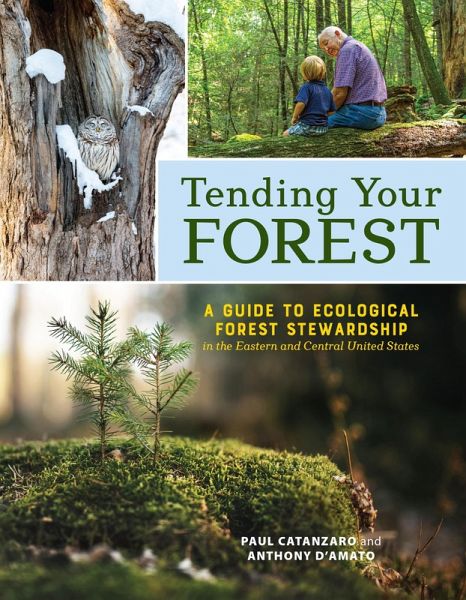
How do you care for the health of your forest? This comprehensive guide empowers landowners with the knowledge of how to manage a family forest to capture more carbon, encourage wildlife and biodiversity, and build a more resilient future. The Family Forest brings a fresh, ecological perspective to forest management, providing landowners with the information they need to understand their forests and their options for stewarding them in the face of new challenges, such as climate change and invasive species. With the help of key professionals, landowners from Maine to Maryland and…mehr
How do you care for the health of your forest? This comprehensive guide empowers landowners with the knowledge of how to manage a family forest to capture more carbon, encourage wildlife and biodiversity, and build a more resilient future.
The Family Forest brings a fresh, ecological perspective to forest management, providing landowners with the information they need to understand their forests and their options for stewarding them in the face of new challenges, such as climate change and invasive species. With the help of key professionals, landowners from Maine to Maryland and Missouri to Minnesota can practice ecological forestry to achieve goals such as restoring old-growth characteristics, protecting wildlife and biodiversity, sequestering and storing carbon to mitigate climate change, preserving tree species at risk of extinction, and sustainably harvesting trees for local wood products. Finally, landowners will learn how to ensure their legacy by passing land on to their heirs and making use of conservation easements and other tools for protecting the land long into the future.
This publication conforms to the EPUB Accessibility specification at WCAG 2.0 Level AA.
Dieser Download kann aus rechtlichen Gründen nur mit Rechnungsadresse in A, B, BG, CY, CZ, D, DK, EW, E, FIN, F, GR, HR, H, IRL, I, LT, L, LR, M, NL, PL, P, R, S, SLO, SK ausgeliefert werden.
Die Herstellerinformationen sind derzeit nicht verfügbar.
Autorenporträt
Paul Catanzaro is a professor in the Forest Ecology and Conservation program at University of Massachusetts, where he teaches forest ecology, forest management, silviculture, and land protection. He is co-director of the Family Forest Research Center, a partnership of the USDA Forest Service and UMass. Catanzaro also serves as the state extension forester. For nearly 20 years, he has studied family forest owners to understand their goals and challenges, turning this knowledge into practical and effective outreach resources. Anthony D'Amato is a professor of Silviculture and Applied Forest Ecology and director of the Forestry Program at the University of Vermont. Prior to that, D'Amato was a tenured faculty member at the University of Minnesota and Bullard Fellow at Harvard University's Harvard Forest. His research focuses on long-term forest dynamics, disturbance effects on ecosystems, and silviculture within the context of global change, such as introduced insects or diseases. He has published over 190 peer-reviewed papers on these topics as well as authored Ecological Silvicultural Systems.
Inhaltsangabe
Caring for Your Forest: Outline Introduction: It’s time for a new relationship with forests.
Part I: Understanding Your Forest
1. How Forests Work * The basic processes that shape forests: succession, disturbance, shade tolerance, regeneration, moisture. Illustration: Forest Succession Clock * There is no specific endpoint to forests. The goal is to help forests express their full potential. * Your forest is part of a larger landscape. Illustration: Parcel map of average landscape, puzzle piece.
2. Forests of the Past * Pre-colonial: the characteristics and extent of old-growth forests * Indigenous land use * Colonial land use: Clearing for subsistence farms, market farms, box boards, beaver extirpation. * Our forests, while beautiful and providing many essential benefits, have been heavily influenced by humans and are ecologically young. They are missing important components. You can help restore these components to the landscape.
3. Today’s Forests and Future Forests * The impacts of: climate change, invasive insects, invasive plants, excessive herbivory, loss of biodiversity, landowner age. * Working with a professional forester to understand the unique challenges of your own forest and options more implementing ecological forestry on your land.
Part II: Managing with Restoration and Resilience in Mind
4. Restoring Old-Growth Characteristics * Structural differences between our current second-growth forests and old-growth forests: diverse tree sizes/ages, dead standing and downed wood, vertical and horizontal diversity. * Passive strategies: letting nature take its course through natural disturbances. The importance of not salvaging. Likely timeline to meet restoration goals. Deciding where to site the passive approach. * Active strategies: designating patch reserves and legacy trees, regenerating areas by creating small gaps which mimic disturbance, thinning between gaps. Likely timeline to meet restoration goals. Deciding where to site the active approach. * Landscape perspective: If landowners across a landscape apply even a couple of practices, it will add up across the landscape. * Case Study
5. Mitigating Climate Change * Forest carbon pools: above ground, below ground, deadwood, soil, litter. Image: carbon pools by regionally common forest types. * Difference between sequestration and storage, and how it changes over time. * The importance of “keeping forests as forests.” * Best management practices for protecting soil. * Regeneration strategies that leave more trees and more big trees in the woods. * Carbon markets and programs focused on landowners to encourage carbon beneficial practices. * Case Study: Tim Stout (VT) and Cold Hollow to Canada (VT)
6. Increasing Forest Resilience * Don’t put all of your eggs in one basket where one disturbance can impact much of the forest. * Diversify tree species by regenerating species well-suited to the site and future conditions. * Increase structural complexity by creating single tree and small group gaps to establish a new cohort of trees. * Maintain the forest’s ability to function by addressing invasive plant and deer population control measures. * Explore opportunities to enhance regeneration through planting and to experiment with assisted migration. Illustration: resiliency gradient
7. Preserving Tree Species * Each species in a forest has its own unique role and benefit. * Cultural importance of species: Indigenous uses (e.g., ash baskets, stories) * Preserving species from invasive insects. Strategies include identifying groups of individuals (especially females) across the landscape on well-suited sites and implementing individual treatments (e.g., chemical stem injections) * Preserving species from climate change by creating refugia (e.g. red spruce): changes in temperature means that habitat is shifting north. There are opportunities to identify micro-climates within the landscape to sustain species.
8. Protecting and Enhancing Wildlife and Biodiversity * From very small organisms to charismatic mega-fauna, each species plays an important part in our forests. 40% of threatened and endangered species require some sort of active management to sustain. * Most vertebrate species need a variety of forest age classes. Because of our land use history, our current habitat is very uniform in age, species, and structure. We’re missing very young and very old forests. * Turning the successional clock back to create young forest or moving the successional clock forward to develop old forests. * Consider your landscape context and what age classes are in your landscape. How can you add to the age class or diversify it?
9. Wood Is Good: A Local Resource * Though there are certainly timber harvests that are exploitive, timber harvesting remains a crucial tool of ecological forestry. * Meeting goals to enhance wildlife habitat, restore old growth, and build resilience often involves harvesting trees. * Producing high quality wood products can help with storing carbon in long-lived forest products. * Wood is a very environmentally friendly product. * Increasing the quality of the tree being grown results in long-lived forest carbon storage. * Seeing ourselves as part of the forest--a new reciprocal relationship of being engaged with the land. * Case Study: WWII Victory Gardens
10. Your Land, Your Legacy * Ensuring your land remains forested is a critical complement to forest stewardship and a key characteristic of a resilient property. * Tools for passing land on to heirs (direct ownerships, indirection ownerships, wills trusts, LLCs) * Differences between conservation organizations that work with family forest owners. Describe tools for ensuring that some or all of the land is permanently conserved: conservation easements, fee simple, and techniques: sale, donation, bargain sale. * Opportunities to restore indigenous access to the land through cultural use agreements. * Case Study: John Sears – Hawley
Caring for Your Forest: Outline Introduction: It’s time for a new relationship with forests.
Part I: Understanding Your Forest
1. How Forests Work * The basic processes that shape forests: succession, disturbance, shade tolerance, regeneration, moisture. Illustration: Forest Succession Clock * There is no specific endpoint to forests. The goal is to help forests express their full potential. * Your forest is part of a larger landscape. Illustration: Parcel map of average landscape, puzzle piece.
2. Forests of the Past * Pre-colonial: the characteristics and extent of old-growth forests * Indigenous land use * Colonial land use: Clearing for subsistence farms, market farms, box boards, beaver extirpation. * Our forests, while beautiful and providing many essential benefits, have been heavily influenced by humans and are ecologically young. They are missing important components. You can help restore these components to the landscape.
3. Today’s Forests and Future Forests * The impacts of: climate change, invasive insects, invasive plants, excessive herbivory, loss of biodiversity, landowner age. * Working with a professional forester to understand the unique challenges of your own forest and options more implementing ecological forestry on your land.
Part II: Managing with Restoration and Resilience in Mind
4. Restoring Old-Growth Characteristics * Structural differences between our current second-growth forests and old-growth forests: diverse tree sizes/ages, dead standing and downed wood, vertical and horizontal diversity. * Passive strategies: letting nature take its course through natural disturbances. The importance of not salvaging. Likely timeline to meet restoration goals. Deciding where to site the passive approach. * Active strategies: designating patch reserves and legacy trees, regenerating areas by creating small gaps which mimic disturbance, thinning between gaps. Likely timeline to meet restoration goals. Deciding where to site the active approach. * Landscape perspective: If landowners across a landscape apply even a couple of practices, it will add up across the landscape. * Case Study
5. Mitigating Climate Change * Forest carbon pools: above ground, below ground, deadwood, soil, litter. Image: carbon pools by regionally common forest types. * Difference between sequestration and storage, and how it changes over time. * The importance of “keeping forests as forests.” * Best management practices for protecting soil. * Regeneration strategies that leave more trees and more big trees in the woods. * Carbon markets and programs focused on landowners to encourage carbon beneficial practices. * Case Study: Tim Stout (VT) and Cold Hollow to Canada (VT)
6. Increasing Forest Resilience * Don’t put all of your eggs in one basket where one disturbance can impact much of the forest. * Diversify tree species by regenerating species well-suited to the site and future conditions. * Increase structural complexity by creating single tree and small group gaps to establish a new cohort of trees. * Maintain the forest’s ability to function by addressing invasive plant and deer population control measures. * Explore opportunities to enhance regeneration through planting and to experiment with assisted migration. Illustration: resiliency gradient
7. Preserving Tree Species * Each species in a forest has its own unique role and benefit. * Cultural importance of species: Indigenous uses (e.g., ash baskets, stories) * Preserving species from invasive insects. Strategies include identifying groups of individuals (especially females) across the landscape on well-suited sites and implementing individual treatments (e.g., chemical stem injections) * Preserving species from climate change by creating refugia (e.g. red spruce): changes in temperature means that habitat is shifting north. There are opportunities to identify micro-climates within the landscape to sustain species.
8. Protecting and Enhancing Wildlife and Biodiversity * From very small organisms to charismatic mega-fauna, each species plays an important part in our forests. 40% of threatened and endangered species require some sort of active management to sustain. * Most vertebrate species need a variety of forest age classes. Because of our land use history, our current habitat is very uniform in age, species, and structure. We’re missing very young and very old forests. * Turning the successional clock back to create young forest or moving the successional clock forward to develop old forests. * Consider your landscape context and what age classes are in your landscape. How can you add to the age class or diversify it?
9. Wood Is Good: A Local Resource * Though there are certainly timber harvests that are exploitive, timber harvesting remains a crucial tool of ecological forestry. * Meeting goals to enhance wildlife habitat, restore old growth, and build resilience often involves harvesting trees. * Producing high quality wood products can help with storing carbon in long-lived forest products. * Wood is a very environmentally friendly product. * Increasing the quality of the tree being grown results in long-lived forest carbon storage. * Seeing ourselves as part of the forest--a new reciprocal relationship of being engaged with the land. * Case Study: WWII Victory Gardens
10. Your Land, Your Legacy * Ensuring your land remains forested is a critical complement to forest stewardship and a key characteristic of a resilient property. * Tools for passing land on to heirs (direct ownerships, indirection ownerships, wills trusts, LLCs) * Differences between conservation organizations that work with family forest owners. Describe tools for ensuring that some or all of the land is permanently conserved: conservation easements, fee simple, and techniques: sale, donation, bargain sale. * Opportunities to restore indigenous access to the land through cultural use agreements. * Case Study: John Sears – Hawley
Es gelten unsere Allgemeinen Geschäftsbedingungen: www.buecher.de/agb
Impressum
www.buecher.de ist ein Internetauftritt der buecher.de internetstores GmbH
Geschäftsführung: Monica Sawhney | Roland Kölbl | Günter Hilger
Sitz der Gesellschaft: Batheyer Straße 115 - 117, 58099 Hagen
Postanschrift: Bürgermeister-Wegele-Str. 12, 86167 Augsburg
Amtsgericht Hagen HRB 13257
Steuernummer: 321/5800/1497
USt-IdNr: DE450055826