0,91 €
0,91 €
inkl. MwSt.
Sofort per Download lieferbar
payback
0 °P sammeln
0,91 €
0,91 €
inkl. MwSt.
Sofort per Download lieferbar

Alle Infos zum eBook verschenken
payback
0 °P sammeln
Als Download kaufen
0,91 €
inkl. MwSt.
Sofort per Download lieferbar
payback
0 °P sammeln
Jetzt verschenken
0,91 €
inkl. MwSt.
Sofort per Download lieferbar

Alle Infos zum eBook verschenken
payback
0 °P sammeln
  • Format: ePub

The book begins with a chapter on Marlowe: "The first great English poet was the father of English tragedy and the creator of English blank verse. Chaucer and Spenser were great writers and great men: they shared between them every gift which goes to the making of a poet except the one which alone can make a poet, in the proper sense of the word, great. Neither pathos nor humor nor fancy nor invention will suffice for that: no poet is great as a poet whom no one could ever pretend to recognize as sublime. Sublimity is the test of imagination as distinguished from invention or from fancy: and…mehr

  • Geräte: eReader
  • ohne Kopierschutz
  • eBook Hilfe
  • FamilySharing(5)
Produktbeschreibung
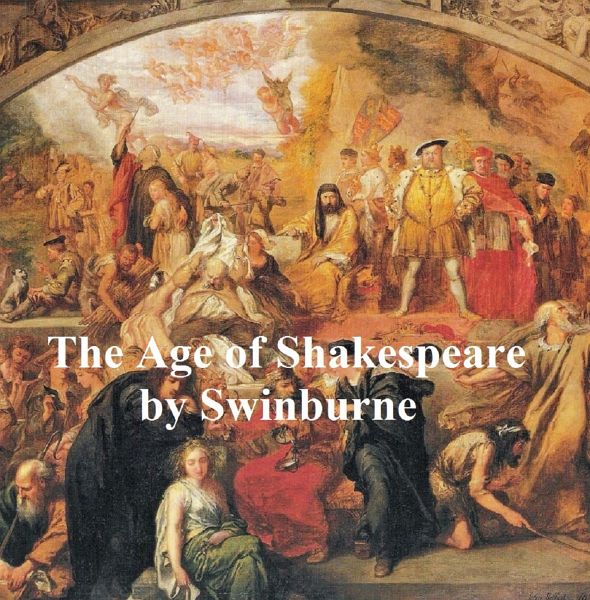
The book begins with a chapter on Marlowe: "The first great English poet was the father of English tragedy and the creator of English blank verse. Chaucer and Spenser were great writers and great men: they shared between them every gift which goes to the making of a poet except the one which alone can make a poet, in the proper sense of the word, great. Neither pathos nor humor nor fancy nor invention will suffice for that: no poet is great as a poet whom no one could ever pretend to recognize as sublime. Sublimity is the test of imagination as distinguished from invention or from fancy: and the first English poet whose powers can be called sublime was Christopher Marlowe."

Dieser Download kann aus rechtlichen Gründen nur mit Rechnungsadresse in A, B, BG, CY, CZ, D, DK, EW, E, FIN, F, GR, H, IRL, I, LT, L, LR, M, NL, PL, P, R, S, SLO, SK ausgeliefert werden.

Autorenporträt
Algernon Charles Swinburne (1837-1909) stands among the distinguished poets and critics of the Victorian era. Born in London into a wealthy Northumbrian family, he was educated at Eton and Balliol College, Oxford, though he left without obtaining a degree. Swinburne quickly became renowned for his poetic brilliance and infamous for the controversial themes of his work, which often explored transgressive subjects and taboo-breaking material. A prolific writer, his literary style is characterized by its musicality, which is often attributed to his fondness for the French Parnassian poets and their focus on formal technique. Swinburne's work contributed significantly to the development of Aestheticism in England and aligned with the movements of Pre-Raphaelitism and Decadence. Among Swinburne's copious works 'Atalanta in Calydon' (1865) and 'Poems and Ballads' (1866) were especially celebrated for their lyrical beauty and intricate versification. Beyond poetry, Swinburne was also an accomplished critic as exemplified by 'The Age of Shakespeare' which illustrates his profound understanding of drama and the bard's corpus. Swinburne's influence extended beyond his lifetime, affecting the writings of subsequent poets and aesthetes. Despite his waning popularity in the 20th century, recent scholarship has revived interest in his works, situating him as a pivotal figure within Victorian literature.