49,44 €
49,44 €
inkl. MwSt.
Sofort per Download lieferbar

0 °P sammeln
49,44 €
Als Download kaufen
49,44 €
inkl. MwSt.
Sofort per Download lieferbar
0 °P sammeln
Jetzt verschenken
Alle Infos zum eBook verschenken
49,44 €
inkl. MwSt.
Sofort per Download lieferbar
Alle Infos zum eBook verschenken
0 °P sammeln

Andere Kunden interessierten sich auch für
") Treasures of the Sakya Lineage (eBook, ePUB)13,95 €
Treasures of the Sakya Lineage (eBook, ePUB)13,95 €") The Lion's Roar of a Yogi-Poet (eBook, ePUB)17,79 €
The Lion's Roar of a Yogi-Poet (eBook, ePUB)17,79 €") The Play of Mahamudra (eBook, ePUB)18,78 €
The Play of Mahamudra (eBook, ePUB)18,78 €") Sakya Pandita (eBook, ePUB)14,83 €
Sakya Pandita (eBook, ePUB)14,83 €") The Sakya School of Tibetan Buddhism (eBook, ePUB)19,77 €
The Sakya School of Tibetan Buddhism (eBook, ePUB)19,77 €") Early Buddhist Oral Tradition (eBook, ePUB)22,74 €
Early Buddhist Oral Tradition (eBook, ePUB)22,74 €") The Treasury of Knowledge: Book Six, Parts One and Two (eBook, ePUB)27,95 €
The Treasury of Knowledge: Book Six, Parts One and Two (eBook, ePUB)27,95 €



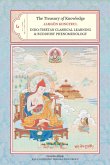
A lucid and landmark translation that offers an intriguing glimpse into Tibetan history, the Mongol Empire, and the spiritual development and remarkable lives of the early luminaries of the Sakya lineage of Tibetan Buddhism.
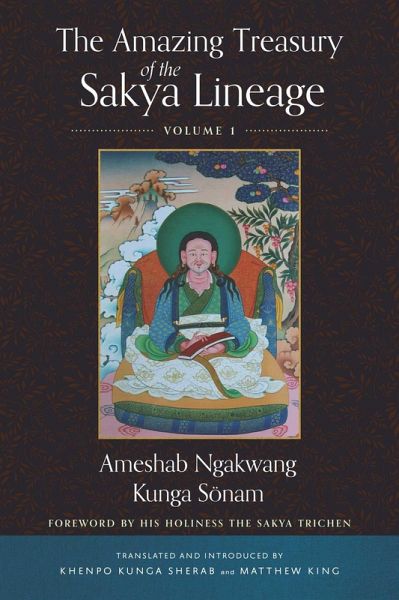
In this first of two volumes of The Amazing Treasury of the Sakya Lineage, translators Khenpo Kunga Sherab and Matthew W. King capture a truly remarkable period in Buddhist and Asian history. Here, Ameshab Ngakwang Kunga Sonam (15971659), a member of the Khon aristocracy and the twenty-seventh throne holder of Sakya Monastery, offers a narrative that recounts the lives of numerous iconic leaders of the Sakya school of Tibetan Buddhism during the transformational period between the tenth and fourteenth centuries. This landmark volume reconstructs that long era of religious and political innovation and upheaval through the rise of the Mongol Empire.
In this book, you'll see how Sakya Buddhist leaders emerged in this early period as translators, adopters, arbiters, and innovators of newly circulating Indian Buddhist scholastic and tantric cultures. In the thirteenth century, when the Mongol Empire forever transformed medieval Eurasia, leaders of the Sakya school became confidants and tutors to some of its most powerful leaders. The biographies of numerous Sakya luminaries are retold here, like Sakya Pandita and Phakpa Lodro Gyaltsen; along with their Mongol contemporaries, Koden Ejen and Qubilai Qayan, these leaders laid the groundwork for forms of patronage, religious and political sovereignty, scholasticism and tantrism, and righteous rule that would endure for the next eight centuries down to today.
In this first of two volumes of The Amazing Treasury of the Sakya Lineage, translators Khenpo Kunga Sherab and Matthew W. King capture a truly remarkable period in Buddhist and Asian history. Here, Ameshab Ngakwang Kunga Sonam (15971659), a member of the Khon aristocracy and the twenty-seventh throne holder of Sakya Monastery, offers a narrative that recounts the lives of numerous iconic leaders of the Sakya school of Tibetan Buddhism during the transformational period between the tenth and fourteenth centuries. This landmark volume reconstructs that long era of religious and political innovation and upheaval through the rise of the Mongol Empire.
In this book, you'll see how Sakya Buddhist leaders emerged in this early period as translators, adopters, arbiters, and innovators of newly circulating Indian Buddhist scholastic and tantric cultures. In the thirteenth century, when the Mongol Empire forever transformed medieval Eurasia, leaders of the Sakya school became confidants and tutors to some of its most powerful leaders. The biographies of numerous Sakya luminaries are retold here, like Sakya Pandita and Phakpa Lodro Gyaltsen; along with their Mongol contemporaries, Koden Ejen and Qubilai Qayan, these leaders laid the groundwork for forms of patronage, religious and political sovereignty, scholasticism and tantrism, and righteous rule that would endure for the next eight centuries down to today.
Dieser Download kann aus rechtlichen Gründen nur mit Rechnungsadresse in A, B, BG, CZ, D, DK, EW, E, FIN, F, GR, HR, H, I, LT, L, LR, NL, PL, P, R, S, SLO, SK ausgeliefert werden.