19,99 €
inkl. MwSt.
Sofort per Download lieferbar
0 °P sammeln

Andere Kunden interessierten sich auch für
") The Country's Need of Greater Railway Facilities and Terminals (eBook, ePUB)19,99 €
The Country's Need of Greater Railway Facilities and Terminals (eBook, ePUB)19,99 €") The Rural Motor ExpressTo Conserve Foodstuffs and Labor and to Supply Rural Transportation. (eBook, ePUB)19,99 €
The Rural Motor ExpressTo Conserve Foodstuffs and Labor and to Supply Rural Transportation. (eBook, ePUB)19,99 €") The heart of the railroad problem (eBook, ePUB)19,99 €
The heart of the railroad problem (eBook, ePUB)19,99 €") Mail Carrying Railways Underpaid (eBook, ePUB)19,99 €
Mail Carrying Railways Underpaid (eBook, ePUB)19,99 €") The Railroad Problem (eBook, ePUB)19,99 €
The Railroad Problem (eBook, ePUB)19,99 €") The Mail Pay on the Burlington Railroad (eBook, ePUB)19,99 €
The Mail Pay on the Burlington Railroad (eBook, ePUB)19,99 €") Railroads (eBook, ePUB)19,99 €
Railroads (eBook, ePUB)19,99 €



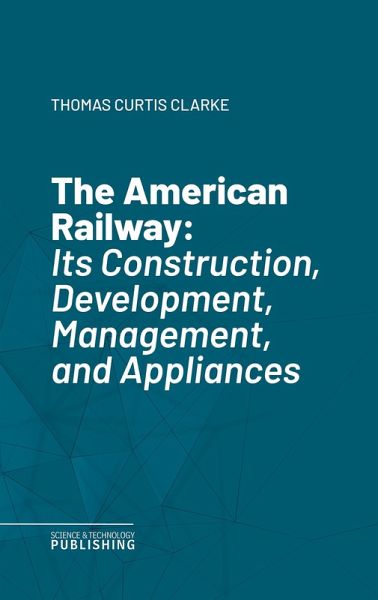
The American Railway: Its Construction, Development, Management, and Appliances is a comprehensive and authoritative exploration of the American railroad system at the height of its influence in the late nineteenth century. Edited by Thomas Curtis Clarke and first published in 1889, this seminal work brings together contributions from leading engineers, managers, and experts of the era, offering readers an in-depth look at every facet of railway operation and technology. The book delves into the origins and rapid expansion of the American railway network, tracing its evolution from early experimental lines to the vast, interconnected system that transformed the nation's economy and society. Detailed chapters cover the planning and surveying of routes, the challenges of constructing tracks across diverse terrains, and the engineering marvels of bridges, tunnels, and stations. The text provides vivid descriptions of the labor and ingenuity required to lay rails through mountains, forests, and prairies, highlighting the technical innovations that made such feats possible. Beyond construction, The American Railway examines the complex management structures that kept the railroads running efficiently. It discusses the organization of railway companies, the roles of executives and workers, and the intricate logistics of scheduling, ticketing, and freight handling. The book also explores the development of rolling stock, from powerful locomotives to luxurious passenger cars and specialized freight wagons, illustrating how advances in design and manufacturing improved speed, safety, and comfort. A significant portion of the book is devoted to the appliances and technologies that revolutionized rail travel, including signaling systems, telegraph communications, braking mechanisms, and track maintenance equipment. Through detailed illustrations and technical explanations, readers gain insight into the machinery and processes that underpinned the daily operation of the railways. Richly illustrated with engravings, diagrams, and photographs, The American Railway captures the drama and dynamism of an industry that shaped the modern United States. It offers firsthand accounts of railway life, from the experiences of engineers and conductors to the perspectives of passengers and townspeople whose lives were touched by the iron horse. The book also addresses the broader social and economic impacts of the railroads, including their role in westward expansion, urbanization, and the integration of distant markets. A landmark in transportation literature, The American Railway remains an invaluable resource for historians, engineers, and anyone fascinated by the story of America's railroads. Its blend of technical detail, historical narrative, and human interest makes it a vivid portrait of an era when the railway was the lifeblood of a growing nation.
Dieser Download kann aus rechtlichen Gründen nur mit Rechnungsadresse in A, B, BG, CY, CZ, D, DK, EW, E, FIN, F, GR, HR, H, IRL, I, LT, L, LR, M, NL, PL, P, R, S, SLO, SK ausgeliefert werden.