4,31 €
4,31 €
inkl. MwSt.
Sofort per Download lieferbar

0 °P sammeln
4,31 €
Als Download kaufen
4,31 €
inkl. MwSt.
Sofort per Download lieferbar
0 °P sammeln
Jetzt verschenken
Alle Infos zum eBook verschenken
4,31 €
inkl. MwSt.
Sofort per Download lieferbar
Alle Infos zum eBook verschenken
0 °P sammeln

Andere Kunden interessierten sich auch für
") Foundations of Safety and Security (eBook, ePUB)4,52 €
Foundations of Safety and Security (eBook, ePUB)4,52 €") Explain the Cloud Like I'm 10 (eBook, ePUB)15,83 €
Explain the Cloud Like I'm 10 (eBook, ePUB)15,83 €") Strategizing Continuous Delivery in the Cloud (eBook, ePUB)32,39 €
Strategizing Continuous Delivery in the Cloud (eBook, ePUB)32,39 €") Kafka Up and Running for Network DevOps (eBook, ePUB)8,49 €
Kafka Up and Running for Network DevOps (eBook, ePUB)8,49 €") AWS Certified Solutions Architect Study Guide with 900 Practice Test Questions (eBook, ePUB)38,99 €
AWS Certified Solutions Architect Study Guide with 900 Practice Test Questions (eBook, ePUB)38,99 €") Get Your Hands Dirty on Clean Architecture (eBook, ePUB)29,99 €
Get Your Hands Dirty on Clean Architecture (eBook, ePUB)29,99 €") Software Architecture Patterns for Serverless Systems (eBook, ePUB)44,39 €
Software Architecture Patterns for Serverless Systems (eBook, ePUB)44,39 €






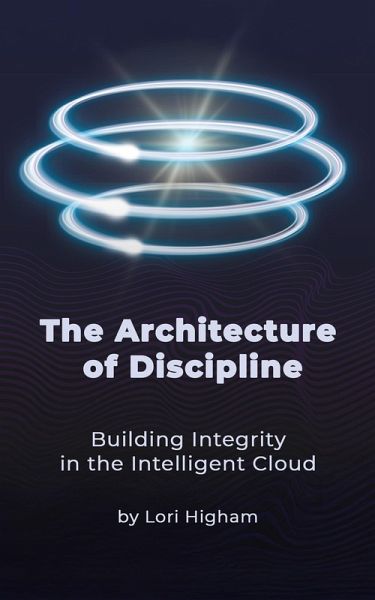
In the era of the intelligent cloud, architecture must do more than enable systems; it must verify them. The Architecture of Discipline defines how modern enterprises design environments capable of demonstrating their own integrity-continuously and at scale. Drawing on extensive leadership experience in cloud security, Zero Trust, governance, and AI oversight, Lori Higham redefines architecture as a discipline of structure and accountability, where evidence emerges as the natural outcome of design rather than the afterthought of audit.
This work moves fluidly between theory and reflection, rhetoric and practice. It invites the reader to question assumptions about control, trust, and automation while offering concrete mechanisms for building systems that remain accurate, accountable, and adaptive as they evolve. Here, architecture becomes both a technical craft and a philosophical inquiry: a dialogue between what is built and what can be proven.
Across chapters on governance, Zero Trust, responsible AI, and assurance, The Architecture of Discipline demonstrates how design becomes verification: how standards translate into automation, ethics into operational boundary, and continuity into measurable assurance. Each section balances rigorous conceptual framing with tangible architectural patterns, reinforcing that discipline in design is both method and mindset.
More than a manual, this is a conversation with the reader-a call to architects, engineers, and decision-makers to examine not only what they build, but how they sustain fidelity between design and outcome. In intelligent environments, integrity is not assumed; it is demonstrated through evidence. The measure of architecture is its capacity to sustain integrity through change-to analyze, constrain, and reveal the systems it governs faster than risk can erode them.
This work moves fluidly between theory and reflection, rhetoric and practice. It invites the reader to question assumptions about control, trust, and automation while offering concrete mechanisms for building systems that remain accurate, accountable, and adaptive as they evolve. Here, architecture becomes both a technical craft and a philosophical inquiry: a dialogue between what is built and what can be proven.
Across chapters on governance, Zero Trust, responsible AI, and assurance, The Architecture of Discipline demonstrates how design becomes verification: how standards translate into automation, ethics into operational boundary, and continuity into measurable assurance. Each section balances rigorous conceptual framing with tangible architectural patterns, reinforcing that discipline in design is both method and mindset.
More than a manual, this is a conversation with the reader-a call to architects, engineers, and decision-makers to examine not only what they build, but how they sustain fidelity between design and outcome. In intelligent environments, integrity is not assumed; it is demonstrated through evidence. The measure of architecture is its capacity to sustain integrity through change-to analyze, constrain, and reveal the systems it governs faster than risk can erode them.
Dieser Download kann aus rechtlichen Gründen nur mit Rechnungsadresse in A, B, BG, CY, CZ, D, DK, EW, E, FIN, F, GR, H, IRL, I, LT, L, LR, M, NL, PL, P, R, S, SLO, SK ausgeliefert werden.