54,95 €
54,95 €
inkl. MwSt.
Sofort per Download lieferbar

27 °P sammeln
54,95 €
Als Download kaufen
54,95 €
inkl. MwSt.
Sofort per Download lieferbar
27 °P sammeln
Jetzt verschenken
Alle Infos zum eBook verschenken
54,95 €
inkl. MwSt.
Sofort per Download lieferbar
Alle Infos zum eBook verschenken
27 °P sammeln

Andere Kunden interessierten sich auch für
") Between Arabia and the Holy Land (eBook, ePUB)39,95 €
Between Arabia and the Holy Land (eBook, ePUB)39,95 €") The Muslim Reception of European Orientalism (eBook, ePUB)38,95 €
The Muslim Reception of European Orientalism (eBook, ePUB)38,95 €") Outskirts of Empire (eBook, ePUB)42,95 €
Outskirts of Empire (eBook, ePUB)42,95 €") In the Shadow of Islamophobia (eBook, ePUB)39,95 €
In the Shadow of Islamophobia (eBook, ePUB)39,95 €") British Imperialism and Turkish Nationalism in Cyprus, 1923-1939 (eBook, ePUB)56,95 €
British Imperialism and Turkish Nationalism in Cyprus, 1923-1939 (eBook, ePUB)56,95 €") Foundations of Modernity (eBook, ePUB)46,95 €
Foundations of Modernity (eBook, ePUB)46,95 € (eBook, ePUB)") Germany, France, Russia and Islam (Routledge Revivals) (eBook, ePUB)55,95 €
Germany, France, Russia and Islam (Routledge Revivals) (eBook, ePUB)55,95 €







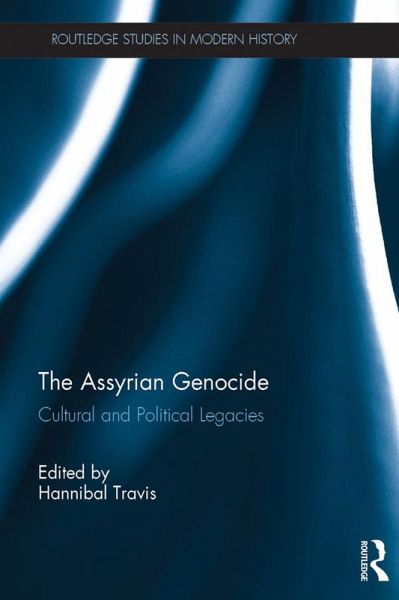
For a brief period, the attention of the international community has focused once again on the plight of religious minorities in Iraq, Syria, and Turkey. In particular, the abductions and massacres of Yezidis and Assyrians in the Sinjar, Mosul, Nineveh Plains, Baghdad, and Hasakah regions in 2007-2015 raised questions about the prevention of genocide. This book, while principally analyzing the Assyrian genocide of 1914-1925 and its implications for the culture and politics of the region, also raises broader questions concerning the future of religious diversity in the Middle East. It gathers and analyzes the findings of a broad spectrum of historical and scholarly works on Christian identities in the Middle East, genocide studies, international law, and the politics of the late Ottoman Empire, as well as the politics of the Ottomans' British and Russian rivals for power in western Asia and the eastern Mediterranean basin.
A key question the book raises is whether the fate of the Assyrians maps onto any of the concepts used within international law and diplomatic history to study genocide and group violence. In this light, the Assyrian genocide stands out as being several times larger, in both absolute terms and relative to the size of the affected group, than the Srebrenica genocide, which is recognized by Turkey as well as by international tribunals and organizations. Including its Armenian and Greek victims, the Ottoman Christian Genocide rivals the Rwandan, Bengali, and Biafran genocides. The book also aims to explore the impact of the genocide period of 1914-1925 on the development or partial unraveling of Assyrian group cohesion, including aspirations to autonomy in the Assyrian areas of northern Iraq, northwestern Iran, and southeastern Turkey. Scholars from around the world have collaborated to approach these research questions by reference to diplomatic and political archives, international legal materials, memoirs, and literary works.
A key question the book raises is whether the fate of the Assyrians maps onto any of the concepts used within international law and diplomatic history to study genocide and group violence. In this light, the Assyrian genocide stands out as being several times larger, in both absolute terms and relative to the size of the affected group, than the Srebrenica genocide, which is recognized by Turkey as well as by international tribunals and organizations. Including its Armenian and Greek victims, the Ottoman Christian Genocide rivals the Rwandan, Bengali, and Biafran genocides. The book also aims to explore the impact of the genocide period of 1914-1925 on the development or partial unraveling of Assyrian group cohesion, including aspirations to autonomy in the Assyrian areas of northern Iraq, northwestern Iran, and southeastern Turkey. Scholars from around the world have collaborated to approach these research questions by reference to diplomatic and political archives, international legal materials, memoirs, and literary works.
Dieser Download kann aus rechtlichen Gründen nur mit Rechnungsadresse in A, B, BG, CY, CZ, D, DK, EW, E, FIN, F, GR, HR, H, IRL, I, LT, L, LR, M, NL, PL, P, R, S, SLO, SK ausgeliefert werden.