42,95 €
42,95 €
inkl. MwSt.
Sofort per Download lieferbar

21 °P sammeln
42,95 €
Als Download kaufen
42,95 €
inkl. MwSt.
Sofort per Download lieferbar
21 °P sammeln
Jetzt verschenken
Alle Infos zum eBook verschenken
42,95 €
inkl. MwSt.
Sofort per Download lieferbar
Alle Infos zum eBook verschenken
21 °P sammeln

Andere Kunden interessierten sich auch für
") The Autonomous Individual (eBook, PDF)42,95 €
The Autonomous Individual (eBook, PDF)42,95 €") Autonomy, Enactivism, and Mental Disorder (eBook, ePUB)39,95 €
Autonomy, Enactivism, and Mental Disorder (eBook, ePUB)39,95 €") The Routledge Handbook of Social Epistemology (eBook, ePUB)46,95 €
The Routledge Handbook of Social Epistemology (eBook, ePUB)46,95 €") Authority and the Metaphysics of Political Communities (eBook, ePUB)42,95 €
Authority and the Metaphysics of Political Communities (eBook, ePUB)42,95 €") Law, Human Agency and Autonomic Computing (eBook, ePUB)51,95 €
Law, Human Agency and Autonomic Computing (eBook, ePUB)51,95 €") The Philosophy of Group Polarization (eBook, ePUB)39,95 €
The Philosophy of Group Polarization (eBook, ePUB)39,95 €") The Network Self (eBook, ePUB)42,95 €
The Network Self (eBook, ePUB)42,95 €



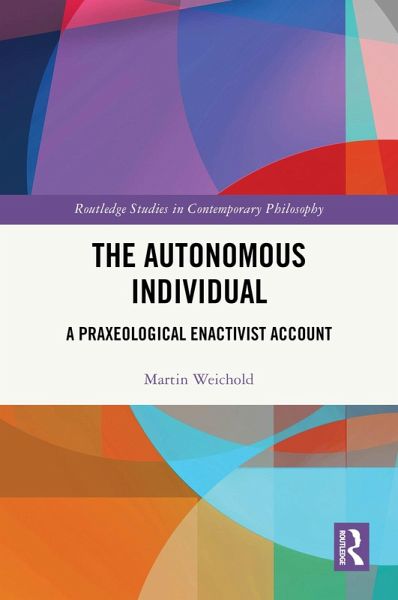
This book advances a new theory of what it means to be an autonomous individual with free will and an authentic self. It synthesizes the new "action turn" from 4E cognitive science with the new "practice turn" from the social sciences to develop a new perspective on our self-interpretation as autonomous individuals.
Our entire life is built upon one central foundation: the idea that we human beings are autonomous individuals. While this idea is presupposed in some academic fields, such as law and moral philosophy, it is challenged or denied in others. This book aims to move beyond debates about whether free will exists. Instead, it proposes that the idea that human beings are autonomous individuals is a culturally developed self-interpretation that is permanently enacted in social practices. Parts of it describe biological reality correctly, parts are social reality, and parts are mere fictions. This view - which the author calls "praxeological enactivism" - combines work from enactive cognitive science with practice theory from the social sciences. The book concludes by discussing the ethical advantages and dangers of the idea of the autonomous individual.
The Autonomous Individual will appeal to philosophers working on free will and autonomy, moral philosophy, and philosophy of social sciences, as well as scholars and advanced students in disciplines such as cognitive science, sociology, cultural theory, and philosophical anthropology.
Our entire life is built upon one central foundation: the idea that we human beings are autonomous individuals. While this idea is presupposed in some academic fields, such as law and moral philosophy, it is challenged or denied in others. This book aims to move beyond debates about whether free will exists. Instead, it proposes that the idea that human beings are autonomous individuals is a culturally developed self-interpretation that is permanently enacted in social practices. Parts of it describe biological reality correctly, parts are social reality, and parts are mere fictions. This view - which the author calls "praxeological enactivism" - combines work from enactive cognitive science with practice theory from the social sciences. The book concludes by discussing the ethical advantages and dangers of the idea of the autonomous individual.
The Autonomous Individual will appeal to philosophers working on free will and autonomy, moral philosophy, and philosophy of social sciences, as well as scholars and advanced students in disciplines such as cognitive science, sociology, cultural theory, and philosophical anthropology.
Dieser Download kann aus rechtlichen Gründen nur mit Rechnungsadresse in A, B, BG, CY, CZ, D, DK, EW, E, FIN, F, GR, HR, H, IRL, I, LT, L, LR, M, NL, PL, P, R, S, SLO, SK ausgeliefert werden.
"This is an impressive and outstanding work in interdisciplinary scholarship on a topic that goes to the heart of what both human individuality and sociality are about. Original, constructive, carefully argued and with a rare devotion to readability."
Jan-Christoph Marschelke, University of Regensburg, Germany
Jan-Christoph Marschelke, University of Regensburg, Germany