Sie sind bereits eingeloggt. Klicken Sie auf 2. tolino select Abo, um fortzufahren.
Bitte loggen Sie sich zunächst in Ihr Kundenkonto ein oder registrieren Sie sich bei bücher.de, um das eBook-Abo tolino select nutzen zu können.
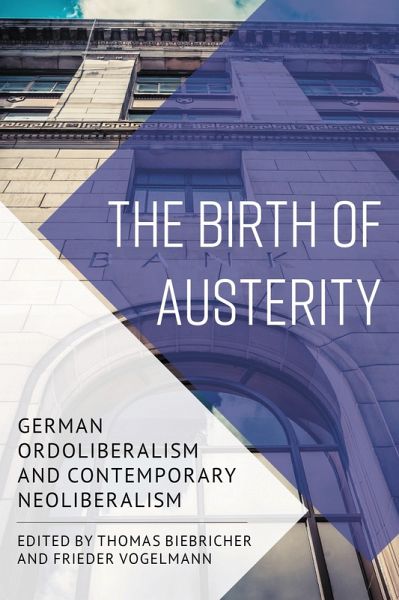
Ordoliberalism and the 'Freiburg School' have gained traction in contemporary political economy in response to two factors: a rising interest in governmentality studies and the banking, financial and sovereign debt crisis in Europe. In the face of these crises, Germany has assumed a position of quasi-hegemony in the European Union, making decisions about bailouts, the politics of crisis management and the rise of austerity. This volume gathers together English translations of seminal ordoliberal texts by thinkers ranging from Walter Eucken and Wilhelm Röpke to Franz Böhm, Alexander Rüstow and…mehr
Ordoliberalism and the 'Freiburg School' have gained traction in contemporary political economy in response to two factors: a rising interest in governmentality studies and the banking, financial and sovereign debt crisis in Europe. In the face of these crises, Germany has assumed a position of quasi-hegemony in the European Union, making decisions about bailouts, the politics of crisis management and the rise of austerity. This volume gathers together English translations of seminal ordoliberal texts by thinkers ranging from Walter Eucken and Wilhelm Röpke to Franz Böhm, Alexander Rüstow and Hans Grossmann-Doerth. Offering some foundational insights into ordoliberalism, these essays give insight into a field that is much misunderstood outside Germany. The second half of the book comprises of analyses of contemporary issues in light of ordoliberal thought, showing how its ideas endure and relate directly to austerity policy across Europe.
Die Herstellerinformationen sind derzeit nicht verfügbar.
Autorenporträt
Thomas Biebricher is Professor of Political Theory and Philosophy at the Goethe-Universität. Frieder Vogelmann is a Research Fellow in Political Theory at the Institute for Intercultural and International Studies, Bremen University.
Inhaltsangabe
Introduction Part I: Sources 1. The Ordo Manifesto of 1936 , Walter Eucken, Franz Böhm and Hans Grossmann-Doerth 2. Structural Transformations of the State and the Crisis of Capitalism , Walter Eucken 3. The Different Types of Economic System, Walter Eucken 4. Competition as the Basic Principle of the Economic Constitution, Walter Eucken 5. Principles of Economic Policy, Walter Eucken 6. Economic Ordering as a Problem of Economic Policy and a Problem of the Economic Constitution, Franz Böhm 7. Decartelization and De-concentration: A Problem for Specialists or a fateful Question?, Franz Böhm 8. State Policy and the Necessary Conditions for Economic Liberalism , Alexander Rüstow 9. General Sociological Causes of the Economic Disintegration and Possibilities of Reconstruction, Alexander Rüstow 10. Social Policy or Vitalpolitik (Organic Policy), Alexander Rüstow Part II: Analyses 11. Ordoliberalism as Governmentality, Johanna Oksala 12. Europe after Ordoliberalism: A Philippic, Christia
Es gelten unsere Allgemeinen Geschäftsbedingungen: www.buecher.de/agb
Impressum
www.buecher.de ist ein Internetauftritt der buecher.de internetstores GmbH
Geschäftsführung: Monica Sawhney | Roland Kölbl | Günter Hilger
Sitz der Gesellschaft: Batheyer Straße 115 - 117, 58099 Hagen
Postanschrift: Bürgermeister-Wegele-Str. 12, 86167 Augsburg
Amtsgericht Hagen HRB 13257
Steuernummer: 321/5800/1497
USt-IdNr: DE450055826