42,95 €
42,95 €
inkl. MwSt.
Erscheint vor. 22.01.26

21 °P sammeln
42,95 €
Als Download kaufen
42,95 €
inkl. MwSt.
Erscheint vor. 22.01.26
21 °P sammeln
Jetzt verschenken
Alle Infos zum eBook verschenken
42,95 €
inkl. MwSt.
Erscheint vor. 22.01.26
Alle Infos zum eBook verschenken
21 °P sammeln

Andere Kunden interessierten sich auch für
") The Braking Mechanism in Mao-era Politics (eBook, PDF)42,95 €
The Braking Mechanism in Mao-era Politics (eBook, PDF)42,95 €") Xi Jinping (eBook, ePUB)36,95 €
Xi Jinping (eBook, ePUB)36,95 €") Xi Jinping's Anticorruption Campaign (eBook, ePUB)39,95 €
Xi Jinping's Anticorruption Campaign (eBook, ePUB)39,95 €") China in the Age of Xi Jinping (eBook, ePUB)42,95 €
China in the Age of Xi Jinping (eBook, ePUB)42,95 € (eBook, ePUB)") The Transition to Socialism in China (Routledge Revivals) (eBook, ePUB)24,95 €
The Transition to Socialism in China (Routledge Revivals) (eBook, ePUB)24,95 €") Local Elites in Post-Mao China (eBook, ePUB)43,95 €
Local Elites in Post-Mao China (eBook, ePUB)43,95 €") China's Role in World Affairs (eBook, ePUB)52,95 €
China's Role in World Affairs (eBook, ePUB)52,95 €
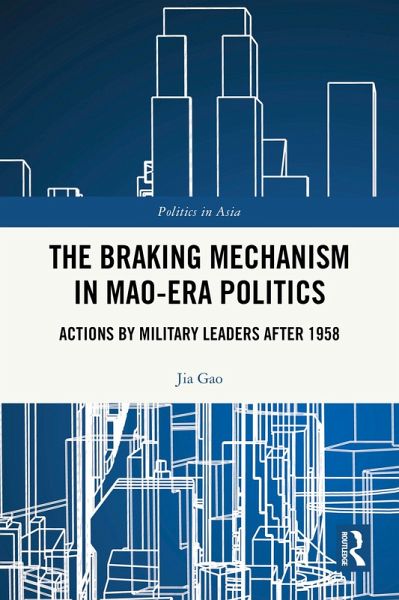
This book offers a compelling re-examination of Mao Zedong's political authority, giving readers a clear understanding and full picture of Mao, the politics of his era and the political life of the CCP.
The widespread view holds that Mao was an authoritarian leader, enjoying what was called absolute leadership authority. This book reveals that in fact from the late 1950s onwards, the CCP leadership was deeply fractured, during a period when China's internal political and economic dynamics and its external existential conditions were very complex. By analysing four major interconnected challenges to Mao's governing decisions and leadership imposed by senior military leaders from the late 1950s to the mid-1970s, the book introduces the concept of a braking mechanism within the CCP during Mao's era, preventing the newly created PRC and its resource distribution rules and patterns from collapse.
Including in-depth textual analysis of documentary sources while contributing to the debate about Mao's authority and political power, this book will be a valuable resource for students and scholars of modern Chinese history and political science.
The widespread view holds that Mao was an authoritarian leader, enjoying what was called absolute leadership authority. This book reveals that in fact from the late 1950s onwards, the CCP leadership was deeply fractured, during a period when China's internal political and economic dynamics and its external existential conditions were very complex. By analysing four major interconnected challenges to Mao's governing decisions and leadership imposed by senior military leaders from the late 1950s to the mid-1970s, the book introduces the concept of a braking mechanism within the CCP during Mao's era, preventing the newly created PRC and its resource distribution rules and patterns from collapse.
Including in-depth textual analysis of documentary sources while contributing to the debate about Mao's authority and political power, this book will be a valuable resource for students and scholars of modern Chinese history and political science.
Dieser Download kann aus rechtlichen Gründen nur mit Rechnungsadresse in A, B, BG, CY, CZ, D, DK, EW, E, FIN, F, GR, HR, H, IRL, I, LT, L, LR, M, NL, PL, P, R, S, SLO, SK ausgeliefert werden.