Sie sind bereits eingeloggt. Klicken Sie auf 2. tolino select Abo, um fortzufahren.
Bitte loggen Sie sich zunächst in Ihr Kundenkonto ein oder registrieren Sie sich bei bücher.de, um das eBook-Abo tolino select nutzen zu können.
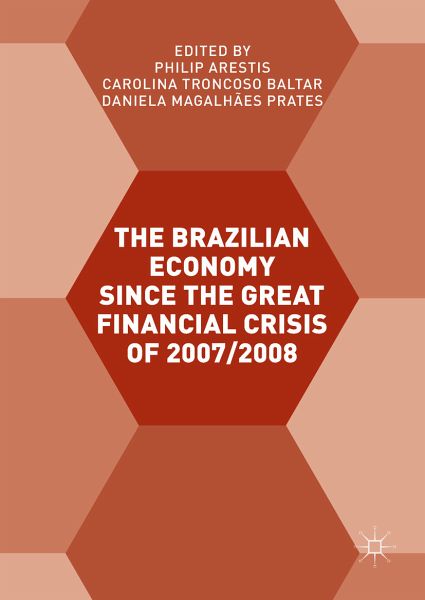
Thoroughly examines diverse aspects of the contemporary Brazilian economic context Gives exposure to the heterodox line of economic thinking in Brazilian economics Empirically analyses complexity of economic recessions and recovery in past ten years
Thoroughly examines diverse aspects of the contemporary Brazilian economic context
Gives exposure to the heterodox line of economic thinking in Brazilian economics
Empirically analyses complexity of economic recessions and recovery in past ten years
Dieser Download kann aus rechtlichen Gründen nur mit Rechnungsadresse in A, B, BG, CY, CZ, D, DK, EW, E, FIN, F, GR, HR, H, IRL, I, LT, L, LR, M, NL, PL, P, R, S, SLO, SK ausgeliefert werden.
Die Herstellerinformationen sind derzeit nicht verfügbar.
Autorenporträt
Philip Arestis is Professor and Director of Research at the Cambridge Centre for Economics and Public Policy, Department of Land Economy, University of Cambridge, UK, and Professor at the Department of Applied Economics, University of the Basque Country, Spain. He is also Distinguished Adjunct Professor of Economics at the University of Utah, USA, and Research Associate at the Levy Economics Institute, USA. He previously served as Chief Academic (External) Adviser to the UK Government Economic Service (GES) on Professional Development in Economics. He is holder of the Queen Victoria Eugenia award of the British Hispanic Chair of Doctoral Studies, and was awarded homage by the Brazilian Keynesian Association (AKB) for his contribution to the spread of Keynesianism in Brazil. He has published a number of books and papers in academic journals. Carolina Troncoso Baltar is Associate Professor at the Institute of Economics, University of Campinas, Brazil, and research er at the Centre of Industrial and Technological Economics (NEIT). She holds a PhD degree, Land Economy, University of Cambridge, UK. She was a visiting fellow at the East China Normal University, Shanghai, China, and was a lecturer at the Global Supply Chain, online course, organized by the Global Labour University and International Labour Organization. She has published as sole author and co-author papers in academic journals (such as Cambridge Journal of Economics, Journal of Economic Studies and Panoeconomicus) and book chapters and has produced research reports for research institutes. Her main areas of research are Macroeconomics, International Economics, External Trade and Industrial Economics. Daniela Magalhães Prates is Associate Professor at the Institute of Economics of the University of Campinas and senior researcher at the Brazilian National Council for Scientific and Technological Development (CNPq). She was visiting professo r at Université Paris 13, Freie Universität/Berlin, HTW/Berlin and University of Pretoria. From September 2016 to June 2017, she has been visiting scholar at the Department of Land Economy, University of Cambridge. She has published many papers in academic journals (such as Journal of Post Keynesian Economics, International Review of Applied Economics and Monthly Review) and book chapters. Her main areas of research are International Economics and Open Macroeconomics with focus on monetary and financial issues and emerging economies.
Inhaltsangabe
Chapter 1: The Brazilian Economy Downhill: Assessing the Debate from a Keynesian-Structuralist Perspective.- Chapter 2: Monetary Institutions and Macroeconomic Performance in Brazil after the Inflation Targeting Regime: Theoretical Aspects and Empirical Evidence.- Chapter 3: Asymmetric Exchange Rate Pass-Through: Evidence and Policy Implications for Brazil (1999-2013).- Chapter 4: External Vulnerability of the Brazilian Economy since the Great Global Crisis: New Features in a Turbulent World.- Chapter 5: Brazilian Industry: Recent Performance and Future Challenges.- Chapter 6: Financialization and Investment Behaviour among Non-Financial Corporations in Brazil since the Global Crisis.- Chapter 7: Income Distribution, Productivity and Economic Growth: Empirical Evidence in the Case of Brazil.- Chapter 8: Brazil's Fiscal Policy in Perspective: From Expansion to Austerity.- Chapter 9: Social Policy under Stress: Major Shifts after the Crisis.- Chapter 10: The Impact of the Great FinancialCrisis on the Brazilian Stock Market.- Chapter 11: Foreign Exchange Derivatives, Banking Competition and Financial Fragility in Brazil.-
Chapter 1: The Brazilian Economy Downhill: Assessing the Debate from a Keynesian-Structuralist Perspective.- Chapter 2: Monetary Institutions and Macroeconomic Performance in Brazil after the Inflation Targeting Regime: Theoretical Aspects and Empirical Evidence.- Chapter 3: Asymmetric Exchange Rate Pass-Through: Evidence and Policy Implications for Brazil (1999-2013).- Chapter 4: External Vulnerability of the Brazilian Economy since the Great Global Crisis: New Features in a Turbulent World.- Chapter 5: Brazilian Industry: Recent Performance and Future Challenges.- Chapter 6: Financialization and Investment Behaviour among Non-Financial Corporations in Brazil since the Global Crisis.- Chapter 7: Income Distribution, Productivity and Economic Growth: Empirical Evidence in the Case of Brazil.- Chapter 8: Brazil's Fiscal Policy in Perspective: From Expansion to Austerity.- Chapter 9: Social Policy under Stress: Major Shifts after the Crisis.- Chapter 10: The Impact of the Great FinancialCrisis on the Brazilian Stock Market.- Chapter 11: Foreign Exchange Derivatives, Banking Competition and Financial Fragility in Brazil.-
Es gelten unsere Allgemeinen Geschäftsbedingungen: www.buecher.de/agb
Impressum
www.buecher.de ist ein Internetauftritt der buecher.de internetstores GmbH
Geschäftsführung: Monica Sawhney | Roland Kölbl | Günter Hilger
Sitz der Gesellschaft: Batheyer Straße 115 - 117, 58099 Hagen
Postanschrift: Bürgermeister-Wegele-Str. 12, 86167 Augsburg
Amtsgericht Hagen HRB 13257
Steuernummer: 321/5800/1497
USt-IdNr: DE450055826