42,95 €
inkl. MwSt.
Sofort per Download lieferbar
21 °P sammeln

Andere Kunden interessierten sich auch für
") The British Conservative Party (eBook, ePUB)42,95 €
The British Conservative Party (eBook, ePUB)42,95 €") Inside the Black Box of 'White Backlash' (eBook, PDF)41,95 €
Inside the Black Box of 'White Backlash' (eBook, PDF)41,95 €") The Conservative Party and the Destruction of Selective Education in Post-War Britain (eBook, PDF)24,95 €
The Conservative Party and the Destruction of Selective Education in Post-War Britain (eBook, PDF)24,95 €") Margaret Thatcher, the Conservative Party and the Northern Ireland Conflict, 1975-1990 (eBook, PDF)25,95 €
Margaret Thatcher, the Conservative Party and the Northern Ireland Conflict, 1975-1990 (eBook, PDF)25,95 €") The Discourse of Repatriation in Britain, 1845-2016 (eBook, PDF)42,95 €
The Discourse of Repatriation in Britain, 1845-2016 (eBook, PDF)42,95 €") Intellectual Conservatism (eBook, PDF)45,95 €
Intellectual Conservatism (eBook, PDF)45,95 €") Power and Political Economy from Thatcher to Blair (eBook, PDF)41,95 €
Power and Political Economy from Thatcher to Blair (eBook, PDF)41,95 €



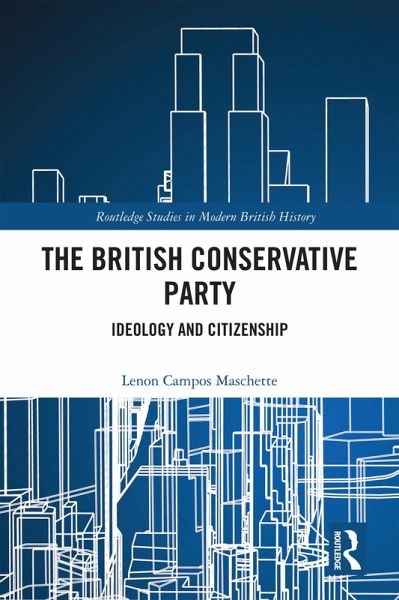
Citizenship has been an ill-explored subject within Conservative Party studies. When this subject has been analysed, it is usually made by scholars of citizenship, more concerned with general overviews than understanding specific Conservative approaches to the concept. This book intends to fill this gap.
Through a rigorous analysis of sources, the author explores how the Conservative Party contested the welfare model of citizenship and sought to recreate a new relationship between the individual, the state and civil society. Starting from Thatcher's idea of 'active citizenship' and going through the analysis of John Major's 'Citizen's Charter' and David Cameron's 'Big Society' project, the book sheds new light on how these developments responded to long-term problems while dialoguing with specific circumstances and the different Conservative leaders' ideas.
From an ideological perspective, the author analyses how these leaders echoed and re-signified more traditional political ideas and ideologies while negotiating with and borrowing new flourishing concepts during those years. Far from being a unidimensional citizenship concept, in reinterpreting old ideas and utilizing new ones, these Conservatives elaborated a complex and many times contradictory citizenship model that tried to address both long-lasting and more timely issues that overlapped in British society.
Through a rigorous analysis of sources, the author explores how the Conservative Party contested the welfare model of citizenship and sought to recreate a new relationship between the individual, the state and civil society. Starting from Thatcher's idea of 'active citizenship' and going through the analysis of John Major's 'Citizen's Charter' and David Cameron's 'Big Society' project, the book sheds new light on how these developments responded to long-term problems while dialoguing with specific circumstances and the different Conservative leaders' ideas.
From an ideological perspective, the author analyses how these leaders echoed and re-signified more traditional political ideas and ideologies while negotiating with and borrowing new flourishing concepts during those years. Far from being a unidimensional citizenship concept, in reinterpreting old ideas and utilizing new ones, these Conservatives elaborated a complex and many times contradictory citizenship model that tried to address both long-lasting and more timely issues that overlapped in British society.
Dieser Download kann aus rechtlichen Gründen nur mit Rechnungsadresse in A, B, BG, CY, CZ, D, DK, EW, E, FIN, F, GR, HR, H, IRL, I, LT, L, LR, M, NL, PL, P, R, S, SLO, SK ausgeliefert werden.
"Lenon Maschette's study shows how understandings of the individual, civil society and the state have developed in Britain since the Thatcherite critique of the post-war view of citizenship. Based on extensive research and packed with insightful commentary, Maschette's book is a very welcome reminder of the importance of this under-researched subject, as well as a valuable contribution to the more general literature on Thatcherism and its aftermath."
- Dr. Mark Garnett, Professor of Politis, Lancaster University
"In this fascinating book, Lenon Maschette traces how the Conservatives have understood and sought to redefine the notion of citizenship in Britain over the past five decades. It throws new light on the intellectual influences and debates that have shaped Conservative efforts to transform the relationship between the state and civil society, revealing that there is a lot more to this story than simply the rise of individualism. The volume is an important addition to the literature on the Conservative Party and provides a valuable reference point for future work in this field."
- Dr Richard Hayton, Associate Professor of Politics, University of Leeds
"An ambitious and wide-ranging work - unusual in its willingness to take the social thought of the modern Conservative Party seriously. It will force many readers to rethink their assumptions and its important arguments will be of interest to all those studying recent British politics."
- Dr. Richard Vinen, Professor in History, King's College London
- Dr. Mark Garnett, Professor of Politis, Lancaster University
"In this fascinating book, Lenon Maschette traces how the Conservatives have understood and sought to redefine the notion of citizenship in Britain over the past five decades. It throws new light on the intellectual influences and debates that have shaped Conservative efforts to transform the relationship between the state and civil society, revealing that there is a lot more to this story than simply the rise of individualism. The volume is an important addition to the literature on the Conservative Party and provides a valuable reference point for future work in this field."
- Dr Richard Hayton, Associate Professor of Politics, University of Leeds
"An ambitious and wide-ranging work - unusual in its willingness to take the social thought of the modern Conservative Party seriously. It will force many readers to rethink their assumptions and its important arguments will be of interest to all those studying recent British politics."
- Dr. Richard Vinen, Professor in History, King's College London