44,95 €
inkl. MwSt.
Sofort per Download lieferbar
22 °P sammeln

Andere Kunden interessierten sich auch für
") The British Atlantic Empire Before the American Revolution (eBook, PDF)0,00 €
The British Atlantic Empire Before the American Revolution (eBook, PDF)0,00 €") The Evolution of Operational Art, 1740-1813 (eBook, PDF)54,95 €
The Evolution of Operational Art, 1740-1813 (eBook, PDF)54,95 €") The Compass of Irony (eBook, PDF)30,95 €
The Compass of Irony (eBook, PDF)30,95 €") War, the Holocaust and Stalinism (eBook, PDF)48,95 €
War, the Holocaust and Stalinism (eBook, PDF)48,95 €") The Women's Suffrage Movement in Britain and Ireland (eBook, PDF)46,95 €
The Women's Suffrage Movement in Britain and Ireland (eBook, PDF)46,95 €") The Neville Chamberlain Diary Letters (eBook, PDF)42,95 €
The Neville Chamberlain Diary Letters (eBook, PDF)42,95 €") The Three Romes (eBook, PDF)46,95 €
The Three Romes (eBook, PDF)46,95 €





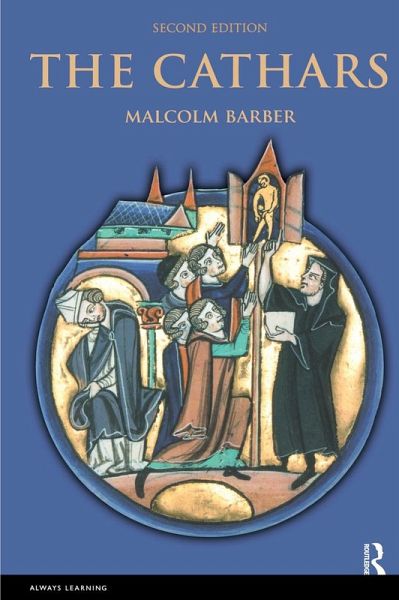
In the second half of the twelfth century, the Catholic Church became convinced that dualist heresy was taking root within Christian society and that it was particularly strong in southern France. The nature and extent of this heresy and the reaction of the Church to the perceived threat have been the focus of extensive research since the mid-nineteenth century, research which has become especially intense in the last decade.
Malcolm Barber's second edition of The Cathars (which first appeared in 2000) brings readers up-to-date with the challenges to previous conclusions of recent scholarship. At the same time, the wider implications of the subject remain relevant, most importantly the fundamental questions raised by the belief in the existence of evil, the ethical problems presented by the use of coercion to suppress forms of dissent believed to threaten the social and religious fabric, and the distortion of the past to underpin present-day policies and arguments.
Malcolm Barber's second edition of The Cathars (which first appeared in 2000) brings readers up-to-date with the challenges to previous conclusions of recent scholarship. At the same time, the wider implications of the subject remain relevant, most importantly the fundamental questions raised by the belief in the existence of evil, the ethical problems presented by the use of coercion to suppress forms of dissent believed to threaten the social and religious fabric, and the distortion of the past to underpin present-day policies and arguments.
Dieser Download kann aus rechtlichen Gründen nur mit Rechnungsadresse in A, B, BG, CY, CZ, D, DK, EW, E, FIN, F, GR, HR, H, IRL, I, LT, L, LR, M, NL, PL, P, R, S, SLO, SK ausgeliefert werden.
This book is beautifully written. While it is, generally, a work of synthesis, the sources have been read afresh in the context of recent research. Barber's cool common sense gives a chance to see the religion and the society in which it became rooted in a new light. Highly recommended, but it will disappoint romantics.
Jonathan Riley-Smith, Times Higher Educational Supplement
The book is especially notable for its careful and sensitive attempt to see the Cathars and their beliefs in a concrete, localised context. The author has done his homework on the regional geography and topography of Languedoc to good effect; the location, role and significance of the castrum, or fortified village, which made Catharism as much a rural as an urban heresy, is particularly well set out.
Malcolm Vale, English Historical Review
Jonathan Riley-Smith, Times Higher Educational Supplement
The book is especially notable for its careful and sensitive attempt to see the Cathars and their beliefs in a concrete, localised context. The author has done his homework on the regional geography and topography of Languedoc to good effect; the location, role and significance of the castrum, or fortified village, which made Catharism as much a rural as an urban heresy, is particularly well set out.
Malcolm Vale, English Historical Review