0,49 €
inkl. MwSt.
Sofort per Download lieferbar
0 °P sammeln

Andere Kunden interessierten sich auch für
") The Charwoman's Daughter (eBook, ePUB)1,99 €
The Charwoman's Daughter (eBook, ePUB)1,99 €") THE STOLEN BACILLUS AND OTHER INCIDENTS - 15 Tales in One Edition (eBook, ePUB)1,99 €
THE STOLEN BACILLUS AND OTHER INCIDENTS - 15 Tales in One Edition (eBook, ePUB)1,99 €") The Stolen Bacillus and Other Incidents (eBook, ePUB)1,99 €
The Stolen Bacillus and Other Incidents (eBook, ePUB)1,99 €") The Midwich Cuckoos (eBook, ePUB)8,99 €
The Midwich Cuckoos (eBook, ePUB)8,99 €") The Island of Doctor Moreau (eBook, ePUB)0,90 €
The Island of Doctor Moreau (eBook, ePUB)0,90 €") The War of the Worlds (eBook, ePUB)1,99 €
The War of the Worlds (eBook, ePUB)1,99 €") The Island of Doctor Moreau (eBook, ePUB)3,99 €
The Island of Doctor Moreau (eBook, ePUB)3,99 €


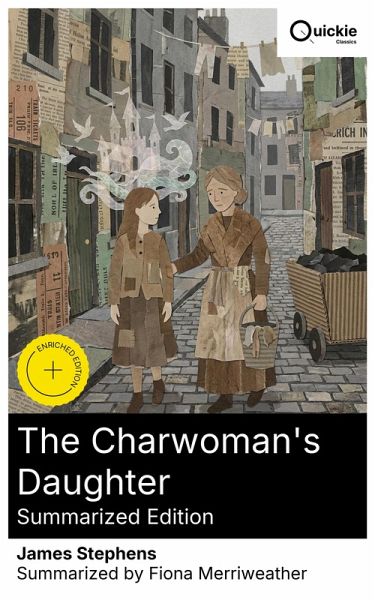
Set amid early-twentieth-century Dublin's tenements, The Charwoman's Daughter follows Mary Makebelieve, a charwoman's child whose dutiful love for her mother and tentative romance awaken a fierce, imaginative resilience. Stephens blends fable and urban realism: the streets seem animate, yet the material pressures of hunger, work, and respectability remain palpable. Situated between the Celtic Twilight and the emerging documentary impulse of Dubliners, the novel's musical sentences, gentle irony, and sudden visionary turns probe class, gendered vulnerability, and the ethics of care without lapsing into mawkishness. James Stephens, Dublin-born poet and novelist, knew the city's speech and privations first-hand and absorbed the Irish Revival's faith in vernacular myth. Mentored by A. E. (George Russell) and trained by clerical work and journalism, he honed an ear for ordinary cadence; this book channels that apprenticeship into a humane portrait where imaginative consolation confronts civic constraint. Recommended to readers of Joyce and Yeats alike, this compact masterpiece offers a lyrical, unsentimental window onto working-class Dublin and a moving study of a young woman's dignity under pressure. Quickie Classics summarizes timeless works with precision, preserving the author's voice and keeping the prose clear, fast, and readable-distilled, never diluted. Enriched Edition extras: Introduction · Synopsis · Historical Context · Brief Analysis · 4 Reflection Q&As · Editorial Footnotes.
Dieser Download kann aus rechtlichen Gründen nur mit Rechnungsadresse in A, B, BG, CY, CZ, D, DK, EW, FIN, F, GR, H, IRL, I, LT, L, LR, M, NL, PL, P, R, S, SLO, SK ausgeliefert werden.