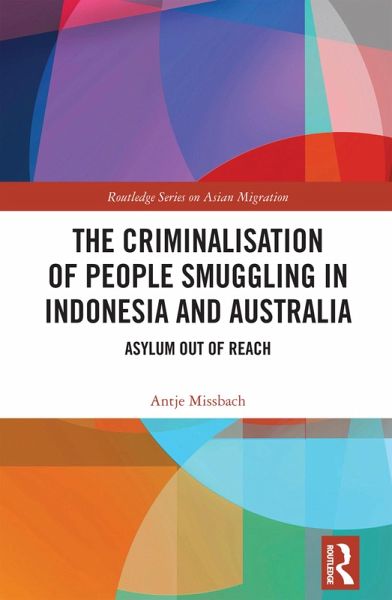
41,95 €
41,95 €
inkl. MwSt.
Sofort per Download lieferbar

21 °P sammeln
41,95 €
Als Download kaufen
41,95 €
inkl. MwSt.
Sofort per Download lieferbar
21 °P sammeln
Jetzt verschenken
Alle Infos zum eBook verschenken
41,95 €
inkl. MwSt.
Sofort per Download lieferbar
Alle Infos zum eBook verschenken
21 °P sammeln

Andere Kunden interessierten sich auch für
") The Criminalisation of People Smuggling in Indonesia and Australia (eBook, ePUB)41,95 €
The Criminalisation of People Smuggling in Indonesia and Australia (eBook, ePUB)41,95 €") Human-Environment Relations and Politics in Indonesia (eBook, PDF)41,95 €
Human-Environment Relations and Politics in Indonesia (eBook, PDF)41,95 €") Gender, Sexuality and Islam in Contemporary Indonesia (eBook, PDF)39,95 €
Gender, Sexuality and Islam in Contemporary Indonesia (eBook, PDF)39,95 €") Islam, Women's Sexuality and Patriarchy in Indonesia (eBook, PDF)41,95 €
Islam, Women's Sexuality and Patriarchy in Indonesia (eBook, PDF)41,95 €") Women, Media, and Power in Indonesia (eBook, PDF)41,95 €
Women, Media, and Power in Indonesia (eBook, PDF)41,95 €") Antiquities Smuggling in the Real and Virtual World (eBook, PDF)41,95 €
Antiquities Smuggling in the Real and Virtual World (eBook, PDF)41,95 €") Hadrami Arabs in Present-day Indonesia (eBook, PDF)45,95 €
Hadrami Arabs in Present-day Indonesia (eBook, PDF)45,95 €
This book offers an ethnographically informed critique of the hyper-politicised debate on the facilitation of irregularised migration for people seeking asylum between Indonesia and Australia. While state authorities decry such facilitation as "people smuggling" and push for its criminalisation, the book's focal points are the need for unsanctioned passages for people seeking asylum and the detrimental consequences of the criminalisation of "people smuggling" for both the facilitators and the people seeking asylum.
Drawing on court verdicts and interviews with convicted facilitators and law enforcement officials in Indonesia, this book provides a unique and holistic picture of the causes, conditions, procedures and intricacies surrounding the facilitation of irregularised maritime journeys between Indonesia and Australia covering almost four decades. It scrutinises the micro-level operational and place-specific characteristics of people smuggling and the consequences of anti-people-smuggling policies in Indonesia and relates those consequences to changes in the macroenvironment, which include relevant legal, political, social and economic factors that determine the overarching conditions of irregularised mobility. Compared to other states in the Global North, Australia has claimed to be more "successful" with its comprehensive approach to eliminate unsanctioned migration at sea by combining punitive, communicative-reventive and interceptive measures. This book challenges key achievements and objectives in regard to criminalising the facilitation of irregularised migration by foregrounding the many negative side effects that have emanated from "stopping the boats".
The book will be of interest to researchers in the fields of anthropology and sociology, law and criminology, Asia-Pacific Studies, Southeast Asian Studies and international migration.
Drawing on court verdicts and interviews with convicted facilitators and law enforcement officials in Indonesia, this book provides a unique and holistic picture of the causes, conditions, procedures and intricacies surrounding the facilitation of irregularised maritime journeys between Indonesia and Australia covering almost four decades. It scrutinises the micro-level operational and place-specific characteristics of people smuggling and the consequences of anti-people-smuggling policies in Indonesia and relates those consequences to changes in the macroenvironment, which include relevant legal, political, social and economic factors that determine the overarching conditions of irregularised mobility. Compared to other states in the Global North, Australia has claimed to be more "successful" with its comprehensive approach to eliminate unsanctioned migration at sea by combining punitive, communicative-reventive and interceptive measures. This book challenges key achievements and objectives in regard to criminalising the facilitation of irregularised migration by foregrounding the many negative side effects that have emanated from "stopping the boats".
The book will be of interest to researchers in the fields of anthropology and sociology, law and criminology, Asia-Pacific Studies, Southeast Asian Studies and international migration.
Dieser Download kann aus rechtlichen Gründen nur mit Rechnungsadresse in A, B, BG, CY, CZ, D, DK, EW, E, FIN, F, GR, HR, H, IRL, I, LT, L, LR, M, NL, PL, P, R, S, SLO, SK ausgeliefert werden.
"The Criminalisation of People Smuggling is the first comprehensive analysis of the smuggling of transit migrants from Indonesia to Australia and shows how this activity influences the relationship of the two countries. [...] Written in a readable narrative style supported by rich empirical data, this book is essential reading for all those who want to understand the complex nature of refugee issues in both countries. [...] The main strength of this book is the author's analytical framework, which allows Missbach to identify the actors and their roles in unsanctioned passages as well as the infrastructure. [...] Because of its unique perspective, this book can be a useful reflection for states such as Australia and Indonesia and might serve as an incentive to humanise their measures towards migrants. It is also a call for migration scholars to pay more attention to the human consequences of each specific measure imposed by states around the world through micro-level empirical work." - Bilal Dewansyah, Journal of Current Southeast Asian Affairs
"In an era where words such as 'migration' and 'smuggling' spark fierce political debates, public responses and, more often than not, negative media attention, Missbach brings a timely perspective to heated debates in a work that goes behind simplistic labels such as 'smuggler' to put names and stories to the many characters present along irregular migration routes. Her unique positionality, having worked on this subject for a significant period in Indonesia and Australia, adds a historical dimension as to how asylum has become ever more difficult for people in need of protection. Of note are the ways in which invasion angst is contextualised in this book, situated within a historical legacy of structural violence and her reflections on the broader political environment for people seeking asylum. The focus this text brings to the polarising topic of migration is a welcome rejoinder to assumptions about the financial benefits of smuggling and the notion of smugglers as 'big fish' who face no risks for their actions. [...] Perhaps the greatest impact of this book is to call into question the continual way in which smuggling is framed and offer methodologies for similar accounts in other contexts. By humanising the people behind the smuggling label and showing how this system operates in a country of transit, Missbach provides a timely and rich analysis of a feature of migration that regretfully shows no trend of abating in the near future."
- Melissa Phillips, Journal of Intercultural Studies 2023
"Antje Missbach's latest book brings together nearly a decade of empirical research on the interconnections between Indonesian and Australian border policing. In particular, she focuses on the criminalisation of people accused of facilitating irregular journeys between these two countries. A well-constructed and humanising critique of deterrence-based migration regimes, this book will be of interest not only to scholars working on this region, but also more broadly to those interested in the infrastructure of people smuggling networks and state efforts to stop irregular migration."
- Victoria Taylor, Border Criminologies Blog, Oxford University, June 2024
"Antje Missbach considers the actions and motivations of Indonesian people smugglers, those who assist people to make the journey to Australia or elsewhere, comparing these to the actions and motivations of the Australian state. [...] Missbach's book is useful to anyone focused on the refugee journey through the Asia-Pacific region, people smuggling, and Australia's deterrence strategies."
- Zoe Bell, Refuge: Canada's Journal on Refugees. 2024, Vol. 40, No. 2, 1-5
"In an era where words such as 'migration' and 'smuggling' spark fierce political debates, public responses and, more often than not, negative media attention, Missbach brings a timely perspective to heated debates in a work that goes behind simplistic labels such as 'smuggler' to put names and stories to the many characters present along irregular migration routes. Her unique positionality, having worked on this subject for a significant period in Indonesia and Australia, adds a historical dimension as to how asylum has become ever more difficult for people in need of protection. Of note are the ways in which invasion angst is contextualised in this book, situated within a historical legacy of structural violence and her reflections on the broader political environment for people seeking asylum. The focus this text brings to the polarising topic of migration is a welcome rejoinder to assumptions about the financial benefits of smuggling and the notion of smugglers as 'big fish' who face no risks for their actions. [...] Perhaps the greatest impact of this book is to call into question the continual way in which smuggling is framed and offer methodologies for similar accounts in other contexts. By humanising the people behind the smuggling label and showing how this system operates in a country of transit, Missbach provides a timely and rich analysis of a feature of migration that regretfully shows no trend of abating in the near future."
- Melissa Phillips, Journal of Intercultural Studies 2023
"Antje Missbach's latest book brings together nearly a decade of empirical research on the interconnections between Indonesian and Australian border policing. In particular, she focuses on the criminalisation of people accused of facilitating irregular journeys between these two countries. A well-constructed and humanising critique of deterrence-based migration regimes, this book will be of interest not only to scholars working on this region, but also more broadly to those interested in the infrastructure of people smuggling networks and state efforts to stop irregular migration."
- Victoria Taylor, Border Criminologies Blog, Oxford University, June 2024
"Antje Missbach considers the actions and motivations of Indonesian people smugglers, those who assist people to make the journey to Australia or elsewhere, comparing these to the actions and motivations of the Australian state. [...] Missbach's book is useful to anyone focused on the refugee journey through the Asia-Pacific region, people smuggling, and Australia's deterrence strategies."
- Zoe Bell, Refuge: Canada's Journal on Refugees. 2024, Vol. 40, No. 2, 1-5