0,49 €
inkl. MwSt.
Sofort per Download lieferbar
0 °P sammeln

Andere Kunden interessierten sich auch für
") The Devachanic Plane (eBook, ePUB)1,99 €
The Devachanic Plane (eBook, ePUB)1,99 €") The Devachanic Plane (eBook, ePUB)1,99 €
The Devachanic Plane (eBook, ePUB)1,99 €") The Astral Plane (eBook, ePUB)1,99 €
The Astral Plane (eBook, ePUB)1,99 €") The Deeper Christian Life: An Aid to It's Attainment (eBook, ePUB)1,99 €
The Deeper Christian Life: An Aid to It's Attainment (eBook, ePUB)1,99 € (eBook, ePUB)") The Interior Castle (Summarized Edition) (eBook, ePUB)0,49 €
The Interior Castle (Summarized Edition) (eBook, ePUB)0,49 € (eBook, ePUB)") The Autobiography of Madame Guyon (Summarized Edition) (eBook, ePUB)0,49 €
The Autobiography of Madame Guyon (Summarized Edition) (eBook, ePUB)0,49 € (eBook, ePUB)") Mortification of Sin (Summarized Edition) (eBook, ePUB)0,49 €
Mortification of Sin (Summarized Edition) (eBook, ePUB)0,49 €







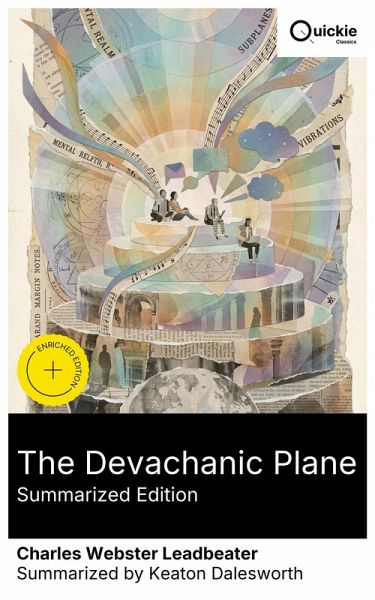
The Devachanic Plane maps the Theosophical mental world, Devachan, as a graded series of seven subplanes where post-mortem consciousness assimilates embodied experience. Leadbeater describes karmic assimilation, the architecture of thought-forms, synesthetic correspondences of color and sound, and the distinction between lower and higher Devachan, situating these states alongside the astral and physical planes. Written in a quasi-empirical register said to derive from trained clairvoyance, it stands within the fin de siecle occult revival and complements his earlier The Astral Plane. Charles Webster Leadbeater (1854-1934), an English clergyman turned Theosophist and collaborator of Annie Besant, pursued occult research under the Society's comparative program of religion, philosophy, and science. His disciplined clairvoyant practice and pedagogical work at Adyar yielded the field-notes distilled here. Drawing on H. P. Blavatsky's cosmogenesis yet seeking finer phenomenology, he aimed to render invisible worlds amenable to methodical description. Recommended to students of Theosophy, comparative religion, and esoteric intellectual history, The Devachanic Plane rewards careful reading. It clarifies the Theosophical interval between death and rebirth and pairs fruitfully with The Astral Plane and Thought-Forms. Quickie Classics summarizes timeless works with precision, preserving the author's voice and keeping the prose clear, fast, and readable-distilled, never diluted. Enriched Edition extras: Introduction · Synopsis · Historical Context · Brief Analysis · 4 Reflection Q&As · Editorial Footnotes.
Dieser Download kann aus rechtlichen Gründen nur mit Rechnungsadresse in A, B, BG, CY, CZ, D, DK, EW, E, FIN, F, GR, H, IRL, I, LT, L, LR, M, NL, PL, P, R, S, SLO, SK ausgeliefert werden.