52,95 €
52,95 €
inkl. MwSt.
Sofort per Download lieferbar

26 °P sammeln
52,95 €
Als Download kaufen
52,95 €
inkl. MwSt.
Sofort per Download lieferbar
26 °P sammeln
Jetzt verschenken
Alle Infos zum eBook verschenken
52,95 €
inkl. MwSt.
Sofort per Download lieferbar
Alle Infos zum eBook verschenken
26 °P sammeln

Andere Kunden interessierten sich auch für
") The Digital Empowerment-Control Nexus (eBook, ePUB)52,95 €
The Digital Empowerment-Control Nexus (eBook, ePUB)52,95 €") Tensions In The U.S.-Mexico Borderlands (eBook, PDF)42,95 €
Tensions In The U.S.-Mexico Borderlands (eBook, PDF)42,95 €") The Italian Diaspora in South Africa (eBook, PDF)15,95 €
The Italian Diaspora in South Africa (eBook, PDF)15,95 €") Language, Labour and Migration (eBook, PDF)45,95 €
Language, Labour and Migration (eBook, PDF)45,95 €") Spatial Planning and the New Localism (eBook, PDF)39,95 €
Spatial Planning and the New Localism (eBook, PDF)39,95 €") Populism and the Crisis of Democracy (eBook, PDF)43,95 €
Populism and the Crisis of Democracy (eBook, PDF)43,95 €") Cities and the Creative Class (eBook, PDF)31,95 €
Cities and the Creative Class (eBook, PDF)31,95 €





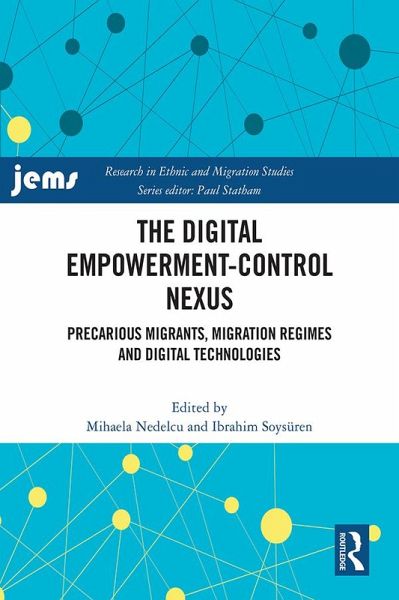
This book analyses the diverse and complex interactions between the emancipatory practices of precarious (i.e. forced, vulnerable, undocumented or deported) migrants enabled by information and communication technologies, and the constraints imposed by technological tools used for surveillance and migration control. It explores the digital empowerment-control nexus by articulating the use of digital technologies - whether by migrants themselves, civil society actors or institutions - with their mediating role in the processes of empowerment, surveillance and migration control.
Based on original empirical studies, the chapters bring contrasting and complementary insights into the use of digital technologies as agentic and/or surveillance tools in different national and supranational contexts (Turkey, Mexico, the United States, Switzerland, France, Romania, Greece and the European Union) and from different disciplinary perspectives (anthropology, sociology, geography, media studies, law and deportation studies). Using different theoretical lenses, they demonstrate the varying degrees of (dis)entanglement between individual and institutional practices, at micro and macro levels.
Helping readers to understand the ambivalent role of digital technologies in (forced) migration processes, The Digital Empowerment-Control Nexus can be used as a resource by students, researchers, practitioners and policymakers interested in digitally mediated migration practices and migration regimes. It was originally published as a special issue of the Journal of Ethnic and Migration Studies.
Based on original empirical studies, the chapters bring contrasting and complementary insights into the use of digital technologies as agentic and/or surveillance tools in different national and supranational contexts (Turkey, Mexico, the United States, Switzerland, France, Romania, Greece and the European Union) and from different disciplinary perspectives (anthropology, sociology, geography, media studies, law and deportation studies). Using different theoretical lenses, they demonstrate the varying degrees of (dis)entanglement between individual and institutional practices, at micro and macro levels.
Helping readers to understand the ambivalent role of digital technologies in (forced) migration processes, The Digital Empowerment-Control Nexus can be used as a resource by students, researchers, practitioners and policymakers interested in digitally mediated migration practices and migration regimes. It was originally published as a special issue of the Journal of Ethnic and Migration Studies.
Dieser Download kann aus rechtlichen Gründen nur mit Rechnungsadresse in A, B, BG, CY, CZ, D, DK, EW, E, FIN, F, GR, HR, H, IRL, I, LT, L, LR, M, NL, PL, P, R, S, SLO, SK ausgeliefert werden.
This collection, edited by Mihaela Nedelcu and Ibrahim Soysüren, promotes a critical and nuanced understanding of the contradictory mediating roles digital technologies play in the lives of migrants. The focus is on mobile subjects who are made precarious as a result of migration regimes, such as forced, vulnerable, undocumented and deported migrants. The articles demonstrate how the "digital empowerment-control nexus" is variously experienced on the ground, contributing to the interdisciplinary research area of digital migration studies by offering conceptual, methodological and empirical means to overcome binary either-or approaches.
- Dr Koen Leurs, Associate Professor in Gender, Media and Migration Studies at the Graduate Gender Program, Department of Media and Culture, Utrecht University, the Netherlands.
- Dr Koen Leurs, Associate Professor in Gender, Media and Migration Studies at the Graduate Gender Program, Department of Media and Culture, Utrecht University, the Netherlands.