46,95 €
46,95 €
inkl. MwSt.
Sofort per Download lieferbar

23 °P sammeln
46,95 €
Als Download kaufen
46,95 €
inkl. MwSt.
Sofort per Download lieferbar
23 °P sammeln
Jetzt verschenken
Alle Infos zum eBook verschenken
46,95 €
inkl. MwSt.
Sofort per Download lieferbar
Alle Infos zum eBook verschenken
23 °P sammeln

Andere Kunden interessierten sich auch für
Subjectivity (eBook, PDF)") The Digitalisation of (Inter)Subjectivity (eBook, PDF)46,95 €
The Digitalisation of (Inter)Subjectivity (eBook, PDF)46,95 €") Routledge International Handbook of Music Psychology in Education and the Community (eBook, ePUB)43,95 €
Routledge International Handbook of Music Psychology in Education and the Community (eBook, ePUB)43,95 €") Identity and Digital Communication (eBook, ePUB)36,95 €
Identity and Digital Communication (eBook, ePUB)36,95 €") Cognitive Neuroscience of Human Systems (eBook, ePUB)61,95 €
Cognitive Neuroscience of Human Systems (eBook, ePUB)61,95 €") Digital Gender-Sexual Violations (eBook, ePUB)32,95 €
Digital Gender-Sexual Violations (eBook, ePUB)32,95 €") Digital Innovation and the Future of Work (eBook, ePUB)42,95 €
Digital Innovation and the Future of Work (eBook, ePUB)42,95 €") T-Group Facilitation (eBook, ePUB)37,95 €
T-Group Facilitation (eBook, ePUB)37,95 €







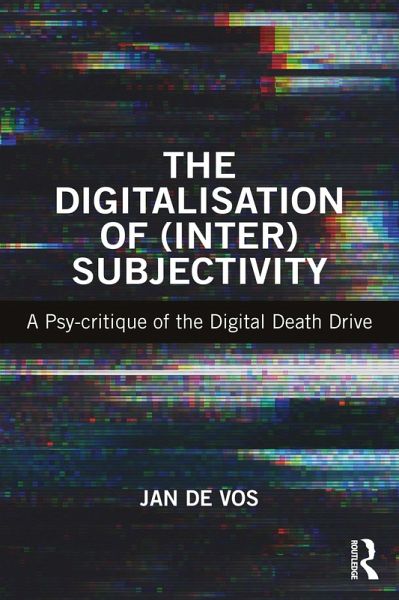
This book explores the responsibility of psychological and neuropsychological perspectives in relation to the digitalisation of inter-subjectivity. It examines how integral their theories and models have been to the development of digital technologies, and by combining theoretical and critical work of leading thinkers, it is a new and highly original perspective on (inter)subjectivity in the digital era.
The book engages with artificial intelligence and cybernetics and the work of Alan Turing, Norbert Wiener, Marvin Minsky, Gregory Bateson, and Warren McCulloch to demonstrate how their use of neuropsy-theories persists in contemporary digital culture. The author aims to trace a trajectory from psychologisation to neurologisation, and finally, to digitalisation, to make us question the digital future of humankind in relation to the idea of subjectivity, and the threat of the 'death-drive' inherent to digitality itself.
This volume is fascinating reading for students and researchers in the fields of critical psychology, neuroscience, education studies, philosophy, media studies, and other related areas.
The book engages with artificial intelligence and cybernetics and the work of Alan Turing, Norbert Wiener, Marvin Minsky, Gregory Bateson, and Warren McCulloch to demonstrate how their use of neuropsy-theories persists in contemporary digital culture. The author aims to trace a trajectory from psychologisation to neurologisation, and finally, to digitalisation, to make us question the digital future of humankind in relation to the idea of subjectivity, and the threat of the 'death-drive' inherent to digitality itself.
This volume is fascinating reading for students and researchers in the fields of critical psychology, neuroscience, education studies, philosophy, media studies, and other related areas.
Dieser Download kann aus rechtlichen Gründen nur mit Rechnungsadresse in A, B, BG, CY, CZ, D, DK, EW, E, FIN, F, GR, HR, H, IRL, I, LT, L, LR, M, NL, PL, P, R, S, SLO, SK ausgeliefert werden.
"One should resist the temptation to proclaim the prospect of a wired brain an illusion, something that we are still far from and that cannot really be actualized: such a view is itself an escape from the threat, from the fact that something new and unheard-of is effectively emerging. Even if it will be realized in a much more modest way than today's grandiose visions of Singularity, everything will change with it. But how will things change? It is here that Jan De Vos points to the role of the mainstream psy-sciences and their simple, cardboard psychological models informing the design of our avatars and 'smart environments'. Are we doomed or is there a prospect for a more emancipatory digital technology? Jan de Vos approaches this question, carefully avoiding the fascination by New Age post-human dreams. His book is simply for everyone who cares about their destiny-if you will ignore it, you will do this at your own risk." -Slavoj Zzk is International Director at Birkbeck Institute for Humanities, Birkbeck College, University of London, and Senior Researcher at the Department of Philosophy, Faculty of Arts, University of Ljubljana, Slovenia
"Jan De Vos's The Digitalisation Of (Inter)Subjectivity provides a trenchant critique of the very terms by which contemporary debates about artificial intelligence and the neurobiological model of the human mind are waged. De Vos shows convincingly that reductive forms of ego psychology ('psychologization') provide the basis for merging machines and human beings in a smooth calculus of late capitalist subjectivity. De Vos throws the sand of psychoanalysis into the well-oiled gears of this machine, providing a stark vision of the human species in the grip of its self-destructive drives. Against this dark picture he offers a renewal of radical left politics that overturns the game board, fractures the screen-based transparencies, and short-circuits the neuralinks that promise utopias of communication and consumer gratification." -W. J. T. Mitchell, editor of Critical Inquiry and author of Iconology, Picture Theory, What Do Pictures Want?, and Image Science, teaches at the University of Chicago, USA
"Jan De Vos's The Digitalisation Of (Inter)Subjectivity provides a trenchant critique of the very terms by which contemporary debates about artificial intelligence and the neurobiological model of the human mind are waged. De Vos shows convincingly that reductive forms of ego psychology ('psychologization') provide the basis for merging machines and human beings in a smooth calculus of late capitalist subjectivity. De Vos throws the sand of psychoanalysis into the well-oiled gears of this machine, providing a stark vision of the human species in the grip of its self-destructive drives. Against this dark picture he offers a renewal of radical left politics that overturns the game board, fractures the screen-based transparencies, and short-circuits the neuralinks that promise utopias of communication and consumer gratification." -W. J. T. Mitchell, editor of Critical Inquiry and author of Iconology, Picture Theory, What Do Pictures Want?, and Image Science, teaches at the University of Chicago, USA