40,95 €
40,95 €
inkl. MwSt.
Sofort per Download lieferbar

20 °P sammeln
40,95 €
Als Download kaufen
40,95 €
inkl. MwSt.
Sofort per Download lieferbar
20 °P sammeln
Jetzt verschenken
Alle Infos zum eBook verschenken
40,95 €
inkl. MwSt.
Sofort per Download lieferbar
Alle Infos zum eBook verschenken
20 °P sammeln

Andere Kunden interessierten sich auch für
") Universal Access in Human-Computer Interaction. Ambient Interaction (eBook, PDF)112,95 €
Universal Access in Human-Computer Interaction. Ambient Interaction (eBook, PDF)112,95 €") Universal Access in Ambient Intelligence Environments (eBook, PDF)40,95 €
Universal Access in Ambient Intelligence Environments (eBook, PDF)40,95 €") Universal Access in Human-Computer Interaction. Applications and Services (eBook, PDF)72,95 €
Universal Access in Human-Computer Interaction. Applications and Services (eBook, PDF)72,95 €") Human-Computer Interaction - INTERACT 2009 (eBook, PDF)112,95 €
Human-Computer Interaction - INTERACT 2009 (eBook, PDF)112,95 €") Human-Computer Interaction. HCI Intelligent Multimodal Interaction Environments (eBook, PDF)112,95 €
Human-Computer Interaction. HCI Intelligent Multimodal Interaction Environments (eBook, PDF)112,95 €") Distributed, Ambient, and Pervasive Interactions (eBook, PDF)40,95 €
Distributed, Ambient, and Pervasive Interactions (eBook, PDF)40,95 €") Engineering Human Computer Interaction and Interactive Systems (eBook, PDF)40,95 €
Engineering Human Computer Interaction and Interactive Systems (eBook, PDF)40,95 €

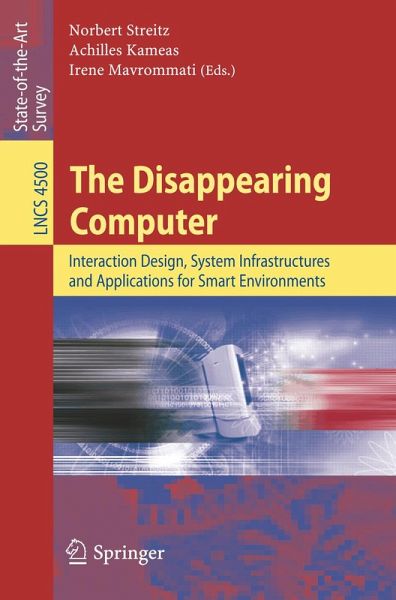
"The-computer-as-we-know-it" will have no role in our future everyday lives. This is the position taken in this book which elaborates how it will be replaced by a new generation of technologies, moving computing off the desktop and ultimately integrating it with real world objects and everyday environments. Computing becomes thus an inseparable part of our everyday activities while simultaneously disappearing into the background. It becomes a ubiquitous utility taking on a role similar to electricity - an enabling but invisible and pervasive medium revealing its functionality on request in an unobtrusive way and supporting people's everyday activities.
As members of the Steering Group of the EU-funded Disappearing Computer research initiative, the editors of this book successfully assembled a collection of 13 elaborate chapters and three forewords that address the issues and challenges in this area. All authors are prominent researchers who set out investigating, developing and deploying future, people-centred smart environments. This book provides a unique combination of concepts, methods and prototypes of ubiquitous and pervasive computing reflecting the current interest in smart environments and ambient intelligence.
Excerpts from the three forewords for the book:
Thierry van der Pyl and Thomas Skordas from the European Commission state that: The Disappearing Computer initiative anticipated and pioneered the concept of ambient intelligence ... and allowed to advance the boundaries of what is possible with the computer today.
Gregory Abowd from GeorgiaTech in the US writes about this research: While substantial progress was shown on the creation of information artefacts, it is the new behaviors and user experiences that promise long-term impact.
Finally, Emile Aarts from Philips Research comments on the relationship of ambient technology and people's behavior: "This current volume undoubtedly provides a majorcontribution to fill up this gap of knowledge."
As members of the Steering Group of the EU-funded Disappearing Computer research initiative, the editors of this book successfully assembled a collection of 13 elaborate chapters and three forewords that address the issues and challenges in this area. All authors are prominent researchers who set out investigating, developing and deploying future, people-centred smart environments. This book provides a unique combination of concepts, methods and prototypes of ubiquitous and pervasive computing reflecting the current interest in smart environments and ambient intelligence.
Excerpts from the three forewords for the book:
Thierry van der Pyl and Thomas Skordas from the European Commission state that: The Disappearing Computer initiative anticipated and pioneered the concept of ambient intelligence ... and allowed to advance the boundaries of what is possible with the computer today.
Gregory Abowd from GeorgiaTech in the US writes about this research: While substantial progress was shown on the creation of information artefacts, it is the new behaviors and user experiences that promise long-term impact.
Finally, Emile Aarts from Philips Research comments on the relationship of ambient technology and people's behavior: "This current volume undoubtedly provides a majorcontribution to fill up this gap of knowledge."
Dieser Download kann aus rechtlichen Gründen nur mit Rechnungsadresse in A, B, BG, CY, CZ, D, DK, EW, E, FIN, F, GR, HR, H, IRL, I, LT, L, LR, M, NL, PL, P, R, S, SLO, SK ausgeliefert werden.
From the reviews:
"The main topic of this book, has been successfully carried out in a variety of settings and activities, such as work environments, health, home, and leisure, to support human collaboration and cooperation. ... The targeted audience is HCI and computer science (CS) specialists who are involved in ubicomp research. Moreover, the book may be useful in HCI, computer-supported collaborative work (CSCW), information technology (IT), and related courses for teaching case studies and the state of the art of ubiquitous computing." (Miguel Garcia Ruiz, Computing Reviews, Vol. 50 (1), January, 2009)
"The main topic of this book, has been successfully carried out in a variety of settings and activities, such as work environments, health, home, and leisure, to support human collaboration and cooperation. ... The targeted audience is HCI and computer science (CS) specialists who are involved in ubicomp research. Moreover, the book may be useful in HCI, computer-supported collaborative work (CSCW), information technology (IT), and related courses for teaching case studies and the state of the art of ubiquitous computing." (Miguel Garcia Ruiz, Computing Reviews, Vol. 50 (1), January, 2009)