42,95 €
42,95 €
inkl. MwSt.
Sofort per Download lieferbar

21 °P sammeln
42,95 €
Als Download kaufen
42,95 €
inkl. MwSt.
Sofort per Download lieferbar
21 °P sammeln
Jetzt verschenken
Alle Infos zum eBook verschenken
42,95 €
inkl. MwSt.
Sofort per Download lieferbar
Alle Infos zum eBook verschenken
21 °P sammeln

Andere Kunden interessierten sich auch für
") The Economics of Sustainable Development and Distribution (eBook, PDF)42,95 €
The Economics of Sustainable Development and Distribution (eBook, PDF)42,95 €") Progressive Policies for Economic Development (eBook, ePUB)21,95 €
Progressive Policies for Economic Development (eBook, ePUB)21,95 €") The Process of Economic Development (eBook, ePUB)61,95 €
The Process of Economic Development (eBook, ePUB)61,95 €") Addicted to Growth (eBook, ePUB)32,95 €
Addicted to Growth (eBook, ePUB)32,95 €") The Sustainable Economics of Elinor Ostrom (eBook, ePUB)41,95 €
The Sustainable Economics of Elinor Ostrom (eBook, ePUB)41,95 €") Emergency Preparedness through Community Cohesion (eBook, ePUB)43,95 €
Emergency Preparedness through Community Cohesion (eBook, ePUB)43,95 €") Vulnerable People, Vulnerable States (eBook, ePUB)54,95 €
Vulnerable People, Vulnerable States (eBook, ePUB)54,95 €
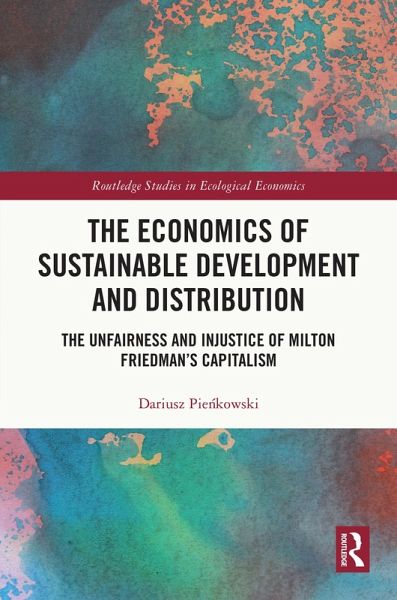
Drawing on a broad transdisciplinary background, this book compares distributive justice systems and related socioeconomic institutions within the liberal and sustainable development traditions. Confronting the capitalist worldview of prominent Nobel Prize-winning economist Milton Friedman, the book offers a theoretical framework for sustainable development: a new paradigm of economics grounded in environmental and social issues. The analysis takes as its starting point that the development and evolution of human beings is codetermined by socioeconomic institutions. These institutions facilitate models of society, morality and human behaviour: they are all social constructs. This matters because the liberal system of justice uses the claim that 'life is unfair' as the justification of socioeconomic inequalities, and it is these institutions which determine the concepts of fairness and justice. Therefore, the liberal system's favouring of entrepreneurs should require advance measures to safeguard the interests of the losers-instead, it seeks to justify their misfortunes. It is argued that this liberal notion of fairness can only be fairly executed in conditions of perfect market competition, which have never existed. In contrast, the principles of sustainable development pay attention to the problems generated by the unjust and unfair distribution of resources and postulate wider use of the fairness formula 'to each according to their needs'. It is thus more focused on fair ends than on fair procedures. This book is addressed to scholars and advanced students in ecological economics, environmental economics, economics of sustainable development and political science.
Dieser Download kann aus rechtlichen Gründen nur mit Rechnungsadresse in A, B, BG, CY, CZ, D, DK, EW, E, FIN, F, GR, HR, H, IRL, I, LT, L, LR, M, NL, PL, P, R, S, SLO, SK ausgeliefert werden.