48,95 €
48,95 €
inkl. MwSt.
Sofort per Download lieferbar

24 °P sammeln
48,95 €
Als Download kaufen
48,95 €
inkl. MwSt.
Sofort per Download lieferbar
24 °P sammeln
Jetzt verschenken
Alle Infos zum eBook verschenken
48,95 €
inkl. MwSt.
Sofort per Download lieferbar
Alle Infos zum eBook verschenken
24 °P sammeln

Andere Kunden interessierten sich auch für
") The Educator's Guide To Substance Abuse Prevention (eBook, ePUB)48,95 €
The Educator's Guide To Substance Abuse Prevention (eBook, ePUB)48,95 €") The Educator's Guide to Writing a Book (eBook, PDF)29,95 €
The Educator's Guide to Writing a Book (eBook, PDF)29,95 €") An Educator's Guide to Project-Based Learning (eBook, PDF)28,95 €
An Educator's Guide to Project-Based Learning (eBook, PDF)28,95 €") Students Taking Charge Implementation Guide for Leaders (eBook, PDF)29,95 €
Students Taking Charge Implementation Guide for Leaders (eBook, PDF)29,95 €") Behaviour in the Classroom (eBook, PDF)10,95 €
Behaviour in the Classroom (eBook, PDF)10,95 €") Title IX and the Protection of Pregnant and Parenting College Students (eBook, PDF)39,95 €
Title IX and the Protection of Pregnant and Parenting College Students (eBook, PDF)39,95 €") Counseling and Therapy With Clients Who Abuse Alcohol or Other Drugs (eBook, PDF)44,95 €
Counseling and Therapy With Clients Who Abuse Alcohol or Other Drugs (eBook, PDF)44,95 €



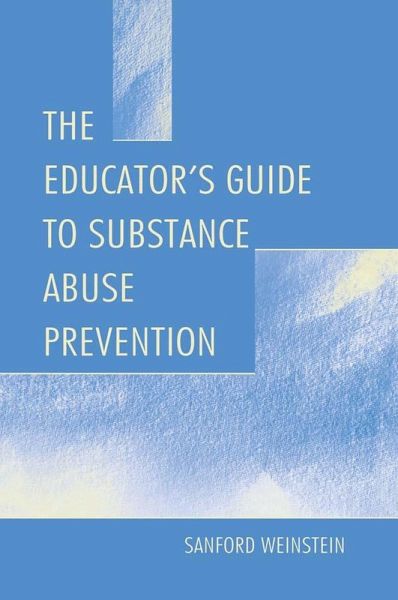
The Educator's Guide to Substance Abuse Prevention is for educators and other school personnel who are concerned about student drug use and school violence. It will help them to appreciate and use their humanity, professional skills, educational ideals, and the school curriculum as tools for substance abuse prevention. Teachers' concerns are addressed in several ways. First, the text provides a guide through which they may resolve personal and professional concerns about the commitments, limits, and boundaries of their working relationships with students. Second, it describes tasks that teachers can perform and mental health issues they can address in creating classroom policies, procedures, and rules to promote healthful learning activity in the classroom. Third, the author summarizes and interprets research and theory about substance abuse as they apply specifically to educational prevention and to professional teaching practice--arguing that classroom management strategies, learning activities, and social interaction are a teacher's primary tools of prevention, and showing how teachers may use these tools in any curricular area and without direct reference to drugs.
A highlight of this text is its emphasis on helping teachers to explore drug-related issues from within the context of their own curricular specialties and to integrate substance abuse prevention with the curriculum in many school subjects--including the arts, literature, social studies, history, government, science, and culture. Action-oriented prevention strategies based on these content areas are suggested. The Educator's Guide to Substance Abuse Prevention:
*focuses primarily on teaching, learning, and prevention rather than on information about drugs;
*helps teachers to better use what they already do, know, and are in order to respond competently, responsibly, and with sensitivity to the needs of their students;
*attends to the needs of teachers who do prevention work and the needs of children who are the target of prevention efforts;
*describes student disappointment and disillusionment with family, school, and community as sources of risk and the legitimate domain in which teachers may serve a curative role;
*provides extensive coverage of historical, social, and cultural issues related to substance abuse and school violence; and
*alerts teachers to the risk to children posed by extremist adult groups, prominent negative role models, popular culture, and peer pressure.
A highlight of this text is its emphasis on helping teachers to explore drug-related issues from within the context of their own curricular specialties and to integrate substance abuse prevention with the curriculum in many school subjects--including the arts, literature, social studies, history, government, science, and culture. Action-oriented prevention strategies based on these content areas are suggested. The Educator's Guide to Substance Abuse Prevention:
*focuses primarily on teaching, learning, and prevention rather than on information about drugs;
*helps teachers to better use what they already do, know, and are in order to respond competently, responsibly, and with sensitivity to the needs of their students;
*attends to the needs of teachers who do prevention work and the needs of children who are the target of prevention efforts;
*describes student disappointment and disillusionment with family, school, and community as sources of risk and the legitimate domain in which teachers may serve a curative role;
*provides extensive coverage of historical, social, and cultural issues related to substance abuse and school violence; and
*alerts teachers to the risk to children posed by extremist adult groups, prominent negative role models, popular culture, and peer pressure.
Dieser Download kann aus rechtlichen Gründen nur mit Rechnungsadresse in A, B, BG, CY, CZ, D, DK, EW, E, FIN, F, GR, HR, H, IRL, I, LT, L, LR, M, NL, PL, P, R, S, SLO, SK ausgeliefert werden.