Sie sind bereits eingeloggt. Klicken Sie auf 2. tolino select Abo, um fortzufahren.
Bitte loggen Sie sich zunächst in Ihr Kundenkonto ein oder registrieren Sie sich bei bücher.de, um das eBook-Abo tolino select nutzen zu können.
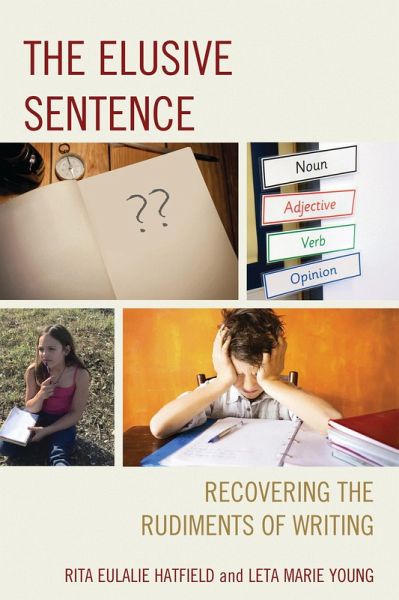
Across our nation, many within our educational system complain that America's children cannot write well. Hatfield and Young assert that the problem lies at the foundation of our pedagogy for writing, that most elementary writing curricula lack rudimentary instruction at the sentence level. The authors introduce a sentence-level writing intervention that explicitly defines the elements found in great sentences. This intervention forms the foundational framework for writing skills acquisition, helping teachers, students, and writers of all ages to understand how to craft well-written sentences…mehr
Across our nation, many within our educational system complain that America's children cannot write well. Hatfield and Young assert that the problem lies at the foundation of our pedagogy for writing, that most elementary writing curricula lack rudimentary instruction at the sentence level. The authors introduce a sentence-level writing intervention that explicitly defines the elements found in great sentences. This intervention forms the foundational framework for writing skills acquisition, helping teachers, students, and writers of all ages to understand how to craft well-written sentences and paragraphs. Research supports that the most effective instruction is skills-based and multisensory; therefore, Hatfield and Young also introduce a cognitively differentiated writing model, which uses arts-integrated instruction to enhance learning and memory for other content areas. This writing model is based on best practice and this sentence-level intervention serves as a precursor for mastering the new writing standards for CCSS. It offers novice writers a precise blueprint for what successful writing looks like and clearly defines the elusive sentence.
Die Herstellerinformationen sind derzeit nicht verfügbar.
Autorenporträt
Both Leta and Eulalie started teaching in a small private school in Fairbanks, Alaska, yet most of their teaching careers were spent in a one-room school house in North Pole, Alaska. Eulalie earned her Master's in Educational Leadership at Concordia University in Portland, Oregon, and Leta earned her Master's in Cross Cultural Education at the University of Alaska at Fairbanks. Leta retired from classroom teaching to pursue a life-long passion, a three-year training program in French Classical Dressage, and Eulalie works as a private tutor for an international business couple, teaching their young daughter and traveling with them as needed. Both Leta and Eulalie continue to write and to develop multimodal resources for their cognitively differentiated writing workshop.
Inhaltsangabe
Introduction Part 1: Language Objective: Sentence-Level Writing Intervention Why should we teach sentence level writing? Chapter 1The Problem: Inverted Writing Pedagogy Chapter 2The Solution: Sentence-Level Writing Chapter 3Sentence-Level Writing Intervention Elementary Writing Pedagogy Chapter 4Linguistic & Musical Syntax Audiation Theory for Music/Writing How do we teach sentence-level writing? Chapter 5Ingham-Webster-Pudewa Method Dress-Ups Sample Writing Matrix Sentence Openers & Decorations Phrase & Clause Manipulation Diagram Basic Report/Essay Model Critique Model & Super Essay Model Scaffolding Common Core State Standards for Writing Chapter 6Writers: Middle School, High School, College, & Beyond Advanced Stylistic Techniques Chapter 7Sheltered Instruction for Writing Part 2: Content Objective: Cognitively Differentiated Learning What is cognitively differentiated learning? Chapter 8Cognitively Differentiated Learning Why should we teach academic content through arts-integrated experiences? Chapter 9Rationale: Teaching through the Arts Art & Cognition Chapter 10Arts-Integrated Learning Rehearsal Effect Elaboration Effect Generation Effect Enactment Effect Production Effect Effort After Meaning Effect Emotional Arousal Effect Picture Superiority Effect Chapter 11Arts-Integrated Instruction & Cognition Writing: Cognitive& Physical Skills Cognitively Differentiated Teaching & Learning Teaching & Learning Relationship Cognitively Differentiated Writing Model Why should we teach academic content through song? Chapter 12Song as a Teaching Tool Balanced Learningthrough Horizontal Differentiation Chapter 13Operational Definitions Rationale: Teaching Content through Song Chapter 14Inherited Dissociated Philosophy Historical Background of Mnemonic Learning Chapter 15Neuroscience of Music & Memory Memory & Music Music & Mnemonics Mnemonics & Diverse Learners Assumptions & Final Thoughts on Mnemonic Song Chapter 16Method & Practice: Putting It All Together Cognitively Differentiated Writing Wheel Sample Weekly Outline Pictures of Writing Journals Chapter 17Best Practice for Writing Instruction Chapter 18Training Teachers for the New Millennium The Hippocratic Oath for Educators Chapter 19Final Reflection Appendix AArts-Integrated Resources Appendix BWriting Matrix Appendix CComposition Checksheet Appendix D Sample Syllabus for College Course Appendix EWebster's Formulas/Chants for Written Communication References
Introduction Part 1: Language Objective: Sentence-Level Writing Intervention Why should we teach sentence level writing? Chapter 1The Problem: Inverted Writing Pedagogy Chapter 2The Solution: Sentence-Level Writing Chapter 3Sentence-Level Writing Intervention Elementary Writing Pedagogy Chapter 4Linguistic & Musical Syntax Audiation Theory for Music/Writing How do we teach sentence-level writing? Chapter 5Ingham-Webster-Pudewa Method Dress-Ups Sample Writing Matrix Sentence Openers & Decorations Phrase & Clause Manipulation Diagram Basic Report/Essay Model Critique Model & Super Essay Model Scaffolding Common Core State Standards for Writing Chapter 6Writers: Middle School, High School, College, & Beyond Advanced Stylistic Techniques Chapter 7Sheltered Instruction for Writing Part 2: Content Objective: Cognitively Differentiated Learning What is cognitively differentiated learning? Chapter 8Cognitively Differentiated Learning Why should we teach academic content through arts-integrated experiences? Chapter 9Rationale: Teaching through the Arts Art & Cognition Chapter 10Arts-Integrated Learning Rehearsal Effect Elaboration Effect Generation Effect Enactment Effect Production Effect Effort After Meaning Effect Emotional Arousal Effect Picture Superiority Effect Chapter 11Arts-Integrated Instruction & Cognition Writing: Cognitive& Physical Skills Cognitively Differentiated Teaching & Learning Teaching & Learning Relationship Cognitively Differentiated Writing Model Why should we teach academic content through song? Chapter 12Song as a Teaching Tool Balanced Learningthrough Horizontal Differentiation Chapter 13Operational Definitions Rationale: Teaching Content through Song Chapter 14Inherited Dissociated Philosophy Historical Background of Mnemonic Learning Chapter 15Neuroscience of Music & Memory Memory & Music Music & Mnemonics Mnemonics & Diverse Learners Assumptions & Final Thoughts on Mnemonic Song Chapter 16Method & Practice: Putting It All Together Cognitively Differentiated Writing Wheel Sample Weekly Outline Pictures of Writing Journals Chapter 17Best Practice for Writing Instruction Chapter 18Training Teachers for the New Millennium The Hippocratic Oath for Educators Chapter 19Final Reflection Appendix AArts-Integrated Resources Appendix BWriting Matrix Appendix CComposition Checksheet Appendix D Sample Syllabus for College Course Appendix EWebster's Formulas/Chants for Written Communication References
Es gelten unsere Allgemeinen Geschäftsbedingungen: www.buecher.de/agb
Impressum
www.buecher.de ist ein Internetauftritt der buecher.de internetstores GmbH
Geschäftsführung: Monica Sawhney | Roland Kölbl | Günter Hilger
Sitz der Gesellschaft: Batheyer Straße 115 - 117, 58099 Hagen
Postanschrift: Bürgermeister-Wegele-Str. 12, 86167 Augsburg
Amtsgericht Hagen HRB 13257
Steuernummer: 321/5800/1497
USt-IdNr: DE450055826