Dieser Download kann aus rechtlichen Gründen nur mit Rechnungsadresse in A, B, BG, CY, CZ, D, DK, EW, E, FIN, F, GR, HR, H, IRL, I, LT, L, LR, M, NL, PL, P, R, S, SLO, SK ausgeliefert werden.
Herstellerkennzeichnung
Die Herstellerinformationen sind derzeit nicht verfügbar.
Autorenporträt
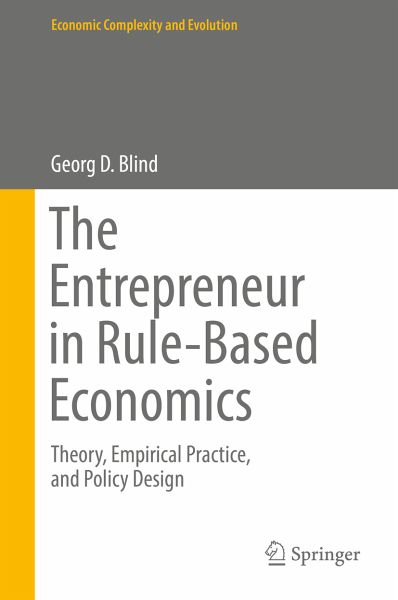
Georg D. Blind is a senior lecturer at the Universities of St. Gallen and Zurich and a Research Fellow with the Institute of Asian and Oriental Studies in Zurich, Switzerland. His recent research includes work on behavioural finance, labour market developments, and the utilisation of free trade agreements. He holds master's degrees in Business and Economics (HEC Paris, St. Gallen University) and in Japanese Studies (Heidelberg University) as well as a PhD in Economics (Hohenheim University). He has been a JSPS guest researcher at Kyoto University's Graduate School of Management (2008-2009) and a visiting researcher at The University of Tokyo in 2017. In addition to his academic activities, he has worked as a consultant with McKinsey & Company and has also undertaken contracted research for private and public sector clients (Ernst&Young, PWC, Switzerland Global Enterprise, Japan Science and Technology Agency).
Inhaltsangabe
Introduction.- Part I A Theory of Entrepreneurship Through the Rule-Based Approach.- The rule-based approach in the analysis of economic change.- The rule-based economy and the function of the entrepreneur.- The entrepreneurial process in terms of rules.- Part II The Rule-Based Approach in Empirics: A Methodological Sketch.- Construction of empirical models: the system of factor rules (SFR).- Changing and meta-stable sub-systems (CSS and MSSS).- Analysis of the CSS: Developing and testing of hypotheses.- The RBA methodology in practice: An exemplar.- Part III Entrepreneurship in Japan: 1992-2012.- Assembling the model: The system of factor rules (SFR).- Reducing the model: extracting the changing sub-system (CSS).- Putting the model to work.- Analysis of changing sub-system.- Interpretation of findings.- Part IV Conclusion.- Summary of findings and research outlook.- Policy implications.- The RBA in empirical practice: effective tool for theory building.
Introduction.- Part I A Theory of Entrepreneurship Through the Rule-Based Approach.- The rule-based approach in the analysis of economic change.- The rule-based economy and the function of the entrepreneur.- The entrepreneurial process in terms of rules.- Part II The Rule-Based Approach in Empirics: A Methodological Sketch.- Construction of empirical models: the system of factor rules (SFR).- Changing and meta-stable sub-systems (CSS and MSSS).- Analysis of the CSS: Developing and testing of hypotheses.- The RBA methodology in practice: An exemplar.- Part III Entrepreneurship in Japan: 1992-2012.- Assembling the model: The system of factor rules (SFR).- Reducing the model: extracting the changing sub-system (CSS).- Putting the model to work.- Analysis of changing sub-system.- Interpretation of findings.- Part IV Conclusion.- Summary of findings and research outlook.- Policy implications.- The RBA in empirical practice: effective tool for theory building.
Es gelten unsere Allgemeinen Geschäftsbedingungen: www.buecher.de/agb
Impressum
www.buecher.de ist ein Internetauftritt der buecher.de internetstores GmbH
Geschäftsführung: Monica Sawhney | Roland Kölbl | Günter Hilger
Sitz der Gesellschaft: Batheyer Straße 115 - 117, 58099 Hagen
Postanschrift: Bürgermeister-Wegele-Str. 12, 86167 Augsburg
Amtsgericht Hagen HRB 13257
Steuernummer: 321/5800/1497
USt-IdNr: DE450055826