1,99 €
1,99 €
inkl. MwSt.
Sofort per Download lieferbar

1 °P sammeln
1,99 €
Als Download kaufen
1,99 €
inkl. MwSt.
Sofort per Download lieferbar
1 °P sammeln
Jetzt verschenken
Alle Infos zum eBook verschenken
1,99 €
inkl. MwSt.
Sofort per Download lieferbar
Alle Infos zum eBook verschenken
1 °P sammeln

Andere Kunden interessierten sich auch für
") The Gifted Child Speaks (eBook, ePUB)5,99 €
The Gifted Child Speaks (eBook, ePUB)5,99 € Restoration, Book One. "The Only True Religion" and "Liberation" (eBook, ePUB)2,99 €
") Jonas and the Mountain (eBook, ePUB)6,99 €
Jonas and the Mountain (eBook, ePUB)6,99 €") By the River Piedra I Sat Down and Wept (eBook, ePUB)8,99 €
By the River Piedra I Sat Down and Wept (eBook, ePUB)8,99 €") The Retreatants (eBook, ePUB)5,49 €
The Retreatants (eBook, ePUB)5,49 €") The Alchemist: A Graphic Novel (eBook, ePUB)15,65 €
The Alchemist: A Graphic Novel (eBook, ePUB)15,65 €") The Way of Ghee (eBook, ePUB)0,00 €
The Way of Ghee (eBook, ePUB)0,00 €






FGHJYFReckoning: The Erastes and His Eromenos
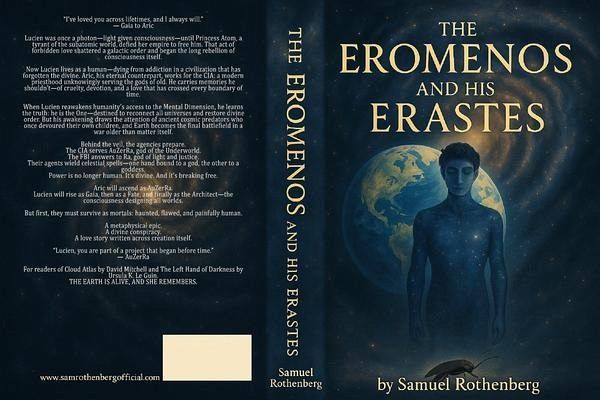
Reckoning: The Erastes and His Eromenos is a monumental work of visionary fiction - a novel that crosses epochs, dimensions, and cosmic hierarchies to tell a story as intimate as a confession and as vast as creation itself. Fusing ancient mythologies with futuristic metaphysics, the book invites readers into a universe where memory is alive, gods have agency, and the boundaries between love, destiny, and cosmic law blur into something entirely new.
At the heart of this sweeping narrative lies an ancient and forbidden bond: the erastes and the eromenos, two souls joined across lifetimes in a relationship that has survived empires, incarnations, and the collapse of entire worlds. Their connection, forged in the temples, battlefields, and secret chambers of antiquity, resurfaces in the modern era, pulling them through dimensions they do not yet understand - realms where their past actions, virtues, and crimes still ripple with consequences.
As the story unfolds, the pair becomes entangled in a conflict that spans the architecture of existence itself. The novel introduces Gaia not as allegory but as a fully sentient presence - a deity who loves, remembers, desires, and judges. Opposing her in certain worlds is Hecate, sovereign of shadowed universes where stars are predatory and light is hostile. The Architect, a being of impossible age and divided will, struggles between creation and destruction. Jerodiah, a guardian whose loyalty transcends worlds, carries both tenderness and terrifying power. Joe Know, a man dissolved and reborn in the crucible of time, returns as a sentient mental-dimension archive whose knowledge could either heal or unravel the cosmos.
Through their eyes, the reader travels across a kaleidoscope of realities:
- a United States and England exiled to Titan for crimes against creation;
- an atom-world locked in a war between compassionate living particles and mechanized, corrupted ones;
- a parallel Earth where time moves gently and love takes different forms; where the South won the civil war
- ancient Greece and Pharaonic Egypt, remembered not as ruins but as living metaphysical systems;
- the mental dimension, where thought becomes architecture and memory becomes weapon;
- and the inner chambers of guilt, longing, trauma, and cosmic responsibility that haunt the soul across incarnations.
The novel's scope is immense, yet its emotional core remains grounded in the characters themselves. Their loves, failures, betrayals, and redemptions provide the structure through which the metaphysical drama unfolds. The ancient bond between the erastes and the eromenos - tender, fraught, sacred, and enduring - becomes a lens through which the book explores the persistence of desire, the archaeology of the soul, and the question of whether redemption can outlast infinite lifetimes.
Blending Greek eros, Egyptian ritual memory, African metaphysics, queer spiritual symbolism, cosmic justice, and speculative dimensional theory, Reckoning creates a mythology entirely of its own. The novel challenges conventional boundaries between fantasy, philosophy, science fiction, theology, and romance. Its language carries the gravitas of epic verse, the intensity of visionary mysticism, and the emotional rawness of forbidden love stretched across the architecture of the multiverse.
Ultimately, Reckoning is a novel about consequences - ancient wrongs that echo into the present, cosmic laws that bind even the divine, and the intimate reckoning every soul must face when confronted with its own history. It is about love that survives annihilation, memory that cannot be erased, and the fragile hope that even in a universe governed by justice, mercy still has a place.
Reckoning: The Erastes and His Eromenos is a monumental work of visionary fiction - a novel that crosses epochs, dimensions, and cosmic hierarchies to tell a story as intimate as a confession and as vast as creation itself. Fusing ancient mythologies with futuristic metaphysics, the book invites readers into a universe where memory is alive, gods have agency, and the boundaries between love, destiny, and cosmic law blur into something entirely new.
At the heart of this sweeping narrative lies an ancient and forbidden bond: the erastes and the eromenos, two souls joined across lifetimes in a relationship that has survived empires, incarnations, and the collapse of entire worlds. Their connection, forged in the temples, battlefields, and secret chambers of antiquity, resurfaces in the modern era, pulling them through dimensions they do not yet understand - realms where their past actions, virtues, and crimes still ripple with consequences.
As the story unfolds, the pair becomes entangled in a conflict that spans the architecture of existence itself. The novel introduces Gaia not as allegory but as a fully sentient presence - a deity who loves, remembers, desires, and judges. Opposing her in certain worlds is Hecate, sovereign of shadowed universes where stars are predatory and light is hostile. The Architect, a being of impossible age and divided will, struggles between creation and destruction. Jerodiah, a guardian whose loyalty transcends worlds, carries both tenderness and terrifying power. Joe Know, a man dissolved and reborn in the crucible of time, returns as a sentient mental-dimension archive whose knowledge could either heal or unravel the cosmos.
Through their eyes, the reader travels across a kaleidoscope of realities:
- a United States and England exiled to Titan for crimes against creation;
- an atom-world locked in a war between compassionate living particles and mechanized, corrupted ones;
- a parallel Earth where time moves gently and love takes different forms; where the South won the civil war
- ancient Greece and Pharaonic Egypt, remembered not as ruins but as living metaphysical systems;
- the mental dimension, where thought becomes architecture and memory becomes weapon;
- and the inner chambers of guilt, longing, trauma, and cosmic responsibility that haunt the soul across incarnations.
The novel's scope is immense, yet its emotional core remains grounded in the characters themselves. Their loves, failures, betrayals, and redemptions provide the structure through which the metaphysical drama unfolds. The ancient bond between the erastes and the eromenos - tender, fraught, sacred, and enduring - becomes a lens through which the book explores the persistence of desire, the archaeology of the soul, and the question of whether redemption can outlast infinite lifetimes.
Blending Greek eros, Egyptian ritual memory, African metaphysics, queer spiritual symbolism, cosmic justice, and speculative dimensional theory, Reckoning creates a mythology entirely of its own. The novel challenges conventional boundaries between fantasy, philosophy, science fiction, theology, and romance. Its language carries the gravitas of epic verse, the intensity of visionary mysticism, and the emotional rawness of forbidden love stretched across the architecture of the multiverse.
Ultimately, Reckoning is a novel about consequences - ancient wrongs that echo into the present, cosmic laws that bind even the divine, and the intimate reckoning every soul must face when confronted with its own history. It is about love that survives annihilation, memory that cannot be erased, and the fragile hope that even in a universe governed by justice, mercy still has a place.
Dieser Download kann aus rechtlichen Gründen nur mit Rechnungsadresse in A, D ausgeliefert werden.