Sie sind bereits eingeloggt. Klicken Sie auf 2. tolino select Abo, um fortzufahren.
Bitte loggen Sie sich zunächst in Ihr Kundenkonto ein oder registrieren Sie sich bei bücher.de, um das eBook-Abo tolino select nutzen zu können.
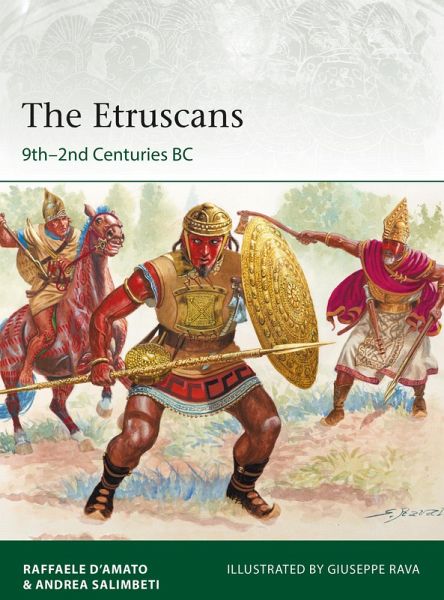
Ancient Rome had deep roots in the 'Villanovan' culture that we call today the Etruscans. Their long-lived civilization can be traced to 900-750 BC in north-west Italy. They were a sea-faring people trading with and competing against Greek and Phoenician peoples, including the Carthaginians. They were also a great land-based power, especially in the 'Classical' period, where they expanded their power north into the Po Valley and south to Latium. In the 6th century BC an Etruscan dynasty ruled Rome, and their power extended southwards to the Amalfi coast. In 509 BC the Romans rose up to…mehr
Ancient Rome had deep roots in the 'Villanovan' culture that we call today the Etruscans.
Their long-lived civilization can be traced to 900-750 BC in north-west Italy. They were a sea-faring people trading with and competing against Greek and Phoenician peoples, including the Carthaginians. They were also a great land-based power, especially in the 'Classical' period, where they expanded their power north into the Po Valley and south to Latium. In the 6th century BC an Etruscan dynasty ruled Rome, and their power extended southwards to the Amalfi coast. In 509 BC the Romans rose up to expel their kings, which began the long 'Etruscan twilight' when their power was squeezed by the Samnites and, most especially, the Romans.
Drawing on archaeological evidence including warrior tombs, paintings, sculptures, and fully illustrated throughout, this study examines one of the early rivals to Ancient Rome.
Die Herstellerinformationen sind derzeit nicht verfügbar.
Autorenporträt
Raffaele D'Amato, PhD, is the author of some 40 books and has written numerous articles on the Roman Empire, Byzantium, medieval Europe and the military of Ancient Greece. He has taught at the University of Ferrara, and was a visiting professor at Fatih University, Istanbul. He currently lives in England, working as an archaeological consultant and lawyer for Timeline Auctions Ltd of Harwich, and also as an external researcher for the Laboratory of the Danubian Provinces at the University of Ferrara.
Andrea Salimbeti has had a lifelong interest in ancient military historical research, in particular the Bronze Age in Greece and the Middle East, and has collaborated with magazines and special publications in these fields. He also writes on aviation topics such as aerospace technology and flight equipment.
Giuseppe Rava was born in Faenza in 1963, and took an interest in all things military from an early age. Entirely self-taught, Giuseppe has established himself as a leading military history artist, and is inspired by the works of the great military artists, such as Detaille, Meissonier, Röchling, Lady Butler, Ottenfeld and Angus McBride. He lives and works in Italy.
Inhaltsangabe
Introduction - chronology The Villanovan warrior culture - the Villanovan army Arms and equipment of the Villanovan era: offensive weapons - defensive equipment: helmets, shields and armour - ranks symbols and insignia - clothing The Classical and late Etruscan armies - organization Arms and equipment: offensive weapons - defensive equipment: helmets, shields and armour - rank symbols and insignia - clothing Chariots and cavalry Select bibliography [Plate commentaries dispersed throughout]
Introduction - chronology The Villanovan warrior culture - the Villanovan army Arms and equipment of the Villanovan era: offensive weapons - defensive equipment: helmets, shields and armour - ranks symbols and insignia - clothing The Classical and late Etruscan armies - organization Arms and equipment: offensive weapons - defensive equipment: helmets, shields and armour - rank symbols and insignia - clothing Chariots and cavalry Select bibliography [Plate commentaries dispersed throughout]
Es gelten unsere Allgemeinen Geschäftsbedingungen: www.buecher.de/agb
Impressum
www.buecher.de ist ein Internetauftritt der buecher.de internetstores GmbH
Geschäftsführung: Monica Sawhney | Roland Kölbl | Günter Hilger
Sitz der Gesellschaft: Batheyer Straße 115 - 117, 58099 Hagen
Postanschrift: Bürgermeister-Wegele-Str. 12, 86167 Augsburg
Amtsgericht Hagen HRB 13257
Steuernummer: 321/5800/1497
USt-IdNr: DE450055826