22,49 €
inkl. MwSt.
Sofort per Download lieferbar
0 °P sammeln

Andere Kunden interessierten sich auch für
") Who Owns the Moon? (eBook, ePUB)12,85 €
Who Owns the Moon? (eBook, ePUB)12,85 €") Redefining the Modern Military (eBook, ePUB)15,95 €
Redefining the Modern Military (eBook, ePUB)15,95 €") Resist the Punitive State (eBook, ePUB)11,95 €
Resist the Punitive State (eBook, ePUB)11,95 €") The Ethical Economy (eBook, ePUB)19,95 €
The Ethical Economy (eBook, ePUB)19,95 €") Nation of Homeowners: Solving the Philippine Housing Crisis Through Singapore's Proven Blueprint (eBook, ePUB)8,99 €
Nation of Homeowners: Solving the Philippine Housing Crisis Through Singapore's Proven Blueprint (eBook, ePUB)8,99 €") The No-Nonsense Guide to Green Politics (eBook, ePUB)7,99 €
The No-Nonsense Guide to Green Politics (eBook, ePUB)7,99 €") NoNonsense Globalization (eBook, ePUB)6,99 €
NoNonsense Globalization (eBook, ePUB)6,99 €






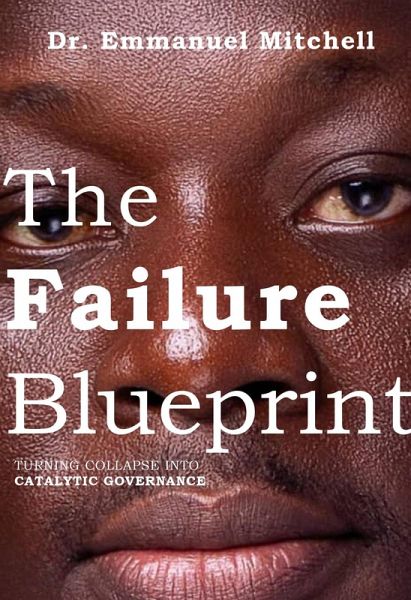
In an era where institutional failures seem to cascade across every sector-from corporate scandals to governmental breakdowns, from educational system collapses to healthcare crises-Dr. Emmanuel Mitchell presents a revolutionary framework that transforms our understanding of organizational and systemic failure. "The Failure Blueprint" challenges the conventional wisdom that failure is something to be avoided at all costs, instead revealing it as the most powerful catalyst for creating adaptive, resilient, and truly effective governance structures.
Drawing from decades of research in organizational psychology, systems theory, and crisis management, Dr. Mitchell demonstrates how the most successful institutions throughout history
have emerged not despite their failures, but because of how they learned to harness the transformative power of collapse. Through compelling case studies ranging from the resurrection of bankrupt cities to the reformation of failed democracies, this groundbreaking work shows how intelligent failure analysis can become the foundation for unprecedented institutional strength.
The book introduces the concept of "Catalytic Governance"-a dynamic approach to leadership and institutional design that actively incorporates failure scenarios as essential components of strategic planning. Unlike traditional risk management that seeks to prevent failure, catalytic governance creates systems that can rapidly absorb, process, and transform failure into evolutionary advantage. Mitchell argues that in our rapidly changing world, the ability to fail well has become more critical than the ability to succeed consistently.
Central to Mitchell's thesis is the "Failure Blueprint"-a systematic methodology for diagnosing institutional weaknesses, mapping failure pathways, and redesigning governance structures to not merely survive collapse but to emerge stronger and more capable. This blueprint provides leaders with practical tools for conducting "failure audits," implementing "collapse protocols," and building "adaptive resilience" into their organizations before crisis strikes.
The book is structured around seven core principles of catalytic governance, each illustrated through real-world examples of institutions that have successfully transformed failure into strength. From the Finnish education system's embrace of pedagogical experimentation to Singapore's approach to policy innovation through controlled failure, Mitchell shows how forward-thinking leaders are already implementing these principles with remarkable results.
Perhaps most provocatively, Mitchell argues that our current institutional crises-from political polarization to climate change response failures-represent not signs of societal breakdown but opportunities for unprecedented transformation. He contends that by learning to read these failures correctly and respond with catalytic governance principles, we can build institutions capable of thriving in an age of perpetual change and uncertainty.
"The Failure Blueprint" is essential reading for leaders, policymakers, organizational designers, and anyone seeking to understand how to build antifragile institutions in an age of increasing volatility. Mitchell's work offers both hope and practical guidance for transforming our relationship with failure from one of fear and avoidance to one of strategic embrace and intelligent utilization.
This book will fundamentally change how you think about failure, governance, and the future of institutional design in the twenty-first century.
Drawing from decades of research in organizational psychology, systems theory, and crisis management, Dr. Mitchell demonstrates how the most successful institutions throughout history
have emerged not despite their failures, but because of how they learned to harness the transformative power of collapse. Through compelling case studies ranging from the resurrection of bankrupt cities to the reformation of failed democracies, this groundbreaking work shows how intelligent failure analysis can become the foundation for unprecedented institutional strength.
The book introduces the concept of "Catalytic Governance"-a dynamic approach to leadership and institutional design that actively incorporates failure scenarios as essential components of strategic planning. Unlike traditional risk management that seeks to prevent failure, catalytic governance creates systems that can rapidly absorb, process, and transform failure into evolutionary advantage. Mitchell argues that in our rapidly changing world, the ability to fail well has become more critical than the ability to succeed consistently.
Central to Mitchell's thesis is the "Failure Blueprint"-a systematic methodology for diagnosing institutional weaknesses, mapping failure pathways, and redesigning governance structures to not merely survive collapse but to emerge stronger and more capable. This blueprint provides leaders with practical tools for conducting "failure audits," implementing "collapse protocols," and building "adaptive resilience" into their organizations before crisis strikes.
The book is structured around seven core principles of catalytic governance, each illustrated through real-world examples of institutions that have successfully transformed failure into strength. From the Finnish education system's embrace of pedagogical experimentation to Singapore's approach to policy innovation through controlled failure, Mitchell shows how forward-thinking leaders are already implementing these principles with remarkable results.
Perhaps most provocatively, Mitchell argues that our current institutional crises-from political polarization to climate change response failures-represent not signs of societal breakdown but opportunities for unprecedented transformation. He contends that by learning to read these failures correctly and respond with catalytic governance principles, we can build institutions capable of thriving in an age of perpetual change and uncertainty.
"The Failure Blueprint" is essential reading for leaders, policymakers, organizational designers, and anyone seeking to understand how to build antifragile institutions in an age of increasing volatility. Mitchell's work offers both hope and practical guidance for transforming our relationship with failure from one of fear and avoidance to one of strategic embrace and intelligent utilization.
This book will fundamentally change how you think about failure, governance, and the future of institutional design in the twenty-first century.
Dieser Download kann aus rechtlichen Gründen nur mit Rechnungsadresse in A, B, CY, CZ, D, DK, EW, E, FIN, F, GR, H, IRL, I, LT, L, LR, M, NL, PL, P, R, S, SLO, SK ausgeliefert werden.