4,49 €
4,49 €
inkl. MwSt.
Sofort per Download lieferbar

0 °P sammeln
4,49 €
Als Download kaufen
4,49 €
inkl. MwSt.
Sofort per Download lieferbar
0 °P sammeln
Jetzt verschenken
Alle Infos zum eBook verschenken
4,49 €
inkl. MwSt.
Sofort per Download lieferbar
Alle Infos zum eBook verschenken
0 °P sammeln

Andere Kunden interessierten sich auch für
") Children of the Albatross (eBook, ePUB)4,49 €
Children of the Albatross (eBook, ePUB)4,49 €") Seduction of the Minotaur (eBook, ePUB)4,49 €
Seduction of the Minotaur (eBook, ePUB)4,49 €") Under a Glass Bell (eBook, ePUB)4,49 €
Under a Glass Bell (eBook, ePUB)4,49 €") The Winter of Artifice, 1939 edition (eBook, ePUB)4,49 €
The Winter of Artifice, 1939 edition (eBook, ePUB)4,49 €") Collages (eBook, ePUB)4,49 €
Collages (eBook, ePUB)4,49 €") Cities of the Interior (eBook, ePUB)8,99 €
Cities of the Interior (eBook, ePUB)8,99 €") The House of Incest (eBook, ePUB)3,49 €
The House of Incest (eBook, ePUB)3,49 €




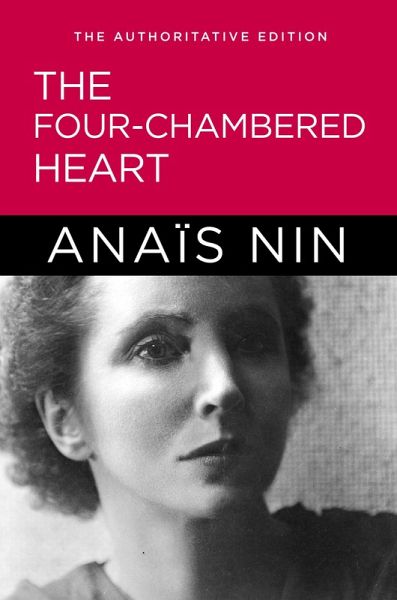
The Four-Chambered Heart, Anais Nin's third title in the Cities of the Interior series of novels, is one of Nin's most compelling books, with well-defined characters (Djuna, Rango, and Zora), rhythmic waves of tension, and a powerful climax. Based on Nin's own relationship with the Peruvian radical Gonzalo More and his wife Helba, The Four-Chambered Heart examines how each of us experiences love in our own way, and how we are sometimes forced by social mores to compartmentalize one relationship in order to preserve the other.
Nin's use of symbolism has never been more effective: the river Seine represents the immutable force of life, the houseboat is the elusive dream, the shore is reality, and a doll found by a fisherman represents the part of Djuna that has committed suicide to allow the rest of her to grow.
Djuna, through her torturous journey with Rango and Zora, arrives at a conclusion that is bitter yet critical to her survival as a woman seeking an understanding of how the exterior world affects the interior: "...very rarely did midnight strike in two hearts at once, very rarely did midnight arouse two equal desires, and that any dislocation in this, any indifference, was an indication of disunity, of the difficulties, the impossibilities of fusion between two human beings."
This new authoritative edition contains Nin's introduction, character descriptions, publishing history, and an author's chronology.
Nin's use of symbolism has never been more effective: the river Seine represents the immutable force of life, the houseboat is the elusive dream, the shore is reality, and a doll found by a fisherman represents the part of Djuna that has committed suicide to allow the rest of her to grow.
Djuna, through her torturous journey with Rango and Zora, arrives at a conclusion that is bitter yet critical to her survival as a woman seeking an understanding of how the exterior world affects the interior: "...very rarely did midnight strike in two hearts at once, very rarely did midnight arouse two equal desires, and that any dislocation in this, any indifference, was an indication of disunity, of the difficulties, the impossibilities of fusion between two human beings."
This new authoritative edition contains Nin's introduction, character descriptions, publishing history, and an author's chronology.
Dieser Download kann aus rechtlichen Gründen nur mit Rechnungsadresse in A, B, CY, CZ, D, DK, EW, E, FIN, F, GR, H, IRL, I, LT, L, LR, M, NL, PL, P, R, S, SLO, SK ausgeliefert werden.