0,49 €
inkl. MwSt.
Sofort per Download lieferbar
0 °P sammeln

Andere Kunden interessierten sich auch für
") The Gallery (eBook, ePUB)11,95 €
The Gallery (eBook, ePUB)11,95 €") The Gallery (eBook, ePUB)1,99 €
The Gallery (eBook, ePUB)1,99 €") The Use of Man (eBook, ePUB)10,95 €
The Use of Man (eBook, ePUB)10,95 €") Midnight in the Century (eBook, ePUB)9,95 €
Midnight in the Century (eBook, ePUB)9,95 €") Apartment in Athens (eBook, ePUB)10,95 €
Apartment in Athens (eBook, ePUB)10,95 €") Varina (eBook, ePUB)3,99 €
Varina (eBook, ePUB)3,99 €") Varina (eBook, ePUB)3,89 €
Varina (eBook, ePUB)3,89 €





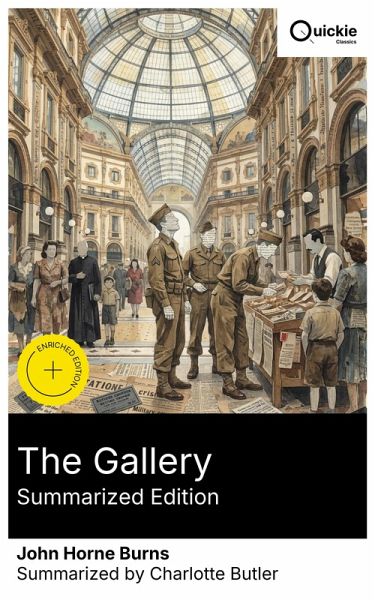
Set beneath the glass canopy of Naples's Galleria Umberto I in the uneasy aftermath of Allied liberation, The Gallery assembles a cycle of interlinked portraits-soldiers, shopkeepers, black-marketeers, priests, and street children-whose intersecting lives expose the moral ambiguities of victory. Burns's prose shifts from acid satire to lyrical lament, fusing reportorial clarity with a modernist, mosaic structure reminiscent of Dos Passos and conversant with Italian neorealism. The book's unsentimental vision scrutinizes power, desire, and hunger with liturgical cadences and a fierce ethical intelligence, resisting the triumphalist narratives of conventional war fiction. Harvard-educated and later an Army intelligence officer, Burns served in North Africa and, crucially, Naples, whose polyglot streets supplied this debut's textures and disillusions. A cultured skeptic-and a gay man in midcentury America-he wrote with insider access and outsider vulnerability, transmuting field reports and moral outrage into art. Readers of war literature, Italian history, and queer cultural studies will find The Gallery a bracing companion: not a battlefield chronicle but a report from the ambiguous zone of liberation. For stylistic daring and historical witness, it richly rewards close, ethically alert reading. Quickie Classics summarizes timeless works with precision, preserving the author's voice and keeping the prose clear, fast, and readable-distilled, never diluted. Enriched Edition extras: Introduction · Synopsis · Historical Context · Brief Analysis · 4 Reflection Q&As · Editorial Footnotes.
Dieser Download kann aus rechtlichen Gründen nur mit Rechnungsadresse in A, B, BG, CY, CZ, D, DK, EW, FIN, F, GR, H, IRL, I, LT, L, LR, M, NL, PL, P, R, S, SLO, SK ausgeliefert werden.