0,49 €
inkl. MwSt.
Sofort per Download lieferbar

payback
0 °P sammeln
  • Format: ePub

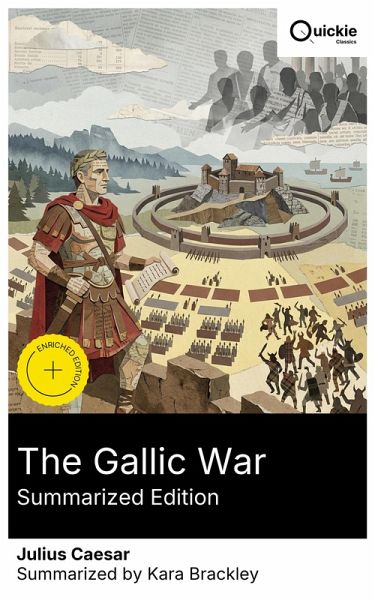
The Gallic War is Caesar's spare, commanding narrative of the campaigns in Gaul (58-50 BCE), composed in the Commentarii mode. Written in taut, paratactic Latin and the third person, it interweaves precise logistics, topography, Alesia's siegecraft, and battle order with ethnographic sketches of Gauls, Germans, and Britons, and set-piece speeches that guide interpretation. At once field report and crafted literature, it stands at the hinge of late Republican historiography, balancing annalistic clarity with authorial self-fashioning, and establishing a model for military prose. As proconsul,…mehr

  • Geräte: eReader
  • ohne Kopierschutz
  • eBook Hilfe
  • Größe: 0.85MB
  • FamilySharing(5)
Produktbeschreibung
The Gallic War is Caesar's spare, commanding narrative of the campaigns in Gaul (58-50 BCE), composed in the Commentarii mode. Written in taut, paratactic Latin and the third person, it interweaves precise logistics, topography, Alesia's siegecraft, and battle order with ethnographic sketches of Gauls, Germans, and Britons, and set-piece speeches that guide interpretation. At once field report and crafted literature, it stands at the hinge of late Republican historiography, balancing annalistic clarity with authorial self-fashioning, and establishing a model for military prose. As proconsul, Gaius Julius Caesar - indebted aristocrat, consummate politician, and innovator of coalition-building - needed victories and narrative control. These Commentaries circulated rapidly in Rome to influence Senate and people, legitimating unprecedented command extensions and overshadowing rivals like Pompey. The third-person stance feigns impartiality, while selective emphasis, casualty accounting, and moral contrasts advance a persuasive defense of conquest. This book repays close reading by historians, classicists, and strategists alike. Approach it as both source and argument, ideally alongside Cicero's correspondence, Plutarch, and modern commentaries, to triangulate its claims. For lucid tactics, statecraft under pressure, and the rhetoric of empire, few ancient works are more instructive. Quickie Classics summarizes timeless works with precision, preserving the author's voice and keeping the prose clear, fast, and readable-distilled, never diluted. Enriched Edition extras: Introduction · Synopsis · Historical Context · Author Biography · Brief Analysis · 4 Reflection Q&As · Editorial Footnotes.

Dieser Download kann aus rechtlichen Gründen nur mit Rechnungsadresse in A, B, BG, CY, CZ, D, DK, EW, E, FIN, F, GR, H, IRL, I, LT, L, LR, M, NL, PL, P, R, S, SLO, SK ausgeliefert werden.

Autorenporträt
Gaius Julius Caesar was a prominent Roman general and statesman born on July 12, 100 BC. His political career reached its zenith when he formed the First Triumvirate with Crassus and Pompey in 60 BC. This alliance allowed him to gain considerable political power, opposed by many in the Senate such as Cato the Younger, with Cicero's private support. Caesar's military prowess was demonstrated during the Gallic Wars, where he expanded Roman territories significantly and undertook ventures such as invading Britain and building a bridge across the Rhine. These successes eventually overshadowed Pompey, who had turned to the Senate for support. In 49 BC, defying the Senate's orders to disband his army, Caesar famously crossed the Rubicon, initiating a civil war against Pompey and his allies, which he won, thus consolidating his power.By 45 BC, Caesar was the uncontested leader of Rome, initiating vast social and governmental reforms including the introduction of the Julian calendar and extending Roman citizenship. He also launched extensive building projects and land reforms to benefit his veterans. In 44 BC, he was declared dictator for life, a decision that led to his assassination on March 15 of the same year by a group of senators including Brutus and Cassius. This event sparked a series of civil wars, ultimately leading to the collapse of the Roman Republic. Caesar's legacy continued through his great-nephew and adopted heir, Octavian (later Augustus), marking the transition from Republic to Empire. Caesar's life and achievements have been extensively documented not only in his own writings but also through works by Cicero, Sallust, Suetonius, and Plutarch, making him a perennial figure in historical and cultural studies.
