42,95 €
42,95 €
inkl. MwSt.
Sofort per Download lieferbar

21 °P sammeln
42,95 €
Als Download kaufen
42,95 €
inkl. MwSt.
Sofort per Download lieferbar
21 °P sammeln
Jetzt verschenken
Alle Infos zum eBook verschenken
42,95 €
inkl. MwSt.
Sofort per Download lieferbar
Alle Infos zum eBook verschenken
21 °P sammeln

Andere Kunden interessierten sich auch für
") The General Will in the Modern Constitutional State (eBook, ePUB)42,95 €
The General Will in the Modern Constitutional State (eBook, ePUB)42,95 €") The Quest for Legitimacy in Chinese Politics (eBook, PDF)41,95 €
The Quest for Legitimacy in Chinese Politics (eBook, PDF)41,95 €") Language, Democracy, and the Paradox of Constituent Power (eBook, PDF)39,95 €
Language, Democracy, and the Paradox of Constituent Power (eBook, PDF)39,95 €") The Making of a Marxist Philosopher (eBook, PDF)38,95 €
The Making of a Marxist Philosopher (eBook, PDF)38,95 €") The Rise and Decline of Modern Democracy (eBook, PDF)38,95 €
The Rise and Decline of Modern Democracy (eBook, PDF)38,95 €") Conflictual Democracy and the South African Constitution (eBook, PDF)39,95 €
Conflictual Democracy and the South African Constitution (eBook, PDF)39,95 €") Democracy, the Courts, and the Liberal State (eBook, PDF)41,95 €
Democracy, the Courts, and the Liberal State (eBook, PDF)41,95 €



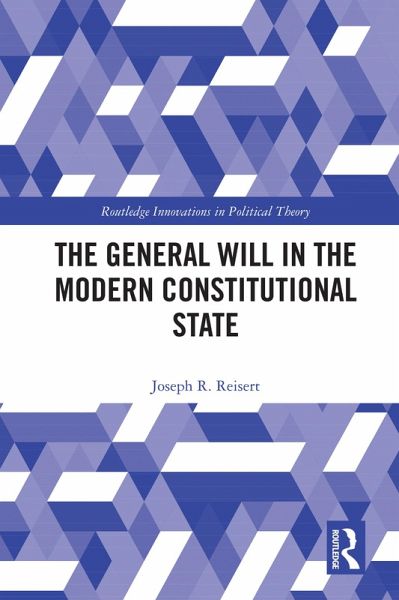
In The General Will in the Modern Constitutional State, Joseph R. Reisert challenges standard interpretations of Rousseau, according to which his political theory either has nothing to offer the present but a radical critique or commends an illiberal, plebiscitary democracy. Reisert argues that the principles of political right Rousseau sets forth in The Social Contract are correct and that the political institutions of modern constitutional and democratic states substantially satisfy them.
Rousseau's central normative commitments - to popular sovereignty, constitutional law, representative government, the rule of law, periodic elections, universal suffrage, and equal basic rights for all - correspond closely to our contemporary understanding of what political legitimacy requires. Taking seriously Rousseau's claim that a sort of contract lies at the foundation of every political society, Reisert offers a novel interpretation of willing a general will, arguing that the experience of formulating and acting upon a general will is as common as are the experiences of membership in a civic association and of undertaking any collective activity as a member of such an organization. Reisert expertly demonstrates that, when we recognize that a nation's true constitution is the content of the people's general will, we will be able to see how our political institutions (mostly) satisfy Rousseau's normative principles of political right, and we will also discover new perspectives on constitutional politics and constitutional interpretation.
The General Will in the Modern Constitutional State will be of interest to those who study Rousseau's political thought, history of political thought, constitutionalism, and constitutional theory.
Rousseau's central normative commitments - to popular sovereignty, constitutional law, representative government, the rule of law, periodic elections, universal suffrage, and equal basic rights for all - correspond closely to our contemporary understanding of what political legitimacy requires. Taking seriously Rousseau's claim that a sort of contract lies at the foundation of every political society, Reisert offers a novel interpretation of willing a general will, arguing that the experience of formulating and acting upon a general will is as common as are the experiences of membership in a civic association and of undertaking any collective activity as a member of such an organization. Reisert expertly demonstrates that, when we recognize that a nation's true constitution is the content of the people's general will, we will be able to see how our political institutions (mostly) satisfy Rousseau's normative principles of political right, and we will also discover new perspectives on constitutional politics and constitutional interpretation.
The General Will in the Modern Constitutional State will be of interest to those who study Rousseau's political thought, history of political thought, constitutionalism, and constitutional theory.
Dieser Download kann aus rechtlichen Gründen nur mit Rechnungsadresse in A, B, BG, CY, CZ, D, DK, EW, E, FIN, F, GR, HR, H, IRL, I, LT, L, LR, M, NL, PL, P, R, S, SLO, SK ausgeliefert werden.