22,95 €
22,95 €
inkl. MwSt.
Sofort per Download lieferbar

11 °P sammeln
22,95 €
Als Download kaufen
22,95 €
inkl. MwSt.
Sofort per Download lieferbar
11 °P sammeln
Jetzt verschenken
Alle Infos zum eBook verschenken
22,95 €
inkl. MwSt.
Sofort per Download lieferbar
Alle Infos zum eBook verschenken
11 °P sammeln

Andere Kunden interessierten sich auch für
") The Birth of Physics (eBook, ePUB)31,95 €
The Birth of Physics (eBook, ePUB)31,95 €") The Reinvention of Social Practices (eBook, ePUB)31,95 €
The Reinvention of Social Practices (eBook, ePUB)31,95 €") The Labyrinth of Modernity (eBook, ePUB)33,95 €
The Labyrinth of Modernity (eBook, ePUB)33,95 €") Domination and Emancipation (eBook, ePUB)27,95 €
Domination and Emancipation (eBook, ePUB)27,95 €") Hegel, Marx, Nietzsche (eBook, ePUB)16,95 €
Hegel, Marx, Nietzsche (eBook, ePUB)16,95 €") Foucault against Neoliberalism? (eBook, ePUB)22,95 €
Foucault against Neoliberalism? (eBook, ePUB)22,95 €") Darwin's Philosophical Legacy (eBook, ePUB)33,95 €
Darwin's Philosophical Legacy (eBook, ePUB)33,95 €




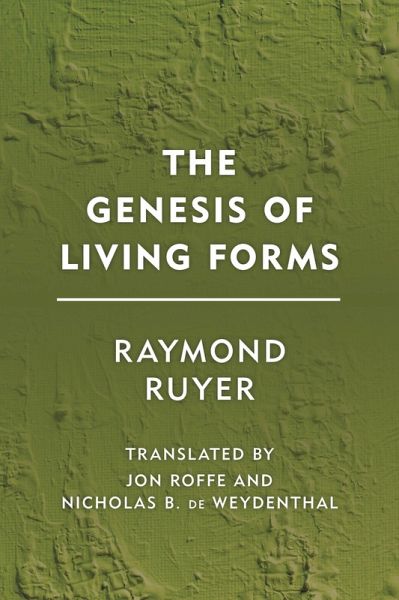
The philosophy of Raymond Ruyer was an important if subterranean influence on twentieth-century French thought, and explicitly engaged with by figures such as Maurice Merleau-Ponty, Georges Canguilhem, Gilbert Simondon, and Gilles Deleuze. The Genesis of Living Forms is Ruyer's most focussed and forceful analysis of a central but apparently paradoxical biological phenomenon that also presents serious problems for philosophy: embryogenesis. When a cat develops from the early stages of fertilization to an adult, what is it that makes it the same cat? How is it that a living being can at once be the same and constantly changing? Ruyer's answer to these questions unfolds through a detailed set of encounters with major scientific fields, from particle physics to social psychology, arguing that the paradox can only be dissolved by seeing the role that form plays in the ongoing development of living beings. In Ruyer's view, embryogenesis is a central problem not just in the life sciences; every thing must possess a relation to a form that is characteristic of it, from carbon atoms to embryos, and to embryologists themselves.