14,39 €
14,39 €
inkl. MwSt.
Sofort per Download lieferbar

0 °P sammeln
14,39 €
Als Download kaufen
14,39 €
inkl. MwSt.
Sofort per Download lieferbar
0 °P sammeln
Jetzt verschenken
Alle Infos zum eBook verschenken
14,39 €
inkl. MwSt.
Sofort per Download lieferbar
Alle Infos zum eBook verschenken
0 °P sammeln

Andere Kunden interessierten sich auch für
") The Human Being as Body and Soul in relation to the Cosmos (eBook, ePUB)15,59 €
The Human Being as Body and Soul in relation to the Cosmos (eBook, ePUB)15,59 €") The Temple Legend (eBook, ePUB)13,00 €
The Temple Legend (eBook, ePUB)13,00 €") The Human Being as Spiritual Being Evolving through the Course of History (eBook, ePUB)15,59 €
The Human Being as Spiritual Being Evolving through the Course of History (eBook, ePUB)15,59 €") Spirit as Sculptor of the Human Organism (eBook, ePUB)13,00 €
Spirit as Sculptor of the Human Organism (eBook, ePUB)13,00 €") Founding a Science of the Spirit (eBook, ePUB)14,39 €
Founding a Science of the Spirit (eBook, ePUB)14,39 €") Enlivening the Chakra of the Heart (eBook, ePUB)8,99 €
Enlivening the Chakra of the Heart (eBook, ePUB)8,99 € (eBook, ePUB)") Matthew (Expository Thoughts on the Gospels) (eBook, ePUB)13,74 €
Matthew (Expository Thoughts on the Gospels) (eBook, ePUB)13,74 €

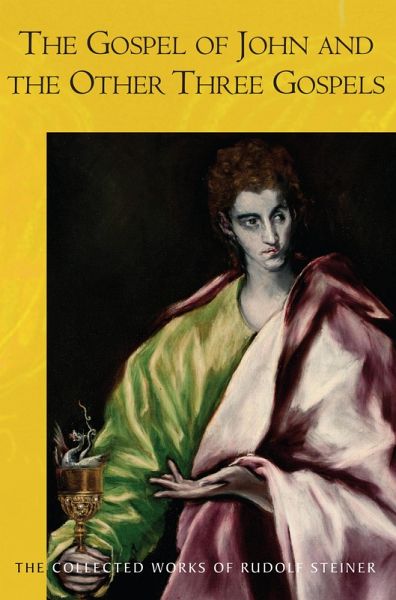
'What is the Christ-event? It is a confluence of all preceding philosophies and religious streams of humanity... united in Palestine; and they were expressed in the Gospels according to the different types of initiation of the one or other Evangelist.' - Rudolf Steiner Speaking two years after his main lecture course on the Gospel of John, Rudolf Steiner discusses initiation traditions in the course of human history, and how the Christ Event unified them all - in particular, those connected to the Western and Eastern mysteries. In addition to esoteric interpretations of passages in the Gospels, Steiner also presents many new and complementary insights on the world-historic significance of Christ's mission, including his initial reference to the Second Coming in the etheric realm. Dense in content, these thirteen lectures - delivered to an audience at the Royal Swedish Academy of Science, Stockholm - enrich our understanding of Rudolf Steiner's Christology. Only recently published in German, and here in English for the first time, the lectures are accompanied with an introduction by Hans-Christian Zehnter, an appendix of photos and facsimiles, extensive notes and an index. 'The voice rose and the speaking took on a more rapid tempo, while it flowed without stopping in perfectly formed, beautiful sentences, as only a born speaker can produce.' (From a contemporary newspaper review.) Thirteen lectures, Stockholm, Jan. 1910, GA 117a
Dieser Download kann aus rechtlichen Gründen nur mit Rechnungsadresse in A, B, BG, CY, CZ, D, DK, EW, E, FIN, F, GR, H, IRL, I, LT, L, LR, M, NL, PL, P, R, S, SLO, SK ausgeliefert werden.