10,95 €
inkl. MwSt.
Sofort per Download lieferbar
5 °P sammeln

Andere Kunden interessierten sich auch für
") Beginning or End of BRAVE NEW WORLD (eBook, ePUB)3,59 €
Beginning or End of BRAVE NEW WORLD (eBook, ePUB)3,59 €") Sensuous Geographies (eBook, ePUB)48,95 €
Sensuous Geographies (eBook, ePUB)48,95 €") The Secret Life of Books (eBook, ePUB)10,49 €
The Secret Life of Books (eBook, ePUB)10,49 €") The State and the Stork (eBook, ePUB)13,95 €
The State and the Stork (eBook, ePUB)13,95 €") Regarding the Pain of Others (eBook, ePUB)8,99 €
Regarding the Pain of Others (eBook, ePUB)8,99 €") Senses of the Future (eBook, ePUB)70,95 €
Senses of the Future (eBook, ePUB)70,95 €") Exodus to the Virtual World (eBook, ePUB)16,95 €
Exodus to the Virtual World (eBook, ePUB)16,95 €






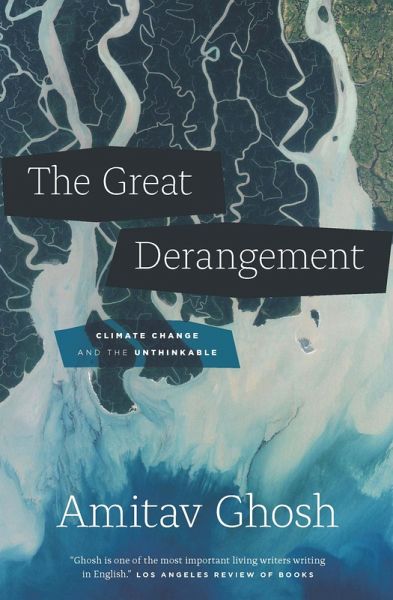
A " concise and utterly enlightening" look at why we can't wrap our minds around climate change ( Publishers Weekly). Are we deranged? Award-winning essayist and novelist Amitav Ghosh argues that future generations may think so. How else to explain our imaginative failure in the face of global warming? The Great Derangement examines our inability-at the level of literature, history, and politics-to grasp the scale and violence of climate change. The extreme nature of today's climate events, Ghosh asserts, make them peculiarly resistant to current modes of thinking and imagining. This is particularly true of serious literary fiction: hundred-year storms and freakish tornadoes simply feel too improbable; they are automatically consigned to genres like science fiction. In the writing of history, too, the crisis has sometimes led to gross simplifications, but the carbon economy is a tangled story with many contradictory and counterintuitive elements. Ghosh ends by suggesting that politics, much like literature, has become a matter of personal moral reckoning rather than an arena of collective action, and that limitation comes at great cost. The climate crisis asks us to imagine other forms of human existence-a task to which fiction, Ghosh argues, is the best suited of all cultural forms. His book serves as a great writer's summons to confront the most urgent task of our time, and "makes the case that climate solutions can't be left to scientists, technocrats, and politicians" ( Los Angeles Review of Books). "Perhaps the most penetrating cultural critic of a new age defined by climate change and the strange, inadequate, and often self-deluding ways we process its transformations in our storytelling."- New York Magazine "Resistance to the grim realities of climate change is so widespread that the crisis barely figures in literary fiction, notes writer Amitav Ghosh...The solution, he argues, lies in collective action as well as scientific and governmental involvement."- Nature
Dieser Download kann aus rechtlichen Gründen nur mit Rechnungsadresse in A, B, BG, CY, CZ, D, DK, EW, E, FIN, F, GR, HR, H, IRL, I, LT, L, LR, M, NL, PL, P, R, S, SLO, SK ausgeliefert werden.