2,99 €
2,99 €
inkl. MwSt.
Sofort per Download lieferbar

1 °P sammeln
2,99 €
Als Download kaufen
2,99 €
inkl. MwSt.
Sofort per Download lieferbar
1 °P sammeln
Jetzt verschenken
Alle Infos zum eBook verschenken
2,99 €
inkl. MwSt.
Sofort per Download lieferbar
Alle Infos zum eBook verschenken
1 °P sammeln

Andere Kunden interessierten sich auch für
") Adam, The Universally Evolving Human Soul, Male & Female (eBook, ePUB)7,99 €
Adam, The Universally Evolving Human Soul, Male & Female (eBook, ePUB)7,99 €") Jihad: What Everyone Needs to Know (eBook, ePUB)6,99 €
Jihad: What Everyone Needs to Know (eBook, ePUB)6,99 €") Demystifying Shariah (eBook, ePUB)9,95 €
Demystifying Shariah (eBook, ePUB)9,95 €") Islamic Law in Early Modern Iran (eBook, ePUB)0,00 €
Islamic Law in Early Modern Iran (eBook, ePUB)0,00 €") Inside the Muslim Brotherhood (eBook, ePUB)8,95 €
Inside the Muslim Brotherhood (eBook, ePUB)8,95 €") Religious Freedom in Islam (eBook, ePUB)13,95 €
Religious Freedom in Islam (eBook, ePUB)13,95 €") Islamic Creed Based on Qur'an and Sunnah (eBook, ePUB)2,99 €
Islamic Creed Based on Qur'an and Sunnah (eBook, ePUB)2,99 €




A Definitive Guide to Islam's Sacred Pilgrimage
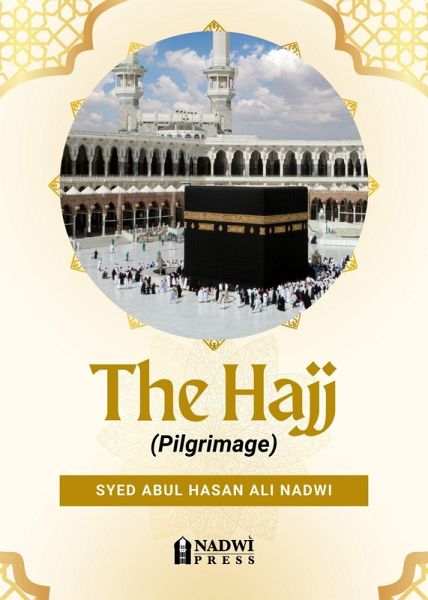
The Hajj (Pilgrimage) by S. Abul Hasan Ali Nadwi stands as one of the most profound and comprehensive examinations of the Hajj available in English. This distinguished work transcends conventional guidebooks and procedural manuals to offer a spiritually transformative exploration of Islam's fifth pillarthe pilgrimage to Mecca that every able Muslim is called to undertake at least once in their lifetime.
Written by one of the twentieth century's most respected Islamic scholars, this book addresses a critical need: restoring understanding of the Hajj's authentic spiritual purpose in an age when this sacred institution has been subjected to reductive political interpretations, materialistic attitudes, and cultural misunderstandings. Nadwi writes not merely about the external rituals of pilgrimage but about its inner dimensions, theological foundations, and transformative power in the life of the believer and the Muslim community.
The Crisis of Understanding
Nadwi begins by acknowledging a troubling modern phenomenon: the Hajj has increasingly been perceivedeven by educated Muslimsas primarily an international conference, a political gathering, or a cultural festival rather than an act of pure worship. This reduction of the Hajj to utilitarian functions strips it of its sacred character and spiritual potency. Against this trend, Nadwi systematically demonstrates that the Hajj represents something far more profound: a covenant with the Divine, a spiritual revolution, and a renewal of the believer's relationship with God.
Pure Monotheism in Practice
At the heart of Nadwi's exposition lies Islam's uncompromising commitment to taw?idpure monotheism. Islam recognizes no intermediaries, no intercessors, no priesthood, no images, and no idols in the relationship between God and humanity. Yet human nature possesses an innate need for tangible connection, visible symbols, and sacred spaces through which to express devotion. How does Islam reconcile these seemingly contradictory truths?
Nadwi's answer illuminates the Hajj's genius: God Himself has designated certain places, times, and rituals as "landmarks of Allah" (sha'a'ir Allah)sacred symbols that evoke divine remembrance without becoming objects of worship themselves. The Ka'bah, the hills of ?afa and Marwah, the plains of 'Arafahthese sites bear special divine grace while remaining mere stone and earth. They point beyond themselves to the Transcendent, satisfying humanity's need for sacred space while preserving absolute monotheism.
The Ibrahimi Foundation
Central to understanding the Hajj is the story of Prophet Ibrahim (Abraham), his wife Hajar, and their son Isma'il (Ishmael). Nadwi devotes substantial attention to this narrative, drawing extensively from Qur'anic accounts to demonstrate how every major Hajj ritual commemorates and reenacts episodes from the Ibrahimi family's trials, sacrifices, and unwavering devotion to God.
The sa'y (walking) between ?afa and Marwah recalls Hajar's desperate search for water for her infant son in the barren valley. The sacrifice of animals during 'Id al-A??a honors Ibrahim's willingness to sacrifice his son in obedience to divine command. The stoning of pillars at Mina symbolizes rejection of Satan's temptations. Each ritual thus becomes not merely a physical act but a spiritual identification with the Prophets' absolute submission to God.
Liberation from Materialism
One of the work's most powerful themes is the Hajj as spiritual liberation from material bondage. Nadwi describes modern civilization's "golden cage of materialism"the comfortable yet spiritually deadening attachment to worldly possessions, status, and physical comforts. The pilgrimage offers radical disruption of ordinary life: pilgrims abandon their homes, professions, luxuries, and even normal clothing to don the simple i?ram garments. Rich and poor, powerful and weak, all stand equal before God, stripped of markers of worldly distinction.
This voluntary poverty and temporary renunciation creates space for spiritual awakening. The pilgrim experiences firsthand that true fulfillment comes not from accumulation but from submission, not from comfort but from devotion, not from self-assertion but from self-surrender to the Divine will.
Demonstration of Islamic Unity
The Hajj provides unparalleled demonstration of Islamic equality and universal brotherhood. In Mecca, millions of Muslims from every nation, race, language, and social class converge, all performing identical rituals, all dressed identically, all with identical purpose. National identities dissolve, racial distinctions vanish, economic hierarchies collapse before the overwhelming reality of shared faith and common devotion.
Nadwi emphasizes that this unity is not merely symbolic or aspirationalit becomes lived reality during pilgrimage. The king and the peasant, the scholar and the illiterate, the Arab and the non-Arab stand shoulder to shoulder in prayer, circle the Ka'bah together, and seek God's mercy with equal urgency. This annual gathering serves as both reminder and renewal of Islam's core principle: all humans are equal before God, distinguished only by their taqwa (God-consciousness).
Reform and Purification
A significant portion of the work addresses how Islam purified the pilgrimage from pre-Islamic pagan practices. Nadwi documents the numerous innovations and corruptions that had accrued to the Hajj during the Jahiliyyah (Age of Ignorance): circumambulating the Ka'bah naked, competitive self-glorification, tribal conflicts, superstitious restrictions on trade, and other practices that violated both reason and divine law.
The Qur'an and Prophet Muhammad's practice systematically eliminated these distortions, restoring the Hajj to its Ibrahimi purity. Nadwi presents numerous Qur'anic verses and prophetic traditions that reformed specific practices, demonstrating Islam's mission to preserve authentic worship while removing cultural accretions and superstitions.
Comparative Religious Perspectives
Nadwi enriches his exposition with comparative analysis of pilgrimage in other religious traditionsJudaism's connection to Jerusalem, Christianity's relationship to holy sites, Hinduism's sacred rivers and temples. These comparisons highlight Islam's distinctive approach: sacred sites exist not as dwelling places of God nor as sources of supernatural power, but as divinely appointed symbols that facilitate remembrance and worship of the One God.
Practical Spiritual Guidance
Throughout the work, Nadwi provides practical spiritual counsel for pilgrims. He explains how to approach each ritual with proper intention (niyyah), how to maintain spiritual presence and awareness amid the physical demands of pilgrimage, and how to carry the Hajj's transformative effects back into daily life. His guidance balances legal correctness with spiritual depth, ensuring readers understand not just what to do, but why and how to do it with sincerity and devotion.
Contemporary Relevance
Though rooted in classical Islamic scholarship, Nadwi's work addresses contemporary challenges facing Muslims. He confronts materialistic attitudes, political reductionism, and cultural confusion with clarity and confidence, presenting the Hajj within its authentic Islamic framework free from both apologetic defensiveness and polemical aggression.
Essential Reading
The Hajj serves multiple audiences with equal effectiveness. For prospective pilgrims, it provides essential intellectual and spiritual preparation. For Islamic studies scholars, it offers rigorous engagement with Qur'anic exegesis, hadith literature, and classical commentary. For general readers interested in Islamic spirituality, it opens windows into the Islamic worldview, devotional life, and communal practices.
The translation by Mohammad Asif Kidwai renders Nadwi's Arabic and Urdu scholarship into clear, accessible English while preserving the author's characteristic blend of scholarly precision and devotional warmth. Published by the Academy of Islamic Research and Publications, Lucknow, this work represents the highest standards of Islamic scholarly publishing.
In an age of information abundance but wisdom scarcity, The Hajj provides what contemporary Muslims and seekers need most: deep, authentic, transformative understanding of one of Islam's central institutions. It invites readers not merely to learn about the Hajj, but to grasp its spiritual significance, appreciate its theological foundations, and prepare for its life-changing experience with proper knowledge, sincere intention, and devotional readiness.
The Hajj (Pilgrimage) by S. Abul Hasan Ali Nadwi stands as one of the most profound and comprehensive examinations of the Hajj available in English. This distinguished work transcends conventional guidebooks and procedural manuals to offer a spiritually transformative exploration of Islam's fifth pillarthe pilgrimage to Mecca that every able Muslim is called to undertake at least once in their lifetime.
Written by one of the twentieth century's most respected Islamic scholars, this book addresses a critical need: restoring understanding of the Hajj's authentic spiritual purpose in an age when this sacred institution has been subjected to reductive political interpretations, materialistic attitudes, and cultural misunderstandings. Nadwi writes not merely about the external rituals of pilgrimage but about its inner dimensions, theological foundations, and transformative power in the life of the believer and the Muslim community.
The Crisis of Understanding
Nadwi begins by acknowledging a troubling modern phenomenon: the Hajj has increasingly been perceivedeven by educated Muslimsas primarily an international conference, a political gathering, or a cultural festival rather than an act of pure worship. This reduction of the Hajj to utilitarian functions strips it of its sacred character and spiritual potency. Against this trend, Nadwi systematically demonstrates that the Hajj represents something far more profound: a covenant with the Divine, a spiritual revolution, and a renewal of the believer's relationship with God.
Pure Monotheism in Practice
At the heart of Nadwi's exposition lies Islam's uncompromising commitment to taw?idpure monotheism. Islam recognizes no intermediaries, no intercessors, no priesthood, no images, and no idols in the relationship between God and humanity. Yet human nature possesses an innate need for tangible connection, visible symbols, and sacred spaces through which to express devotion. How does Islam reconcile these seemingly contradictory truths?
Nadwi's answer illuminates the Hajj's genius: God Himself has designated certain places, times, and rituals as "landmarks of Allah" (sha'a'ir Allah)sacred symbols that evoke divine remembrance without becoming objects of worship themselves. The Ka'bah, the hills of ?afa and Marwah, the plains of 'Arafahthese sites bear special divine grace while remaining mere stone and earth. They point beyond themselves to the Transcendent, satisfying humanity's need for sacred space while preserving absolute monotheism.
The Ibrahimi Foundation
Central to understanding the Hajj is the story of Prophet Ibrahim (Abraham), his wife Hajar, and their son Isma'il (Ishmael). Nadwi devotes substantial attention to this narrative, drawing extensively from Qur'anic accounts to demonstrate how every major Hajj ritual commemorates and reenacts episodes from the Ibrahimi family's trials, sacrifices, and unwavering devotion to God.
The sa'y (walking) between ?afa and Marwah recalls Hajar's desperate search for water for her infant son in the barren valley. The sacrifice of animals during 'Id al-A??a honors Ibrahim's willingness to sacrifice his son in obedience to divine command. The stoning of pillars at Mina symbolizes rejection of Satan's temptations. Each ritual thus becomes not merely a physical act but a spiritual identification with the Prophets' absolute submission to God.
Liberation from Materialism
One of the work's most powerful themes is the Hajj as spiritual liberation from material bondage. Nadwi describes modern civilization's "golden cage of materialism"the comfortable yet spiritually deadening attachment to worldly possessions, status, and physical comforts. The pilgrimage offers radical disruption of ordinary life: pilgrims abandon their homes, professions, luxuries, and even normal clothing to don the simple i?ram garments. Rich and poor, powerful and weak, all stand equal before God, stripped of markers of worldly distinction.
This voluntary poverty and temporary renunciation creates space for spiritual awakening. The pilgrim experiences firsthand that true fulfillment comes not from accumulation but from submission, not from comfort but from devotion, not from self-assertion but from self-surrender to the Divine will.
Demonstration of Islamic Unity
The Hajj provides unparalleled demonstration of Islamic equality and universal brotherhood. In Mecca, millions of Muslims from every nation, race, language, and social class converge, all performing identical rituals, all dressed identically, all with identical purpose. National identities dissolve, racial distinctions vanish, economic hierarchies collapse before the overwhelming reality of shared faith and common devotion.
Nadwi emphasizes that this unity is not merely symbolic or aspirationalit becomes lived reality during pilgrimage. The king and the peasant, the scholar and the illiterate, the Arab and the non-Arab stand shoulder to shoulder in prayer, circle the Ka'bah together, and seek God's mercy with equal urgency. This annual gathering serves as both reminder and renewal of Islam's core principle: all humans are equal before God, distinguished only by their taqwa (God-consciousness).
Reform and Purification
A significant portion of the work addresses how Islam purified the pilgrimage from pre-Islamic pagan practices. Nadwi documents the numerous innovations and corruptions that had accrued to the Hajj during the Jahiliyyah (Age of Ignorance): circumambulating the Ka'bah naked, competitive self-glorification, tribal conflicts, superstitious restrictions on trade, and other practices that violated both reason and divine law.
The Qur'an and Prophet Muhammad's practice systematically eliminated these distortions, restoring the Hajj to its Ibrahimi purity. Nadwi presents numerous Qur'anic verses and prophetic traditions that reformed specific practices, demonstrating Islam's mission to preserve authentic worship while removing cultural accretions and superstitions.
Comparative Religious Perspectives
Nadwi enriches his exposition with comparative analysis of pilgrimage in other religious traditionsJudaism's connection to Jerusalem, Christianity's relationship to holy sites, Hinduism's sacred rivers and temples. These comparisons highlight Islam's distinctive approach: sacred sites exist not as dwelling places of God nor as sources of supernatural power, but as divinely appointed symbols that facilitate remembrance and worship of the One God.
Practical Spiritual Guidance
Throughout the work, Nadwi provides practical spiritual counsel for pilgrims. He explains how to approach each ritual with proper intention (niyyah), how to maintain spiritual presence and awareness amid the physical demands of pilgrimage, and how to carry the Hajj's transformative effects back into daily life. His guidance balances legal correctness with spiritual depth, ensuring readers understand not just what to do, but why and how to do it with sincerity and devotion.
Contemporary Relevance
Though rooted in classical Islamic scholarship, Nadwi's work addresses contemporary challenges facing Muslims. He confronts materialistic attitudes, political reductionism, and cultural confusion with clarity and confidence, presenting the Hajj within its authentic Islamic framework free from both apologetic defensiveness and polemical aggression.
Essential Reading
The Hajj serves multiple audiences with equal effectiveness. For prospective pilgrims, it provides essential intellectual and spiritual preparation. For Islamic studies scholars, it offers rigorous engagement with Qur'anic exegesis, hadith literature, and classical commentary. For general readers interested in Islamic spirituality, it opens windows into the Islamic worldview, devotional life, and communal practices.
The translation by Mohammad Asif Kidwai renders Nadwi's Arabic and Urdu scholarship into clear, accessible English while preserving the author's characteristic blend of scholarly precision and devotional warmth. Published by the Academy of Islamic Research and Publications, Lucknow, this work represents the highest standards of Islamic scholarly publishing.
In an age of information abundance but wisdom scarcity, The Hajj provides what contemporary Muslims and seekers need most: deep, authentic, transformative understanding of one of Islam's central institutions. It invites readers not merely to learn about the Hajj, but to grasp its spiritual significance, appreciate its theological foundations, and prepare for its life-changing experience with proper knowledge, sincere intention, and devotional readiness.
Dieser Download kann aus rechtlichen Gründen nur mit Rechnungsadresse in A, D ausgeliefert werden.